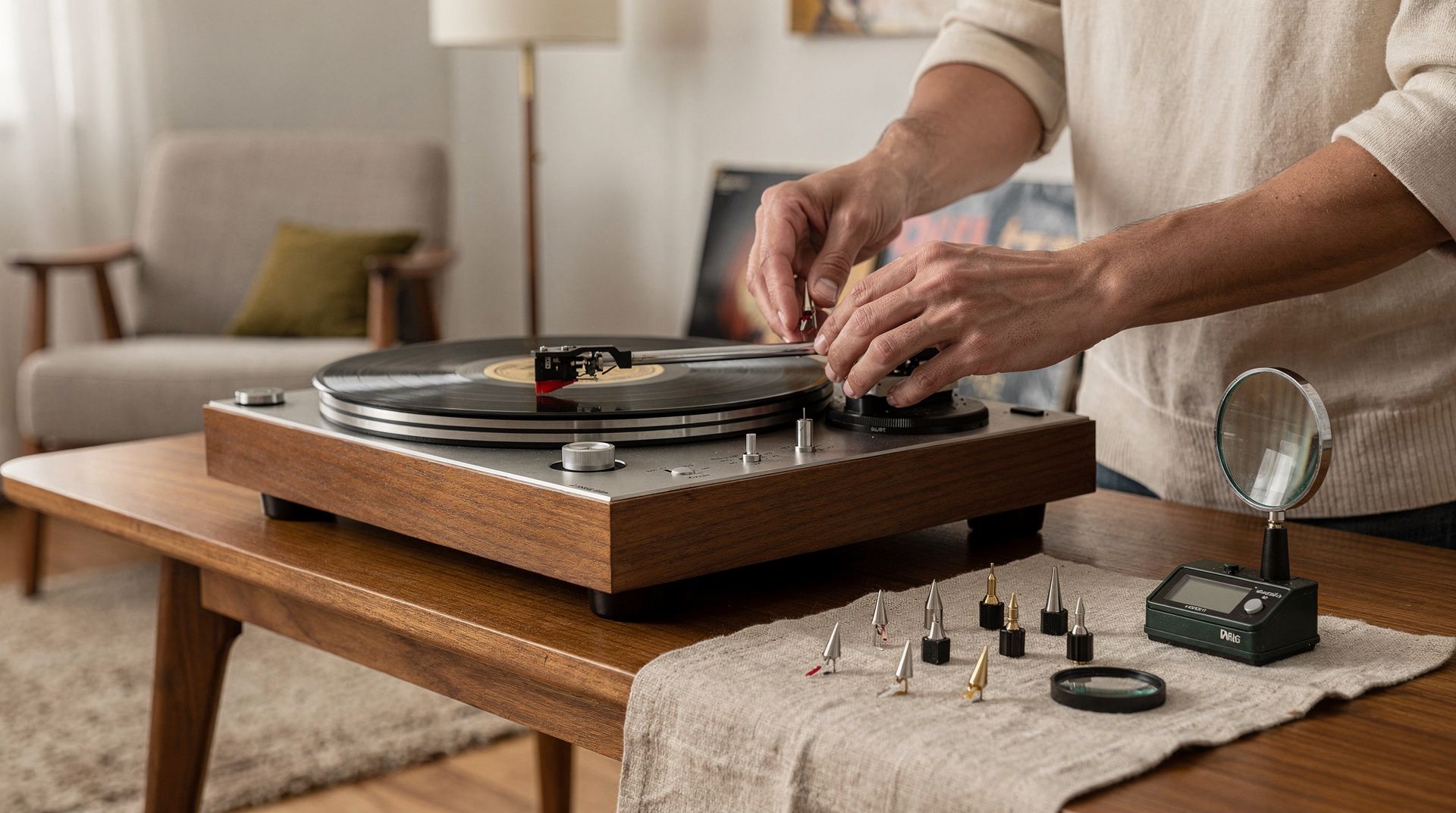
CATEGORY · REPLACE TURNTABLE NEEDLE SET UP CARTRIDGE

Replacing a turntable needle and correctly setting up a cartridge

Needle types, wear, tracking force and anti-skating at a glance

A precisely adjusted cartridge is decisive for the sound image, groove preservation and the value retention of your collection. We show you how to distinguish spherical, elliptical and fine-cut needles (Shibata, Line Contact, MicroLine), recognise signs of wear in time and correctly set the tracking force specified by the manufacturer using a tonearm scale. You will also learn how to align anti-skating, azimuth and stylus rake angle so that a classic from the mid-century era plays the way it was originally conceived.

mid-century·designs

replace turntable needle set up cartridge

ESSAY · 01

Work & Context

mid-century·designs

Replacing a turntable needle and correctly setting up a cartridge

A turntable from the nineteen-fifties or sixties is rarely just a piece of furniture. It is a precision mechanical instrument whose sonic substance is determined at the most sensitive point in the system: the needle and its alignment in the cartridge. Anyone who carefully continues to operate an original Braun, Dual, Thorens or Rek-O-Kut should not regard the replacement of the stylus and the adjustment of the cartridge as a service task, but as part of ongoing maintenance. Incorrect tracking force, a hardened cantilever or an ill-suited tip radius will damage groove walls in ways that can never be restored. The following sections organise needle types, wear patterns and the relevant adjustment parameters so that you protect both the sound and the physical integrity of your collection.

Identifying needle types and assessing wear

For mono and stereo systems of the mid-century era, a basic distinction is drawn between spherical (conical), elliptical and – from the late nineteen-sixties onwards – fine-cut needles such as Shibata, Line Contact or van den Hul. A significantly larger tip radius (typically 2.5 to 3.0 mil) is required for 78 rpm shellac records, while microgroove vinyl calls for 0.7 mil spherical or 0.3 × 0.7 mil elliptical. Mix-ups cause massive wear to both parties. The cantilever is usually made of aluminium, less commonly of boron, beryllium or ruby. The rubber suspension in which the cantilever sits hardens over decades; a system that has not been played since the seventies often sounds dull not because of the needle but because of the stiffened mounting.

Wear can only be reliably identified under a microscope at around 100× magnification or with a USB stylus microscope. What becomes visible are flattened facets on the flanks of the diamond; in advanced stages, mirror-like flat surfaces replace the original curvature. Rule-of-thumb service lives are 500 to 1,000 hours for spherical, 300 to 500 hours for elliptical and up to 1,500 hours for fine-cut diamonds, in each case assuming clean records and correct tracking force. Audible indicators include sibilance on sibilants, distortion in inner grooves and a loss of stereo depth.

Correctly adjusting tracking force, anti-skating and azimuth

Tracking force is the single most important parameter. It must be set according to the cartridge manufacturer’s specification, not the tonearm manufacturer’s. A Shure M75, an Ortofon SPU, a Denon DL-103 or a Grado FTR have very different tolerances, typically between 1.5 and 4 grams. Tracking too lightly causes the needle to skip out of the groove during loud passages and to cut into the flanks; tracking too heavily causes the diamond to heat the groove and deform the vinyl irreversibly. A digital tonearm scale positioned at record surface height is today’s standard and replaces the old mechanical balancing beams.

Equally relevant is anti-skating, which compensates for the inward-pulling force on the tonearm and should correspond approximately to the tracking force value. The azimuth – the vertical alignment of the cantilever at a right angle to the record surface – determines channel separation; it can be checked with a small mirror placed on the platter or by measuring crosstalk attenuation. Vertical tracking angle (VTA) and overhang are set using an alignment protractor (Baerwald, Löfgren, Stevenson). For optimising high-frequency response, often imprecisely referred to as the skating frequency, VTA is the decisive lever: an arm set too low attenuates the highs, one set too high makes them sound harsh. Fine adjustments in the tenth-of-a-millimetre range are audible with fine-cut needles.

Authenticity and condition in vintage systems

Collectors regularly face the question of whether to continue playing a historic system with its original needle or to retrofit a current replacement. For MM systems such as the Shure V15 or the Ortofon VMS series, high-quality replacement styli are available from Jico, Ortofon itself or van den Hul that are at least sonically equivalent. For MC systems, retipping by specialist workshops (Expert Stylus, Soundsmith, Axel Schürholz) is usually the only option, since the needle is permanently bonded to the cantilever. For the collector valuation of a turntable, what remains decisive is that the chassis, plinth, lid and tonearm are original and unrestored or professionally overhauled. A replaced stylus insert does not diminish the value; a replaced tonearm or a newly veneered cabinet, on the other hand, does so considerably. Document every intervention with the date and the workshop responsible; these records become part of the provenance when the piece is passed on.

At mid-centurydesigns.com we inspect turntables and music furniture of the era both mechanically and aesthetically before they are accepted into our inventory. We document the model designation, year of manufacture, condition of the drive, tonearm bearing and the system supplied with the unit, and we openly disclose any restorations. This allows you to make an informed decision as to whether you are acquiring a piece as a playing instrument, a restorable collector’s item or a document of design history.


This article was generated automatically by an AI system. Disclosure pursuant to Article 50 of the EU AI Act.

FAQ · 02

Frequently asked about replace turntable needle set up cartridge

5 Answers

01
How do I tell whether my record player needle is worn?
A worn needle shows clear signs of wear: the tip appears dulled or flattened rather than conical or elliptical in shape. With the naked eye or a magnifying glass you can identify scratches and damage at the needle tip. An audible sign is increased surface noise, scratching or deteriorating high-frequency response. After approximately 1,000 to 2,000 playing hours you should replace the needle, depending on its quality and the tracking force applied. Regular visual inspection with a magnifying glass (from 10× magnification upwards) is more reliable than purely acoustic assessment.
02
What needle types are there and what are they suitable for?
The most common needle types are: conical needles (the simplest form, less precise), elliptical needles (improved contact area, better high-frequency reproduction) and line-contact needles (optimum groove tracing, highest precision). For original mid-century works, high-quality cartridges require a needle matched to the cartridge's manufacture and type. Compatibility with the cartridge is crucial: manufacturers such as Ortofon, Shure or Audio-Technica specify which needle type is intended for which model. The wrong needle type leads to poorer sound and increased wear.
03
How do I set the tracking force correctly?
Tracking force is measured in grams and must be set precisely. Your cartridge manufacturer's recommendation specifies a range (typically 1.25 to 3 grams). Use a digital scale or a dedicated tracking-force gauge: place the tonearm on the scale, read the value and adjust via the counterweight setting. Too high a tracking force wears out the needle and the record more quickly; too low a force causes mistracking and poor reproduction. In the mid-century segment, high-quality Japanese and European cartridges are often precisely calibrated. Regular checks (at least once or twice a year) are quality care for your collection.
04
What does resonance frequency mean and how do I optimise it?
The resonance frequency is the natural frequency of the tonearm-and-cartridge system. It should be below 10 Hz, ideally between 8 and 12 Hz, to avoid resonance problems. A resonance frequency that is too low or too high leads to colouration, distortion or vibration. Adjustment is made via: arm mass, tracking force and cartridge compliance. Using a test instrument or through iterative testing (playing reference records with known frequency ranges) you can find the optimum setting. High-quality Thorens, Technics or Michell turntables from the mid-century vintage segment are usually well aligned from the factory, but require individual fine-tuning whenever the needle or cartridge is changed.
05
What tools and accessories do I need for needle and cartridge maintenance?
Essential tools: a digital tracking-force scale (accuracy to at least 0.1 grams), a magnifying glass (from 10× magnification upwards), replacement needles (original or compatible with your cartridge), fine tweezers, lint-free cloths and specialist record-cleaning solution. Optional but recommended: a resonance-frequency measuring instrument and an ohmmeter to check the contacts. Store needles and cartridges in a cool, dry place protected from dust. High-quality original spare parts for your specific cartridge (Pickering, Shure, Ortofon) are the safest choice for ensuring sound quality and longevity.

GLOSSARY · 03

Related Terms

10 Entries

Stylus
The needle of the cartridge, which tracks the vinyl grooves and converts sound waves into electrical signals. Different tip geometries (spherical, elliptical, line contact) influence sound quality and wear.
Tracking Force
The weight with which the cartridge presses onto the record, measured in grams. Too little force causes mistracking; too much causes accelerated wear to both needle and vinyl.
Tracking Force
The English technical term for the downforce applied by the cartridge. The optimum setting ensures precise groove tracing and maximum service life for all components.
Stylus Profile
The geometric shape of the needle tip. Conical profiles are more robust; elliptical and line-contact profiles offer greater detail resolution and less record wear when correctly adjusted.
Resonance Frequency
The vertical movement frequency of the cartridge at the record edges. Correct adjustment prevents rocking motion and ensures optimum groove contact across the entire record profile.
Wear Indicators
Visible signs of a spent stylus, such as a flat or chipped tip, blue or silver discolouration of the diamond, or whitish wear crystals. Regular inspection prevents record damage.
Cartridge
Also called a cartridge. The moving element of the turntable assembly, consisting of the stylus, cantilever and coil, which converts the mechanical vibrations of the record into audio signals.
Stylus Rake
The alignment of the cartridge relative to the record surface. Incorrect rake angle produces harmonic distortion and significantly accelerates wear on both components.
Elliptical Profile
A needle shape with an enlarged contact area along the length of the groove. Offers better high- and low-frequency reproduction than a spherical profile and reduces record wear at the optimum tracking force.
Vibrato Motion
Vertical oscillation of the cartridge caused by insufficient or incorrectly adjusted tracking force. Leads to distortion and accelerates wear of both the stylus and the record.