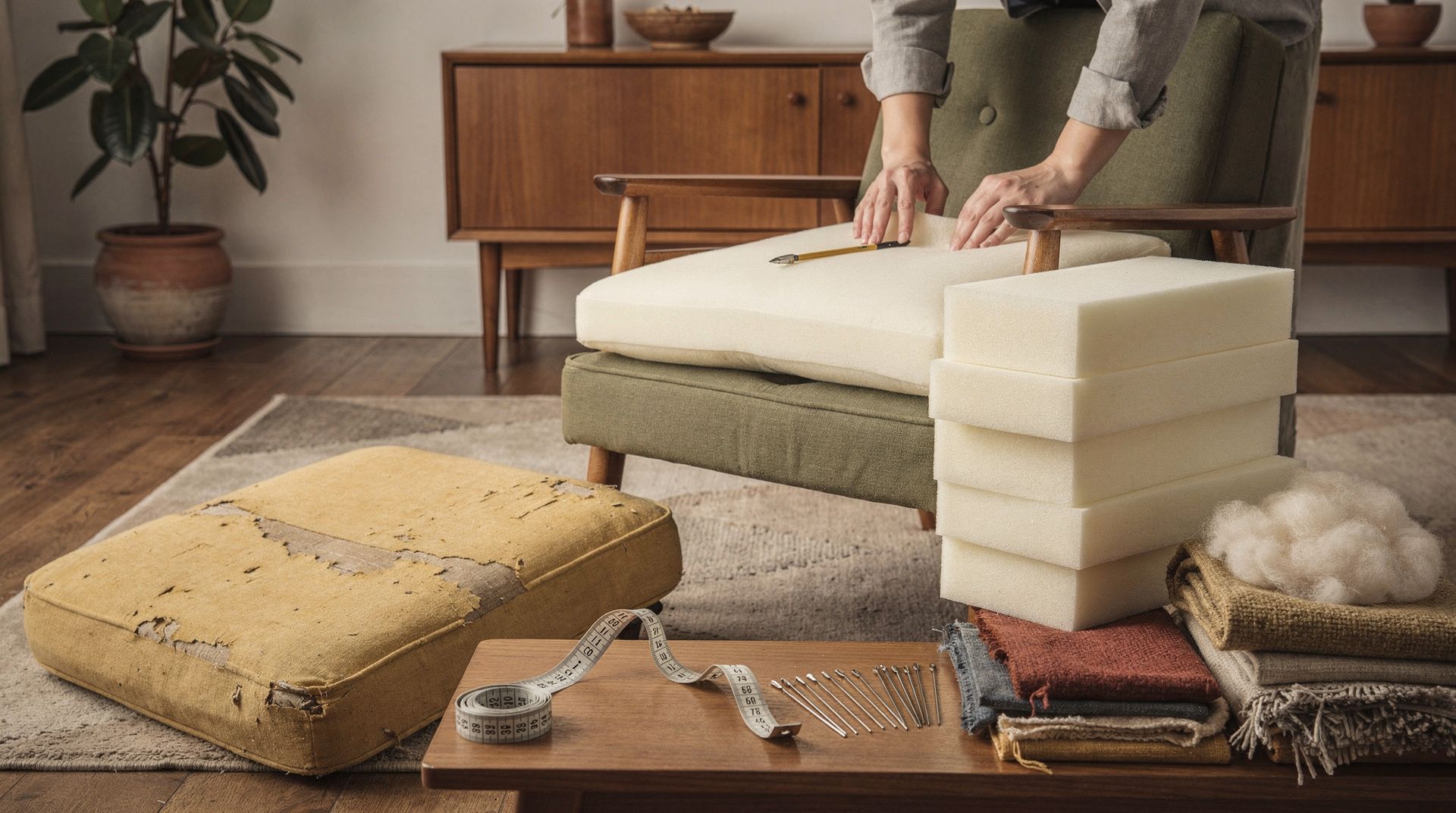
Replacing and renewing foam in vintage upholstered furniture
Worn upholstery is the rule, not the exception, in mid-century seating furniture. Anyone who acquires an armchair by Illum Wikkelsø, a sofa from the circle of Kho Liang Ie or an anonymous Danish lounge chair from the late 1950s will almost invariably find upholstery constructions that are between 55 and 70 years old. Latex crumbles, polyurethane foam hardens, spring straps lose their tension. This is not a defect but a natural condition, and professional replacement determines whether a piece retains its original silhouette, seating comfort and value.
The guiding principle is calm and pragmatic: preserve as much original material as possible, renew only what is necessary. Upholstery is a wear part, comparable to tyres on a collector’s car. Unlike the frame, veneer or original cover, a cleanly executed foam reconstruction does not diminish the collector’s value, provided that the proportions, firmness grades and constructive logic of the original are respected. Whoever works with standard hardware-store foam, over-stuffs the seat or replaces the characteristic softness of Danish classics with hard cold foam destroys the signature of the design.
The following sections place the typical materials in their historical context, outline the upholstery logic of the major design schools and identify what you should look for when purchasing and assessing condition. Costs are estimated conservatively so that you have a reliable basis for evaluating quotes from upholstery workshops.
1. Characteristic materials and construction
Mid-century upholstery works with a manageable but precisely coordinated palette of materials. Knowing them means recognising the correct sequence of construction and being able to evaluate quotes from upholsterers competently.
Latex (natural rubber foam). The classic seat core of the 1950s and early 1960s. Dunlopillo supplied industrially foamed natural latex from the late 1940s onwards, which Scandinavian and Italian manufacturers used extensively. Latex is point-elastic and durable when sealed, but becomes brittle when exposed to air and UV. An original latex core that crumbles when cut open cannot be saved. New natural latex with a density of around 75 to 90 kg/m³ and firmness ratings between 35 and 45 kg for seats and 25 to 30 kg for backs is a suitable authentic replacement. Material costs range from €80 to €220 per cushion depending on size.
Polyurethane flexible foam (PUR). Increasingly widespread from around 1960, dominant by the 1970s. For an authentic replacement you should use high-quality HR cold foam with a density of at least 45 kg/m³; hardware-store products with a density of 25 to 35 kg/m³ lose their shape within a few years. Firmness grades of around 40 to 50 kg for seat surfaces and 25 to 35 kg for backrests are a good starting point.
Spring systems and webbing. Many Danish and German designs use Nosag springs (sinuous springs) or rubber straps by the brand Pirelli. Pirelli straps are by far the most common wear part. Replacement straps in original widths (50 to 60 mm) are available and should always be checked before replacing the foam. For spring-core sofas an intermediate layer of coconut fibre or felt, as originally used, is also recommended.
Top layers. Experienced upholsterers lay a wadding layer (polyester fleece, formerly horse hair or cotton wadding) over the core to soften edges and prevent creasing in the cover fabric. This layer is frequently omitted in DIY attempts and is the most common reason why home repairs look angular and cheap.
Realistic cost framework. A single lounge chair with two cushions will typically cost between €350 and €900 at a professional workshop, including new straps, latex or HR foam cores, fleece and labour. A three-seater with a spring core and several loose cushions ranges from €900 to €2,400. Reupholstering in wool fabric or aniline leather is to be budgeted separately.
2. Regional schools and their upholstery logic
The foam construction is never neutral. It follows the formal language of the respective design, and applying Italian upholstery firmness to a Fritz Hansen classic alienates the furniture.
Denmark. The Copenhagen school around Finn Juhl, Hans J. Wegner, Illum Wikkelsø, Kai Lyngfeldt Larsen and the workshops France & Søn, Fritz Hansen or Getama works with comparatively soft, point-elastic seats. Latex cores over webbing are standard, seat height is low and seat depth is generous. In Wegner’s Papa Bear Chair (AP-19), for example, the soft, yielding back section is constitutive. A construction that is too firm robs the chair of its identity.
Germany and the Werkbund tradition. Designs by Herbert Hirche for Wilkhahn, by Hans Kaufeld or from the circle of the Ulm School of Design rely on more precise, shape-stable upholstery. Spring cores and firmer foams are more common here, and the edges are more sharply defined. Wilkhahn seating furniture of the 1960s follows a more engineering-oriented upholstery logic.
Italy. Osvaldo Borsani (Tecno), Marco Zanuso (Arflex), Gio Ponti, and later Afra and Tobia Scarpa work with sculptural, often multi-layered constructions. Zanuso’s Lady Chair for Arflex from 1951 is one of the first industrially latex-upholstered pieces of furniture; its construction is part of the patent. Anyone restoring such pieces should choose workshops with Italian experience.
The Netherlands and France. Artifort, Rob Parry, Kho Liang Ie and, in the French context, Pierre Guariche or ARP frequently opt for slender, taut silhouettes with thin, very precise upholstery layers over load-bearing straps or metal frames. Too much material build-up destroys the graphic effect here.
3. Authenticity and condition for collectors
Assessing a vintage upholstered piece involves several sober checkpoints that should be addressed before any purchase and before any restoration decision.
What you should preserve. Frame, veneer, solid wood parts, fittings, manufacturer’s marks (burned in, stamped or as a label) and, wherever possible, the original cover. An original wool cover from Kvadrat predecessors, a Savak fabric or an original aniline leather with patina is a value factor, even if it shows signs of wear. Cleaning, conserving and continuing to use a repaired cover is often wiser than complete reupholstering.
What you may replace. Foam cores, straps, springs, fleeces, nailing strips. These materials are constructive, not historically significant. A cleanly documented reconstruction, ideally with photographs taken before and after the work, is part of a serious provenance record.
Warning signs. Seats that appear noticeably higher than in historical manufacturer photographs; edges that run more softly rounded than in the original; covers that ignore the seam routing of the design (for example, piping where there should be none); zips at positions where the manufacturer never installed them. Such interventions reduce value and are barely reversible.
Documentation. Ask workshops for a written list of the materials used: density and firmness grade of the foams, origin of the latex, webbing brand and width, fleece thickness. These details later form part of what makes a piece credible when resold.
At mid-centurydesigns.com we inspect every piece before it enters our inventory for frame stability, originality of the load-bearing components and condition of the upholstery. Where reconstruction is necessary, we document the material, firmness grade and executing workshop. Seating furniture offered with an original latex or spring-core construction in preservable condition is labelled accordingly. For collectors this provides a reliable basis for deciding whether to acquire a piece in its found condition or to have it professionally reworked together with our partner workshops.
This article was generated automatically by an AI system. Disclosure pursuant to Article 50 of the EU AI Act.