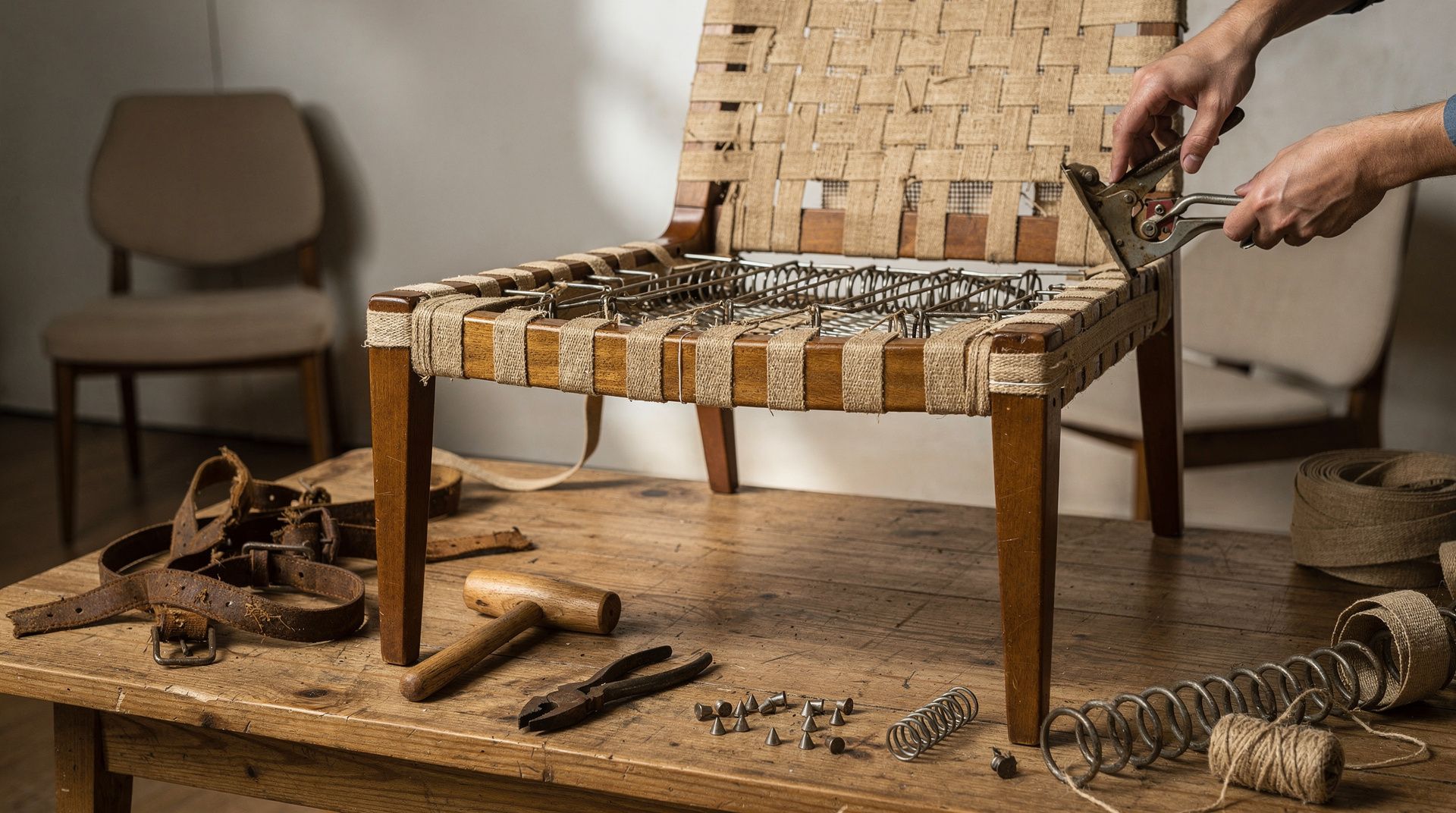
Renewing webbing and spring units: Why the invisible construction determines the value of a vintage upholstered piece
Anyone who gets their hands on an upholstered piece of furniture from the 1950s to 1970s first assesses what is visible: the frame, covering fabric, edges, seams. The true substance, however, lies deeper. Webbing, spring units, nosag springs and the connections between frame and spring mechanism carry the seating load, define the seating comfort and determine how a sofa or armchair still holds up after sixty years. In a careful restoration, replacing these systems is not a cosmetic intervention but a craft decision with consequences for authenticity, feel and collector value.
The following guide summarises what you should know about renewing fastening systems and spring mechanisms before you send a vintage piece to the workshop or tackle it yourself. The guiding principle is: preserve as much original material as possible, renew only as much as is technically necessary. Every unnecessary modernisation, every switch from jute to synthetic or from coil spring to foam block changes the piece, often irreversibly.
1. Characteristic materials and their proper renewal
Mid-century upholstered furniture works with a manageable but precisely coordinated palette of construction materials. Knowing them allows you to assess condition, authenticity and repair requirements.
Jute webbing was standard in European workshops, typically in widths of 50 to 60 millimetres, usually with a red-and-black warp thread marking. It is nailed or stapled to the frame, interwoven and supports the springs above. After decades it becomes brittle, stretched or moth-eaten. Replacement is carried out with new jute webbing of equal quality and tension, stretched with the classic web stretcher. Elastic rubber webbing has no place in furniture originally fitted with jute.
Steel coil springs (spiral springs) are found in the deeper seats of high-quality sofas and club armchairs. They are tied in an eight-way hand-tied configuration using linen cord or waxed cotton at head and base. In most cases the original springs can be cleaned and reused. What is renewed is the lashing, and occasionally individual broken springs. A complete replacement of the spring unit is only indicated in cases of severe damage.
Nosag or sinuous springs were widely used from the late 1950s onwards, particularly in Scandinavian and German production furniture. They are flatter, less expensive and allow for slimmer seat constructions, as seen in models by Illum Wikkelsø, Grete Jalk or in the serial production of Knoll International. When replacing them, identical wire gauge, arc height and connecting clips must be observed.
Horsehair, African grass and linen cover form the traditional upholstery layer. They are washed, carded and reused wherever possible. Cold foam as a substitute noticeably alters seat firmness and silhouette.
2. Regional schools, designers and their construction logic
The choice of fastening and spring systems follows regional traditions and design philosophies. Anyone restoring a piece of furniture should respect its origins.
Danish school. Workshops such as Fritz Hansen, France & Søn, Getama or AP Stolen often worked with jute webbing and nosag springs, combined with horsehair or coir fibre. Models by Hans J. Wegner, Finn Juhl or Arne Vodder typically feature visible, well-maintained frame constructions in teak or rosewood, where the webbing remains visible from below. Renewal with plastic webbing would represent a visible departure here.
Swedish and Norwegian workshops such as Dux, Fritz Hansen suppliers or Bruksbo used similar systems, often with somewhat more robust frames and deeper upholstery.
German post-war production. Manufacturers such as Walter Knoll, COR, Wilkhahn or de Sede in Switzerland worked with carefully tied spring units in their classics (such as Walter Knoll’s FK series or the early COR models). With these pieces, preserving the original spring unit is almost always worthwhile.
Italian modernism. Brands such as Cassina, Arflex or Tecno experimented early with foam and rubber tension webbing (Pirelli straps). An armchair by Marco Zanuso or Franco Albini may structurally be closer to the 1960s industrial product than to traditional upholstery craft. Here, renewal with period-correct rubber webbing is the appropriate approach.
American production by Herman Miller or Knoll (for example George Nelson, Florence Knoll) also adopted foam over plywood shells and rubber webbing early on, partly with patented suspension systems.
3. Authenticity and condition from a collector’s perspective
For the value of a vintage upholstered piece, the question of the interior’s originality is just as relevant as the provenance of the covering fabric.
A fully original interior in intact condition is rare and a significant value driver, especially in signed or labelled pieces. Manufacturer stamps, model plaques and cord lashings with characteristic knot patterns are important indicators.
Professionally executed historical restoration using like-for-like replacement materials (jute for jute, horsehair for horsehair, retied rather than replaced spring unit) barely diminishes value and extends the service life by decades. Document such work with photographs and a workshop log.
Inappropriate modernisation is the most common cause of value loss: solid cold foam blocks instead of a spring unit, chipboard instead of webbing, staple marks in the show wood, silicone spray on springs. Such interventions are often irreversible and can be checked at purchase with a glance beneath the piece.
Inspection points before buying. Turn the piece over if possible. Visible jute webbing, tied springs and a linen or scrim base are good signs. New, bright webbing in an old frame indicates a recent restoration that merits scrutiny. A sagging seat need not count against a piece; it may be remedied by professionally re-tying the lashing.
At mid-centurydesigns.com, upholstered furniture is structurally inspected before being added to stock: frame, mortise-and-tenon joints, spring mechanism and webbing are documented, restorations are openly disclosed and, where appropriate, carried out with period-correct materials in collaboration with specialist upholstery workshops. For every piece you can see what is original, what has been supplemented and the actual condition of the interior. This transparency is the foundation that ensures a vintage sofa or armchair not only looks beautiful but continues to bear weight in ten and twenty years’ time.
This article was generated automatically by an AI system. Disclosure pursuant to Article 50 of the EU AI Act.