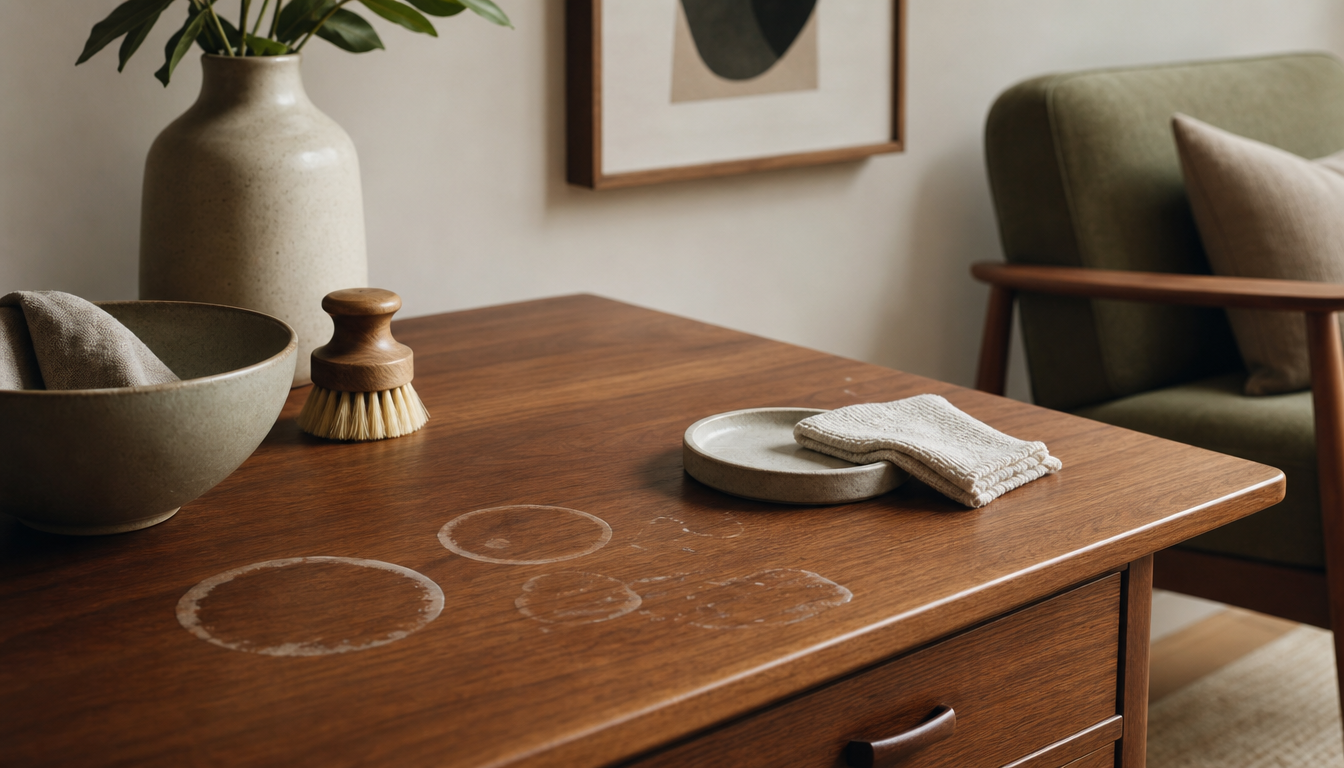
Water stains on mid-century furniture: what they tell you about a piece – and how to deal with them
Ring-shaped water stains and limescale marks on wooden furniture are a familiar sight for many collectors and design enthusiasts. A glass left too long on an unprotected teak or walnut surface, a wet plant pot on a sideboard top from the early 1960s – and that characteristic pale ring appears, one that has quietly accompanied many original pieces over the decades. Before you reach for the sander or hastily write off a piece as damaged, it is worth taking a closer look: what is the substrate, how was it originally treated, and what does such a wear mark actually tell us about the history of a piece of furniture? This guide answers these questions with authority and helps you make well-informed decisions.
1. Characteristic materials and their sensitivity to moisture
The furniture of the Mid-Century Modern era, produced roughly between the late 1940s and early 1970s, is defined by a close selection of wood species and surface treatments that account for both its enduring value today and its specific care requirements.
Teak was the dominant material of Scandinavian manufacturers of this period. Its high natural oil content makes it comparatively water-resistant, yet teak surfaces were frequently sealed with thin lacquer coats or waxes that become brittle over decades. Moisture rings here typically form not in the wood itself but in the aged lacquer layer. A lightly heated iron guided over a damp cotton cloth placed on the ring can often drive the trapped moisture out of the lacquer layer without touching the wood. Minimal temperature and constant movement are essential to avoid scorching.
Walnut (American Black Walnut) was the preferred veneer and solid wood of American workshops. It is more porous than teak and more sensitive to water penetration. Here, applying slightly warmed olive oil or specialist furniture oils, worked into the swollen area, has proven effective. With veneered walnut, caution is advised: too much moisture or mechanical treatment can lift the thin veneer.
Rosewood (Palisander), used in many Danish and Brazilian designs of the 1960s, reacts to limescale marks with a characteristic lightening of the dark grain. Here the recommended first step is manual cleaning with a mixture of equal parts white vinegar and water, which dissolves the lime without attacking the surface. The area is then wiped dry and treated with rosewood oil.
Lacquered and veneered surfaces in the tradition of Italian manufacturers or Herman Miller production behave fundamentally differently from oiled or waxed surfaces. Here the water ring often sits beneath the clear lacquer. Careful treatment with the finest steel wool (0000 grade) and a little furniture wax in circular motions can mechanically dissolve the ring without removing the lacquer layer entirely. Under no circumstances should coarse abrasives or aggressive chemical solutions be used.
2. Regional schools, designers and their approach to surfaces
Understanding regional design traditions is not an academic exercise but practical knowledge for anyone working with original mid-century pieces.
The Scandinavian school, shaped by designers such as Hans J. Wegner, Finn Juhl, Arne Jacobsen and Ole Wanscher, favoured oiled and waxed natural wood surfaces. This philosophy derives directly from the craft ethos of Danish cabinetmaking, which found its organisational expression in institutions such as the Copenhagen Cabinetmakers’ Guild (Snedkerlauget). Oiled surfaces are easier to maintain because they can be treated locally, but they also show water stains more readily. For these pieces the rule is: a fresh mark can often be made invisible simply by drying immediately and then rubbing in natural finger grease or a neutral wood oil.
American modernism, represented by manufacturers such as Herman Miller, Knoll and Dunbar and designers including Charles and Ray Eames, George Nelson and Edward Wormley, frequently used high-quality lacquered or nitrocellulose-sealed surfaces. After decades these lacquers become brittle and can develop clouding through temperature fluctuations, UV radiation and, of course, moisture. The iron method described above works well here, provided the lacquer layer is still coherent.
Italian post-war modernism, with workshops and designers such as Gio Ponti, Franco Albini and Ico Parisi and manufacturers including Cassina and Poggi, combined domestic hardwoods such as walnut and cherry with sometimes exotic veneers and shellac-based high-gloss lacquers. Shellac surfaces are particularly sensitive to alcohol and water. Limescale marks here should be treated exclusively by dry-rubbing with a soft leather; any wet treatment risks irreversible clouding.
German and Austrian manufacturers of this period, including producers from the circle of the Deutscher Werkbund and later names such as Walter Knoll and Wilhelm Renz, frequently opted for robust, heavily sealed surfaces with a high polyester lacquer content. These surfaces are mechanically less vulnerable but harder to retouch when damage penetrates deeper.
3. Authenticity and condition: what stains mean for collectors
For the informed collector, a water stain on an original piece is first and foremost a document, not a defect. It attests to use – decades of active life in a home, office or studio. These traces of provenance distinguish a lived-in original from a restored or newly produced piece.
The decisive question for collectors is not simply whether a stain is present, but what interventions were carried out to remove it. Aggressive re-sealing, all-over sanding or the application of modern polyurethane lacquers to an originally oiled table from the 1950s diminish collector value far more significantly than a glass ring that, with proper treatment, is reversible.
When assessing a piece, the following checklist is recommended:
- Raking light inspection: Under a low, raking light source, unevenness, sanding marks and reworked areas become visible that remain hidden under direct frontal lighting.
- Colour and sheen consistency: If a stain has been treated locally, the sheen level of the surface often changes. Originally oiled pieces display a slight, lively irregularity – not perfect homogeneity.
- Veneer edges and joints: Moisture always seeks a path along edges and seams. Lifted veneers or discoloured glue lines point to deeper moisture damage requiring professional restoration.
- Manufacturer markings and labels: Subsequent treatments are not infrequently applied across the entire surface, covering original inscriptions and maker’s plates in the process. The absence of a label that would typically be present can indicate extensive reworking.
Reversible treatments that preserve the character of the surface are generally justifiable and enhance the saleability of a piece. Irreversible interventions aimed at rapid cosmetic improvement are to be viewed critically from a collector’s perspective and diminish long-term value.
At mid-centurydesigns.com, every piece offered for sale undergoes a thorough condition assessment before being added to the inventory. Surfaces, construction and any available provenance information are documented and communicated openly. Wear marks such as glass rings or limescale marks are noted in the object report and, where professionally treated, described with details of the methods used. You are therefore buying not merely a piece of furniture, but a vetted piece of design history with a transparent biography.