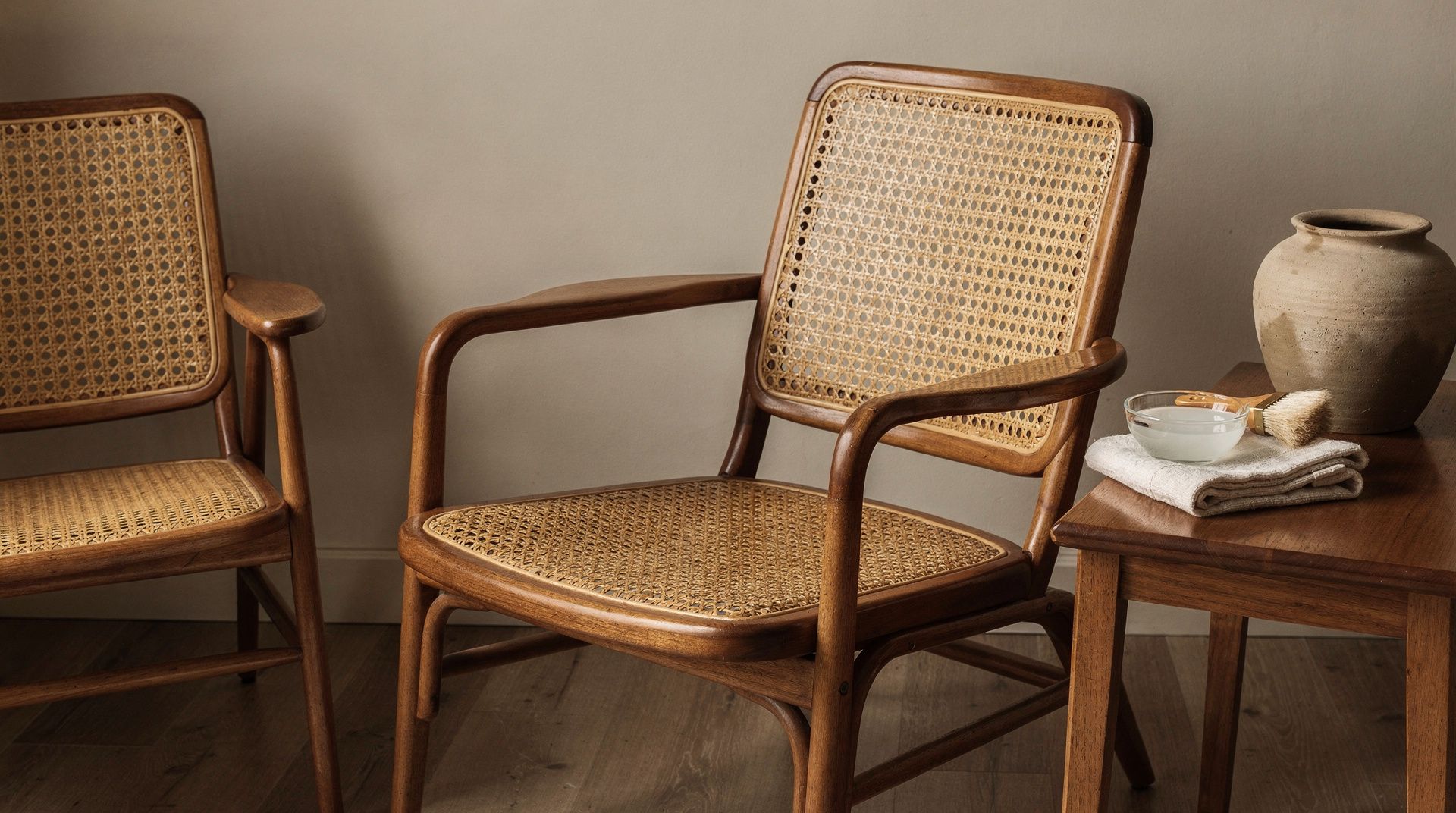
Rattan and Viennese Cane in Vintage Furniture: Care That Preserves Value
Few materials tell the intellectual history of Mid-Century Modern as quietly as rattan and Viennese cane. Both represent the opening of Western furniture-making towards light, open constructions, the rediscovery of handcrafted weaving after 1945, and a design philosophy that values transparency, elasticity and natural texture over heavy solidity. Anyone who owns an original piece from the 1950s to the 1970s today is managing a delicate balance: matured fibres, historical stains, aged adhesives and often the traces of several decades of use.
In this context, care does not mean restoration at any cost, but preservation of substance. Rattan is a tropical palm plant with high tensile strength but limited tolerance for dryness, direct sunlight and trapped moisture. Viennese cane, classically made from cane reed in a hexagonal pattern, is even more sensitive: it is inserted under tension and loses that tension as soon as the fibres dry out. Both materials demand restraint, the right climate and a clear distinction between cleaning, conservation and actual repair. Below we address the topic from a collector’s perspective.
1. Characteristic Materials and Their Care Logic
With vintage furniture you will essentially encounter three forms: machine-prefabricated Viennese cane in sheet form, set into a routed groove and fixed with a cane spline; hand-woven hexagonal or octagonal weave through drilled holes in the frame; and load-bearing rattan constructions made from hollow poles, often combined with reed bindings at the joints.
For structural cleaning: dry dusting first, with a soft natural-bristle brush or a museum vacuum cleaner with gauze over the nozzle to prevent loose fibres from being drawn in. Only then work with moisture — never with water. A tried-and-tested approach is lukewarm water with a drop of pH-neutral soap, applied with a well-wrung cotton cloth, following the direction of the fibre. Afterwards, allow to dry flat, away from heating sources and without direct sunlight, so the fibres do not become brittle. For sagging Viennese cane, the classic approach is to dampen the reverse side evenly with warm water and allow the sheet to dry flat in the direction of tension. The fibres contract as they dry and partially restore the original tension. This only works if the groove and spline are intact, the weave itself shows no broken rods and no lacquer layers are blocking moisture absorption.
Discolouration is tricky. Yellowing caused by UV light is irreversible — it is part of the ageing process and should not be corrected with bleaching agents, as these attack the cell structure of the cane reed. Patchy darkening from moisture or nicotine can be carefully reduced with a highly diluted soap solution, applied at individual points but always evenly across the entire surface to avoid tide marks. Aggressive solvents, oil soaps with additives or furniture care sprays have no place on woven work — they leave sticky residues that attract dust.
Breaks in individual fibres can be invisibly rewoven by an experienced weaver if the material and pattern match. For load-bearing rattan poles — such as armrests or runners — replacing an entire segment is less damaging than a visible binding repair, though it does come with a loss in value. The rule for collectors is: stabilise before replacing, documented repair before invisible imitation.
2. Regional Schools and Influential Designers
The rediscovery of woven work in the 20th century unfolded in several parallel currents. In Denmark, Hans J. Wegner combined Viennese cane with sculptural wooden frames, most famously in the CH24 Wishbone Chair of 1950, produced by Carl Hansen & Søn, as well as in several armchairs for Johannes Hansen. Nanna Ditzel worked with cane reed in freer, sometimes suspended forms, such as the Hanging Egg of 1959, produced at the time by R. Wengler in Copenhagen. Arne Jacobsen used cane sparingly but pointedly.
In France, Audoux Minet from Golfe Juan shaped the Mediterranean vocabulary with twisted cord and rattan, while Adrien Audoux and Frida Minet collaborated with local workshops from the late 1940s onwards. Louis Sognot designed austere rattan furniture for the Maison et Jardin clientele; Janine Abraham and Dirk Jan Rol produced armchairs with wrapped frames in the 1950s, including the Sessel Soleil for Rougier. In Italy, Franco Albini combined cane reed with an open, chalice-like geometry in his Margherita armchair of 1951 for Bonacina, complemented by the Gala model. Gio Ponti and Tito Agnoli also worked with Bonacina.
In the United States, Paul Frankl with his Pretzel furniture of the 1940s, as well as Danny Ho Fong and the import of Japanese and Philippine rattan goods, represent a distinct and often more ornamental tradition. These regional signatures are crucial for attribution, because weave density, pole thickness, binding details and the stains used differ significantly from workshop to workshop. Anyone undertaking restoration should be familiar with these signatures — otherwise they are lost in the course of the work.
3. Authenticity and Condition from a Collector’s Perspective
When assessing a vintage piece made of rattan or featuring a woven seat, two questions matter: is the weave original, and if not, when and how was it replaced. A period-appropriate newly inserted Viennese cane is accepted in functional furniture and diminishes value only moderately, provided the pattern, reed thickness and method of fixing correspond to the original construction. For iconic models, however, collector value drops noticeably if glued sheet cane replaces an originally hand-woven weave.
Examine the frame and weave separately. The frame shows patina, minor retouches and possibly maker’s marks or brand stamps. For Danish pieces, the control marks of the Møbelsnedkerlaug are relevant; for Bonacina, the impressed labels; for French editions, the signatures of the ateliers. On the weave itself, even ageing, homogeneous yellowing and consistent fibre thickness speak for originality. Fresher, lighter fibres in partial areas indicate partial repairs; an overall tone that is uniformly too light points to a complete re-cover.
Structurally decisive are the transitions between rattan and the frame wood, the bindings at leg joints and the tension of the seat weave. A slightly yielding but not sagging weave is normal; localised collapse under load is a warning sign. Fine hairline cracks in rattan poles can be stabilised; gaping longitudinal cracks usually mean the pole must be replaced. For pricing purposes: a documentably original, professionally cleaned condition with visible ageing commands a higher price than a fully renewed piece without provenance.
At mid-centurydesigns.com, rattan and woven furniture is individually assessed, categorised by origin, attribution and condition, and — where necessary — carefully restored by specialist workshops. Each piece is offered with a clear condition description that distinguishes between original substance, conservational care and documented repairs, so that you as a collector or designer know exactly what you are acquiring.
This article was generated automatically by an AI system. Disclosure pursuant to Article 50 of the EU AI Act.