Pressed glass or crystal glass: two material worlds, one care standard
Anyone who collects vintage glass from the mid-twentieth century is quickly confronted with a fundamental distinction: pressed glass is lime-soda glass pressed mechanically into multi-part moulds, usually with visible mould seams, bold reliefs and a rather matte light refraction. Crystal glass in the narrower European sense contains, in accordance with EU Directive 69/493/EEC, a lead oxide content of at least 24 percent (lead crystal) or defined proportions of barium, zinc or potassium oxide in lead-free crystal qualities. It is heavier, rings brighter and longer when struck, and displays a significantly higher play of colour at cut edges. These differences are not cosmetic — they determine how you clean, bond and preserve an object over the long term.
Restoration means to us: as little intervention as possible, as much material preservation as necessary. Every polish, every bond and every aggressive descaling treatment affects the surface and, in case of doubt, cannot be undone. Anyone who chooses the wrong chemistry on a Zwiesel stem glass, a Sklo Union vase or a solid pressed-glass ashtray from the 1960s loses not only lustre but value. The following sections sort out what you should know before you pick up a vintage piece.
1. Characteristic materials and their care logic
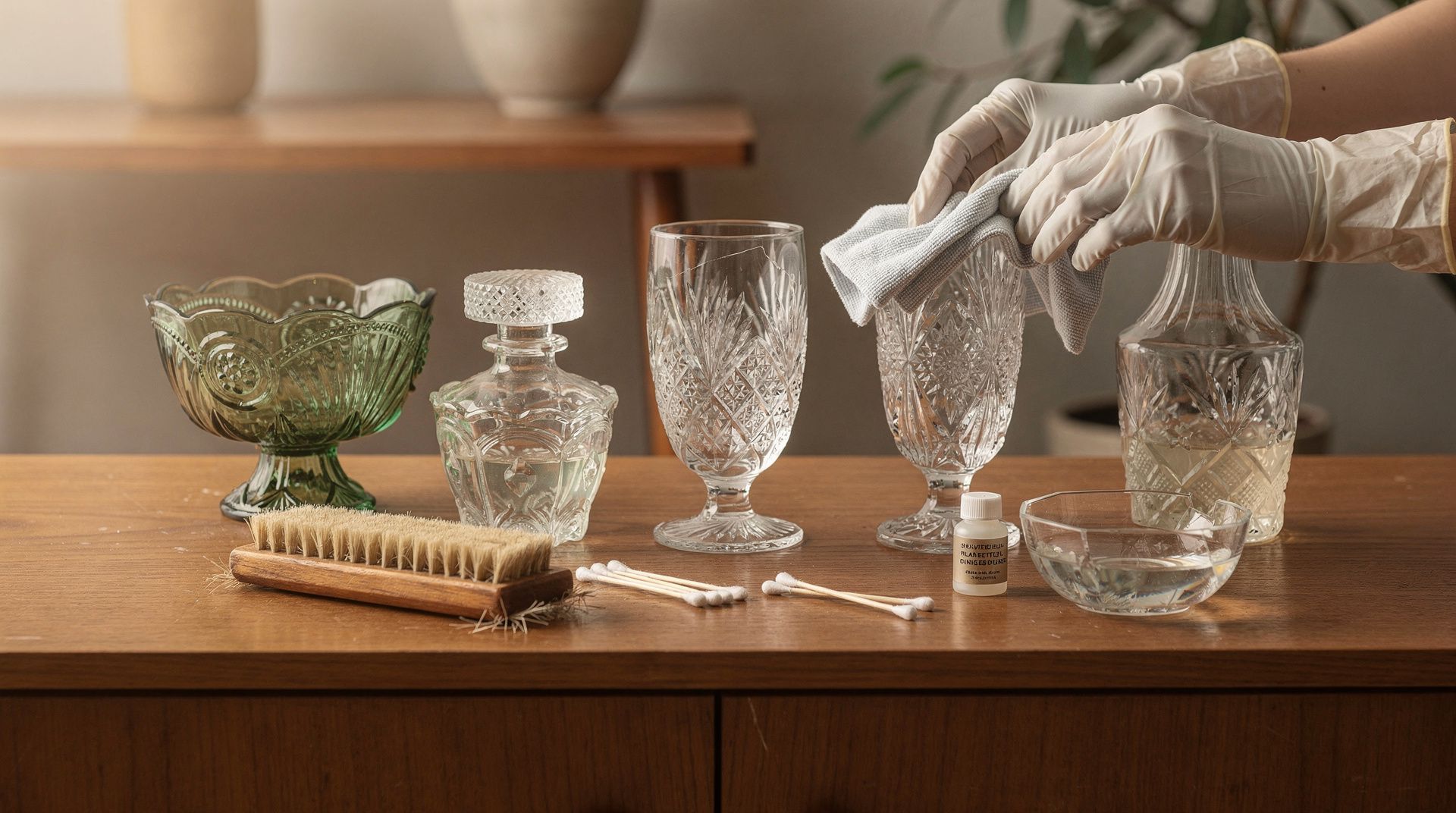
Pressed glass can be identified by mould seams, slightly rounded edges and a softer light effect compared to cut crystal. The surface is less susceptible to mechanical abrasion but prone to limescale haze, because the pressed reliefs trap water in the recesses. Clean with lukewarm water and pH-neutral washing-up liquid, use a soft microfibre cloth and soft natural-hair brushes for gaps. You should categorically avoid steel wool, scouring cream and baking-soda pastes: they leave fine scratches that are visible in raking light.
Lead crystal and lead-free crystal glass are denser, heavier, and more susceptible to edge chipping at cut facets. Lead crystal also reacts with acidic agents; prolonged contact with vinegar cleaners can cause matte haze. For limescale deposits, a combination of distilled water and a splash of citric acid solution at a maximum of five percent has proved effective — leave to act briefly, rinse thoroughly with distilled water and dry immediately with a lint-free linen cloth. Cloudiness on the inside of decanters (known as glass disease or weathering caused by standing water) is a physical leaching of the surface and, in advanced cases, can no longer be removed chemically. The only remedy here is professional grinding, which however reduces the wall thickness and should be disclosed.
Fractures in transparent glass should be bonded exclusively with UV-curing acrylic adhesive with a matching refractive index (close to 1.52 for lime-soda glass, higher for lead crystal). Two-component epoxies yellow over the years and can only be reversed with considerable effort. Clean the fracture edges with isopropanol, fix dry, apply the adhesive sparingly and cure at specific points with a UV lamp. Bonds at load-bearing stems or base rings are conservatorially delicate and significantly reduce collector value; they should be left to experienced hands.
2. Regional schools and defining designers
European post-war modernism produced several clearly distinguishable centres in glass. In Czechoslovakia, Rudolf Jurnikl, František Vízner and Adolf Matura defined from the late 1950s onwards at Sklo Union (Rosice, Libochovice, Hermanova Hut) a pressed-glass vocabulary of geometric reliefs that is design-historically related to the studio work of Stanislav Libenský and René Roubíček. These objects are today reference points for distinguishing between industrial series and studio art.
In Italy, Paolo Venini, Fulvio Bianconi, Carlo Scarpa and later Tapio Wirkkala (who worked for Venini from 1966) shaped the Murano glass techniques Sommerso, Battuto and Inciso. These are almost exclusively mouth-blown lime-soda glass with a high degree of craftsmanship, not lead crystal. Scandinavia during this period stood for Nanny Still (Riihimäki), Timo Sarpaneva and Tapio Wirkkala (Iittala), Per Lütken (Holmegaard), and Vicke Lindstrand and Bertil Vallien (Kosta Boda). Iittala’s “Ultima Thule” series (Wirkkala, 1968) and Sarpaneva’s “i-Glass” (1956) remain in production to this day; early editions differ in signature, base mark and glass composition.
In the German-speaking world, the Vereinigten Werkstätten, Zwiesel, WMF (“Glaskunst” series under Wilhelm Wagenfeld) and Peill & Putzler supplied functional stemware and pressed-glass series. Wagenfeld’s work for the Vereinigte Lausitzer Glaswerke dates back to the 1930s and was continued after 1945. Knowledge of these factory catalogues is a prerequisite for making reliable attributions.
3. Authenticity and condition: what collectors should check
Reliable attribution rests on several independent pieces of evidence: base marks or etched signatures, factory adhesive labels (at Iittala, Holmegaard, Kosta often only partially preserved), mould numbers, catalogue illustrations and provenance documents. Appearance alone is not sufficient — Sklo Union models in particular were produced in identical moulds over decades, meaning that dating without secondary sources remains imprecise. With Murano objects, unsigned pieces are the norm; here technique, colour chemistry and documentation such as invoices, gallery labels or factory photographs are what counts.
Regarding condition: small rubbing marks on the base ring are age-appropriate and barely detract from value. Edge chips on rims and cut edges, subsequently ground edges (identifiable by altered proportions and a fresh facet), bonds and deep weathering cloudiness significantly reduce value and must be disclosed. Examine in raking light, with UV light (fresh bonds often fluoresce differently from the surrounding glass) and acoustically: a clean, long-lasting ring indicates integrity in crystal glass, while a dull tone can point to hairline cracks. With lead crystal, watch for early signs of glass disease (iridescent haze, milky inner surfaces) — this is widespread in tightly stored decanters with residual moisture and progresses if they are not dried out and stored open.
At mid-centurydesigns.com we examine and describe every glass object individually: material, attribution, production period, condition and, where available, provenance. We disclose bonds, re-ground edges and weathering rather than concealing them. This gives you a basis on which to decide, as a collector or designer, whether a piece belongs in your collection, in an interior or in professional restoration.
This article was generated automatically by an AI system. Disclosure pursuant to Article 50 of the EU AI Act.