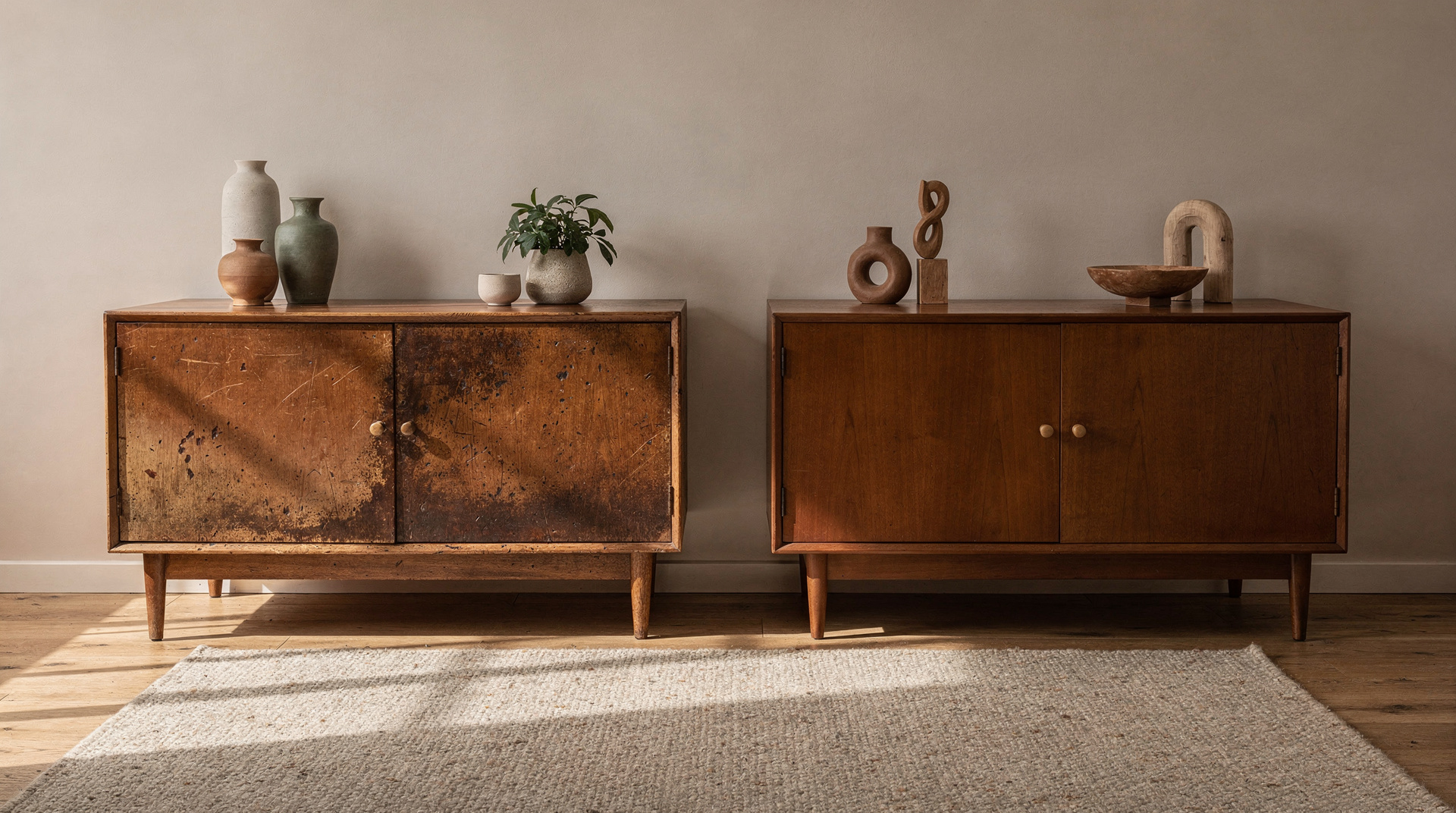
Preserve or restore patina: When original surfaces should stay and when a refresh makes sense
Few questions are debated as controversially among collectors of mid-century furniture as the treatment of surfaces. On one side stands patina as a witness to time, use and material behaviour; on the other, the desire to return a piece to a condition that is both fit for everyday use and aesthetically coherent. Both positions have their justification, yet they lead to very different outcomes — both in terms of design and market value.
The curatorial ground rule is simple to state but hard to apply: as little as possible, as much as necessary. An intact, evenly aged shellac or oil surface on a 1960s rosewood sideboard is a historical document. Sanding it down removes not only superficial loss of sheen, but also the thin, oxidised outer zone of the wood in which the characteristic depth of colour has developed. Conversely, a piece with cracked nitro lacquer, water-induced swelling or active damage can only regain its design impact through professional restoration. Between these poles lies the real craft: cleaning, feeding the existing polish, partial retouching. Restoration in the strict sense begins where substance is secured — not where traces are erased.
Characteristic materials and their ageing behaviour
The question of surface cannot be answered generically — it depends on the material. Rosewood, in particular Rio rosewood (Dalbergia nigra), develops a shift towards a warmer, reddish-brown spectrum under light. The typical contrasts between dark heartwood and lighter grain lose sharpness over the decades. Sanding does bring fresh figure back in the short term, but sacrifices precisely the maturation that later reproductions do not possess. Teak reacts similarly, but is more oil-rich and generally tolerates cleaning with a sparingly applied teak oil well, provided the original finish was also an oil treatment. For soap-finished surfaces — as frequently used in the Danish tradition for light woods such as beech, oak or maple — re-soaping with a mild pure-soap solution is the correct care, not an application of oil.
Veneers demand particular restraint. The knife-cut veneers typical of the 1950s and 1960s are considerably thicker than today’s material at around 0.6 to 0.9 millimetres, but repeated sanding quickly wears them down. With lacquered surfaces — often nitrocellulose or early synthetic resin lacquers — a distinction must be drawn between age-related yellowing that has become part of the aesthetic, and actual failure of the film-forming agent. Metals, such as nickel- or chrome-plated frames in the style of Knoll or Thonet, should not be polished as long as the coating is intact. Upholstered pieces, on the other hand, are the one segment in which renewal of covering and foam is often unavoidable. Here, period accuracy counts: original fabric qualities such as Kvadrat, wool hopsack or matching bouclé rather than arbitrary substitutes.
Regional schools and the approach of their restorers
The treatment of surfaces also has a geographical dimension, rooted in the workshop cultures of the respective design centres. In Denmark — shaped by the cabinetmaking training of the Copenhagen Furniture School and names such as Finn Juhl, Hans J. Wegner, Arne Vodder or Kai Kristiansen — a culture of open, oiled or soaped surfaces prevailed. Furniture from the workshops of Niels Vodder, Johannes Hansen or A.P. Stolen was conceived from the outset as requiring maintenance. Here, a sensitive refreshing using the Danish method is usually the right answer.
Scandinavian and Finnish modernism around Bruno Mathsson, Alvar Aalto or the Artek workshop worked more extensively with laminated wood and light surfaces that show greying and UV-induced discolouration. For Artek pieces, the clear market consensus is that the original surface should be preserved wherever possible. In Italy — with Gio Ponti, Ico Parisi or Osvaldo Borsani and production at Tecno or Cassina — more complex lacquer builds and brass details were used, the restoration of which requires specialist knowledge. The American school around Charles and Ray Eames, George Nelson or Florence Knoll, produced at Herman Miller and Knoll International, is in turn industrially oriented: plywood shells, aluminium casting, fibreglass. Here, production stamps, labels and original upholstery carry considerable weight — a re-upholstery of an Eames Lounge Chair, for example, must be documented and carried out with appropriate materials, otherwise the collector value drops noticeably.
Authenticity, condition and market value for collectors
For the collector, the question of surface plays a significant role in provenance and value. Auction houses and serious dealers distinguish between “unrestored, original surface”, “sensitively revised” and “restored”. The first condition achieves markedly higher prices for icons — such as a Poul Kjærholm PK22 from early Kold Christensen production or a Finn Juhl Chieftain from the Niels Vodder workshop — provided the substance is intact. A complete sanding down with subsequent refinishing can mean a loss in value of twenty to forty percent for iconic pieces, and in individual cases more.
How do you recognise a serious restoration? By the reversibility of the interventions, the use of period-appropriate materials and traceable documentation. Indicators to check are edges and profiles that lose their crispness when re-sanded, veneer thickness on drawer sides and undersides, the depth of colour in areas around knots, the behaviour of the surface under raking light, and maker’s marks that must not have been damaged by surface-wide treatment. The consistency of ageing also matters: a piece whose visible surfaces gleam while the back panel and underside appear considerably more aged has probably been reworked without this being disclosed.
This is precisely where the work at mid-centurydesigns.com begins. Every piece is assessed for the originality of its surface, maker’s marks, construction and provenance before it is included in the catalogue. Where a refresh has taken place, it is communicated transparently — with details of the scope and materials used. Where the original patina is preserved, it remains untouched. This allows you as a collector or designer to decide which condition you prefer — without having to become an expert yourself.