DESIGNER · POUL KJAERHOLM

Poul Kjærholm: The Purist of Steel Craftsmanship

The PK Series and a Philosophy of Subtle Elegance

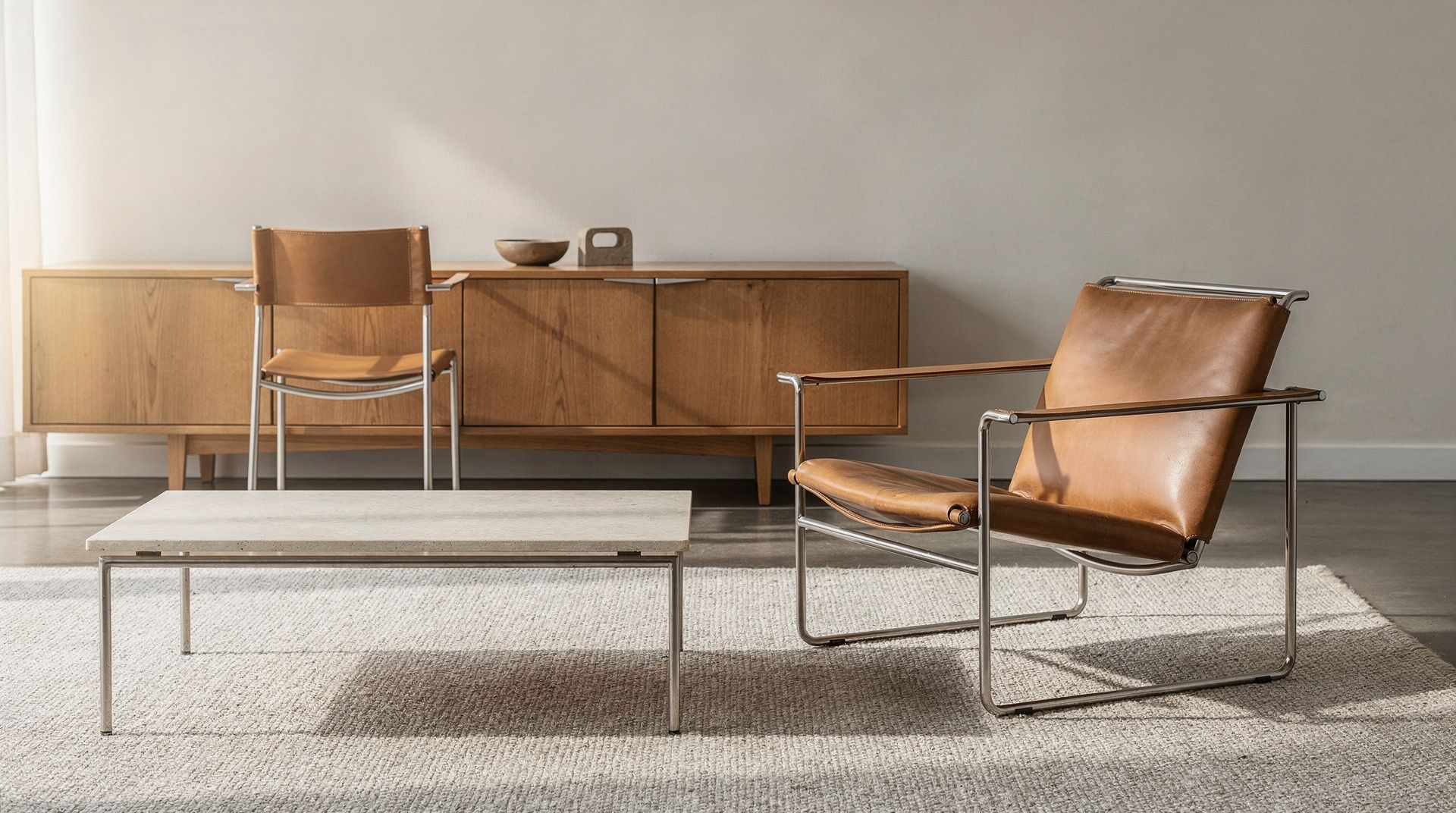
Poul Kjærholm (1929–1980) occupied a singular position within Danish Mid-Century design: rather than wood, he chose resilient spring steel as his primary structural element, combining it with leather, cane webbing, marble or slate. His PK series, produced from 1955 by Ejvind Kold Christensen and later by Fritz Hansen, follows a rigorous constructive logic. With us you will find curated originals with documented provenance.

mid-century·designs

Poul Kjaerholm

ESSAY · 01

Work & Context

mid-century·designs

Poul Kjærholm – The Purist of Steel Craftsmanship

Poul Kjærholm (1929–1980) holds a singular position within Danish Mid-Century design. While his contemporaries Hans J. Wegner, Finn Juhl and Arne Jacobsen continued the woodworking tradition of the Copenhagen cabinetmaking school, Kjærholm turned decisively to steel. Trained as a carpenter, from 1952 schooled at the Kunsthåndværkerskolen under Professor Erik Herløw and later a teacher himself at the Royal Danish Academy of Fine Arts, he understood metal not as a break with Danish tradition but as its logical continuation by other means. His work is defined by an almost ascetic discipline: exposed construction, precise proportions, the elimination of every decorative element.

The collaboration with furniture manufacturer Ejvind Kold Christensen from 1955 gave Kjærholm the freedom to realise his ideas without commercial compromise. The PK series that emerged is today a reference point for an attitude that might be described as Nordic Constructivism: related to Mies van der Rohe and Charlotte Perriand, yet grounded in Danish material culture and craft rigour. After the death of Kold Christensen, Fritz Hansen took over production in 1982 and continues the series to this day under the supervision of the Kjærholm estate.

Characteristic Materials and Constructive Signature

Kjærholm’s material language is concentrated. Central to it is matt-chromed or burnished spring steel, usually fashioned as a flat strip profile whose narrow silhouette avoids any sense of heaviness. The PK22 (1956), for instance, rests on a frame of just two bent flat-steel elements whose plug-in joint requires no welding and openly displays its construction logic. For this design Kjærholm received the Grand Prix at the Milan Triennale in 1957.

On the steel frames he combines materials that enrich the cool ground tone: vegetable-tanned natural leather (Elegance leather), hand-woven cane webbing as on the PK24 (1965, also known as the Hammock chaise longue), canvas, marble (such as Cipollino or Portoro on the PK61 coffee table, 1956) or slate slabs. Wood recedes, appearing only in exceptions such as the PK0 (1952) with its moulded plywood shell. The union of an industrially inflected metal structure with warm, tactilely differentiated upholstery is not a stylistic device but Kjærholm’s central thesis: the chair comes into being in the dialogue between structure and sensuality.

Regional Schools and the Context of Danish Modernism

Kjærholm belongs to a Copenhagen lineage that Kaare Klint established as a methodical school in the furniture department of the Academy of Fine Arts from 1924 onwards: analytical measurement of the human body, study of historical precedents, constructive honesty. Poul Kjærholm took over the leadership of that department in 1976. His direct teacher Hans J. Wegner shaped him with regard to attention to detail, even as he distanced himself from the wooden vocabulary of his surroundings.

At the same time in Denmark, Arne Jacobsen was working on industrially produced series furniture for Fritz Hansen, Verner Panton on sculptural plastic forms, and Nanna Ditzel on textile experiments. Kjærholm’s position is most readily compared with Grete Jalk or the early Jørgen Høvelskov, yet his radical reduction to steel remains singular within the Danish context. Internationally he drew visible reference from the Werkbund tradition, from Marcel Breuer and Mies van der Rohe, transposing their tubular-steel vocabulary into a flatter, more finely proportioned register. The PK80 (1957), a daybed with leather upholstery on a flat-steel base, can be read as a conscious response to the Barcelona Daybed without repeating its gesture.

Authenticity and Condition for Collectors

Those seeking original Kjærholm editions distinguish three periods. Early productions by E. Kold Christensen (1955–1980) typically bear a round embossed metal label with the intertwined initials “EKC” along with the model and designer’s name, usually on the underside of the frame. These pieces are regarded as the most collectorially significant reference. From 1982 Fritz Hansen continues the series with its own label; early Fritz Hansen editions frequently carry an oval metal stamp, later ones embossed or printed labels with a production date. Unlicensed reproductions, particularly of the PK22, circulate in large numbers and can be identified by coarser steel profiles, imprecise plug-in joints, inferior chrome quality and absent signatures.

When assessing condition, experienced collectors pay attention to several points. The spring steel should show an even, matt chrome surface; pitting, rust blisters or re-chroming reduce value considerably, as later coatings alter the original texture. Leather upholstery develops a desirable patina over decades; cracks at the edge reinforcements or stretched strap suspensions are repairable but should be disclosed openly. The cane webbing on the PK24 is a wear component and has been professionally renewed on many examples, which does not diminish the value of a good piece provided the work matches the original. Marble and slate slabs should be examined for original attribution, edge chips and old repairs. Provenance documents, receipts and historical catalogues support attribution and are particularly value-enhancing for EKC editions.

At mid-centurydesigns.com the Kjærholm pieces on offer come from verified provenance. We document labelling, production period, material condition and any restorations transparently, engage specialist restorers for leather, cane webbing and metal surfaces as required, and consistently refrain from re-chroming that would compromise the historical substance. You will therefore find with us editions whose authenticity is demonstrably evidenced and whose condition meets the standards of long-term collection worthiness.


This article was generated automatically by an AI system. Disclosure pursuant to Article 50 of the EU AI Act.

FAQ · 02

Frequently asked about Poul Kjaerholm

5 Answers

01
Who was Poul Kjaerholm and why is he considered a purist of steel craftsmanship?
Poul Kjaerholm (1929–1980) was a Danish furniture designer who elevated cold-rolled steel profiles to an art form. After his training under Arne Jacobsen he deliberately distanced himself from the wooden aesthetic of the teak era and developed a design philosophy that placed steel as the primary creative material at its centre. His works reduce construction to essential elements: minimal steel frames supporting maximally elegant seating surfaces. This makes him the antithesis of opulent Scandinavian Modernism and a pioneer of a coolly rigorous yet not cold-hearted modernity.
02
What characterises the PK series and which pieces are particularly relevant for collectors?
The PK series is Kjaerholm's signature work: 22 numbered designs (PK1 through PK61, with gaps), developed between 1953 and 1967, almost all in matt or chromed steel with leather, cane or fabric. The PK22 (three-piece sofa constellation) is iconic, the PK6 and PK7 are compact lounge classics. The PK31 stool and the PK20 chair are staples of any serious collection. The series follows a clear line: no superfluous ornament, steel frames with a minimum diameter of 5–8 mm, precisely crafted corners. Original productions by Fritz Hansen or PP Møbler are the references.
03
How does Kjaerholm's steel minimalism differ from other Scandinavian designers of the period?
While contemporaries such as Wegner, Juhl and Mogensen celebrated wood as an expression of Scandinavian tradition, Kjaerholm rejected sentimental formal language. He worked with cold-formed steel and left the construction visible rather than hidden. This resulted in a spatially open, almost sculptural aesthetic that stood closer to High Modernism and Minimalism than to folklorism. His guiding principles were precision, weight reduction and the beauty of proportion over material warmth. This made him an outsider within the Danish design elite, but considerably enhanced his value among collectors.
04
What should I look out for when buying original Poul Kjaerholm furniture?
Authenticity is paramount: original productions were made by Fritz Hansen and PP Møbler (later PP Mobler International). Look for the stamp or manufacturer's mark on the steel underframe. The steel quality is high-grade but not stainless, so genuine pieces show a differentiated patina rather than surface rust. Screw joints should be cleanly crafted and not over-corroded. Leather upholstery ages characterfully but can be repaired. Beware of reproductions without provenance: Kjaerholm's designs are now available from licensed producers, but without a manufacturer's stamp they are not original. The price reflects this: an original PK22 costs €15,000–25,000, a PK6 €6,000–10,000.
05
What is the philosophy behind Kjaerholm's 'subtle elegance' and why does it still fascinate collectors today?
Kjaerholm worked according to the principle of reduction to the necessary, not minimalism for its own sake. Every steel rod must be structurally justified, every proportion must be felt rather than merely seen. This is what makes it subtle: you notice the elegance only when sitting, when touching the steel frame, when viewing it from different angles. This quietness and depth appeals to collectors who turn away from the noise of contemporary design. His furniture is timeless because it does not appear time-bound, and it is uncompromising because Kjaerholm disregarded economic constraints. That is what makes original PK pieces a sound investment rather than mass-produced goods.

GLOSSARY · 03

Related Terms

8 Entries

Steel frame
A fundamental constructive element in which load-bearing structures are made from steel. In Mid-Century design, particularly in the work of Poul Kjaerholm, thin steel profiles are fashioned into geometrically reduced furniture frameworks that offer maximum stability with minimal material.
PK series
Furniture collection by Danish designer Poul Kjaerholm, named after his initials. The series comprises chairs, tables and daybeds with characteristic spring steel frames and is the epitome of the modern Scandinavian design philosophy from 1957 onwards.
Subtle elegance
A design principle that achieves beauty through reduction and balance rather than decoration. In Kjaerholm's work this means the perfected harmony between construction, material and form, which explains itself without superfluous elements.
Constructivism
A design attitude that uses structure and construction as primary aesthetic means of expression. The architecture of the piece of furniture is not concealed but staged. Characteristic of Kjaerholm's work and of Nordic Modernism.
Spring profile
A special steel profile form used by Kjaerholm in his furniture. The profile provides elasticity and flexibility through its shape, enabling ergonomic seating and reclining without additional upholstery or springs in the conventional sense.
Material minimalism
A design strategy in which the quantity of material used is deliberately minimised without compromising stability or function. Kjaerholm's furniture embodies this approach through thin, refinedly shaped steel structures.
Danish Modernism
A 20th-century design movement in Denmark characterised by functionality, high-quality craftsmanship and subtle aesthetics. Kjaerholm is one of its key figures and has substantially shaped the international perception of Scandinavian design.
PK 22
Classic lounge chair from the PK series with an apparently floating steel frame and leather seating surface. The PK 22 is regarded as a masterpiece of minimalist furniture design and is the architectural expression of lightness in steel.