DESIGNER · POUL HENNINGSEN

Poul Henningsen: The Architect of Glare-Free Light

From the PH prototype of 1925 to the PH 5 – a grammar of light

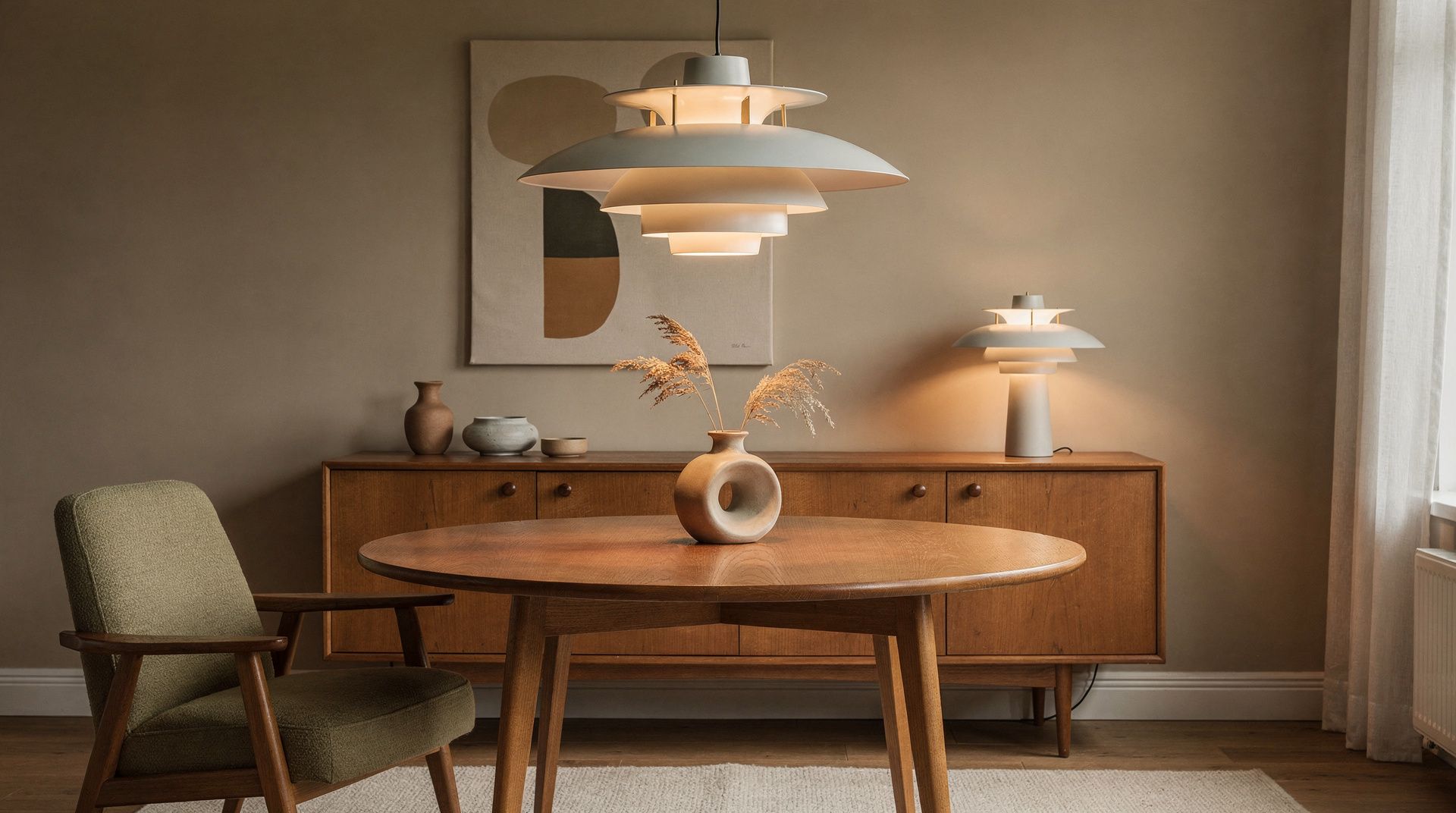
Poul Henningsen (1894–1967) reimagined electric light: starting from logarithmically calculated shade curves, he developed from the mid-1920s onwards, together with Louis Poulsen, a lighting system that completely shields the light source and allows only reflected, warm light into the room. Icons such as the PH Lamp (Paris 1925), the PH Artichoke (1958) and the PH 5 (1958) embody this philosophy: light as craft, not as effect. At mid-century designs you will find carefully verified originals and editions from this design history.

mid-century·designs

Poul Henningsen

ESSAY · 01

Work & Context

mid-century·designs

Poul Henningsen – The Light Artist and Lamp Pioneer

Poul Henningsen (1894–1967) was an architect, publicist, cultural critic and arguably the most influential lighting designer of the 20th century. His engagement with electric light began in the early 1920s, when the bare light bulb was displacing the warm glow of the oil lamp and candle. Henningsen experienced this harsh light as a social and aesthetic rupture. From this critique he developed a system of several concentrically arranged shades that completely shields the light source and supplies the room exclusively with reflected, glare-free light. The three-shade luminaire presented together with Louis Poulsen at the Paris World Exhibition (Exposition internationale des Arts décoratifs, 1925) established the logarithmic principle that every PH luminaire carries to this day.

Henningsen’s thinking is therefore less decorative than scientific. He studied the physiology of vision, the colour temperature of the incandescent lamp and the reflection angles of the shades in order to create a light that comes closer to the evening sky or the gentle kitchen light of his childhood than to factory illumination. Whoever acquires a PH luminaire today is not buying an object but an attitude: the conviction that good light is a fundamental right of domestic culture. For Danish Mid-Century Modern, Henningsen’s work forms the quiet foundation upon which Wegner, Juhl and Mogensen first made their rooms truly liveable.

Characteristic Materials and Colour Theory

The vocabulary of the PH luminaires is compact and all the more consistent for it. The early shades of the 1920s and 1930s were made of mouth-blown opal glass, whose milky layer softly diffuses light without absorbing it. In parallel, versions in copper-plated, brass-plated or chrome-plated metal were produced, their interiors matt-lacquered to control back-reflections. Henningsen’s precision is already apparent here: the interior colour of a shade is not decoration but an optical component.

Between 1925 and 1931, Henningsen experimented with colour-lacquered shades in red, yellow, blue and green in order to recover the spectral components missing from the incandescent lamp. This colour theory, derived directly from observations on colour temperature, is documented as “PH lampe med farvet skærme” and is today particularly sought after by collectors. In the post-war years Henningsen refined the system into the PH 5 (1958), whose matt shades in red and blue correct the warm tone of the incandescent lamp on the inside, and into the PH Artichoke (1958), which consists of 72 curved, staggered leaves and was originally designed for the Copenhagen restaurant Langelinie Pavillonen. The contrasts always result from a few materials: pressed or blown glass, rolled copper, brushed brass, white stove-enamelled lacquer.

Regional Schools, Louis Poulsen and the Wider Context

Henningsen’s work is inseparable from the Copenhagen lighting manufacturer Louis Poulsen, with whom he began collaborating in 1925 and who exclusively produces his designs to this day. This bond made Copenhagen the centre of a school that understood light as an architectural element. Gathered around Henningsen are contemporaries such as Vilhelm Lauritzen, who followed similarly functional paths with his Radiohus luminaires (1937), as well as the later generation around Arne Jacobsen, whose AJ lamp (1957/60) for the SAS Royal Hotel continues Henningsen’s glare-free principle in a sculptural language.

Verner Panton, who worked in Jacobsen’s office between 1955 and 1957, also owes Henningsen the conceptual foundation of his later light objects such as the Flowerpot (1968). Poul Henningsen’s son, the designer Simon Henningsen, continued the family tradition with the Tivoli luminaire (1963) for the Copenhagen amusement park. This Danish school differs markedly from the contemporaneous Italian approaches around Gino Sarfatti or the American work of George Nelson: where sculpture or the bubble principle dominates there, in Denmark reflected, indirect light remains the supreme measure.

Authenticity and Condition for Collectors

The assessment of an original PH luminaire follows clear criteria. Central is the stamping “Louis Poulsen” on the shade holder or the upper shade rim, frequently supplemented by the model designation (“PH 5/3”, “PH 4/3”, “PH 3/2”) and, on older models, the addition “Patented” or “Pat. Appl.”. Until well into the 1960s, suspension fittings and shade carriers were made from brass, which develops a characteristic, uneven patina. From the late 1960s onwards, chrome-plated and white-lacquered versions became increasingly common.

With the glass, attention to detail is required: early opal glasses show slight bubble inclusions and minimal variations in wall thickness, while later serial productions are more homogeneous. Retrofitting with modern LED bulbs can alter the colour effect, since Henningsen’s calculations were based on the incandescent lamp. Collector-relevant condition features are: integrity of all shades (especially all 72 original leaves on the Artichoke), preservation of the original interior lacquer, no subsequent polishing of the brass parts, and ideally the original wiring with textile sleeving. Replacement parts are still available from Louis Poulsen, but they reduce collector value if fitted extensively. Early colour-shade versions from the 1920s and the first Artichoke editions rank among the most sought-after segments of the market.


At mid-centurydesigns.com we examine every Poul Henningsen luminaire for stampings, material consistency, shade condition and traceability of provenance. Where possible, we document purchase context, previous collections and restoration steps transparently, so that you can make a decision on the basis of reliable facts – not on the basis of promises.


This article was generated automatically by an AI system. Disclosure pursuant to Article 50 of the EU AI Act.

FAQ · 02

Frequently asked about Poul Henningsen

5 Answers

01
What makes Poul Henningsen and his PH luminaires so special in Mid-Century design?
Poul Henningsen (1894–1967) revolutionised lighting design through scientific colour theory. His PH luminaires are based on mathematical principles: the characteristic shade constructions direct light and heat so that glare-free, colour-accurate light is produced. That was groundbreaking in 1924. Henningsen investigated how different material layers filter light and combined function with an organic, sculptural aesthetic that is still considered the epitome of Danish design thinking today.
02
What role did colour theory play in Henningsen's lamp design?
Henningsen was fascinated by colour theory and applied it deliberately in his lamp shades. He understood that coloured light fundamentally changes the perception of rooms and objects. His PH luminaires use specific shade colours (opal, red, blue) to optimise both light quality and colour rendering. This was not an aesthetic exercise but was grounded in scientific findings on human light perception.
03
How do I recognise a genuine PH luminaire by Henningsen, and what should I look out for when buying?
Original PH luminaires bear the Henningsen signature and manufacturer markings (Louis Poulsen is the classic producer since 1924). Pay attention to the precise workmanship of the shade parts, the harmonious proportions of the overlapping shells and the quality of the materials. Collector pieces should have the correct socket, original patina and documented provenance. Many PH variants exist; the most famous are the PH Artichoke (1958), PH Snowball and the smaller PH models. Originals from the 1950s/60s are considerably more expensive but technically and aesthetically superior.
04
What is Poul Henningsen's legacy for design today?
Henningsen demonstrated that functionality and beauty need not be in conflict. His approach of combining science (optics, colour theory) with formal language continues to shape the understanding of good design today. In design history he established the idea of light as a design element, not merely a by-product. His works show that the finest organic minimalism arises from a deep understanding of the subject matter, not from pure intuition. This makes him absolutely relevant to contemporary sustainable and intelligent design.
05
How much should I expect to pay for an original PH luminaire from the 1950s/60s?
Prices vary considerably depending on model, condition and provenance. Smaller PH models (PH 3.5, PH 4.5) from this period fetch 800–1,500 euros in good condition. The iconic PH Artichoke (1958) costs 2,500–6,000 euros and upwards at auctions and specialist dealers, depending on state of preservation and documentation. New productions are less expensive (400–1,200 euros) but lose the historical authenticity and patina. For collectors it makes sense to invest in documented, undamaged originals, as these hold their value and authentically embody Henningsen's design philosophy.

GLOSSARY · 03

Related Terms

8 Entries

PH Luminaire
Lamp design by Poul Henningsen, characterised by several overlapping shades of opal glass or metal that diffuse light and achieve glare-free, homogeneous illumination. The innovative construction is based on geometric optics and has been produced since 1926.
Organic Lighting Design
Design philosophy that places natural lighting conditions and human perception at its centre. For Henningsen this means: light without glare, colour-accurate and space-defining, modelled on the diffuse brightness of an overcast sky.
Colour Rendering (CRI/Ra Value)
The ability of a light source to reproduce the colours of objects faithfully. As early as the 1920s, Poul Henningsen developed luminaires that achieve high colour rendering through special glass types and reflective shades, long before this standard was metrologically standardised.
Glare Freedom
A criterion for quality light: the exclusion of direct glare effects from the light source or its reflection. The multi-shell PH construction deflects light rays so that they do not strike the human eye directly but are distributed diffusely into the room.
Opal Glass
Translucent glass with a milky appearance that diffuses and scatters light. Used in PH luminaires to avoid hard shadows and create an even, pleasant brightness corresponding to the light quality of a natural sky.
Mid-Century Modern Lighting Design
Design era of the 1930s–1960s with a focus on functionality, material honesty and geometric form. Poul Henningsen is among the pioneers who combined technical innovation (optics, colour theory) with aesthetic elegance.
Lighting-Technical Function
The scientific basis of Henningsen's work: the application of the laws of reflection, colour temperature and brightness distribution to create technically sophisticated luminaires. In contrast to pure formal design, the physical effect of light is central to PH.
Danish Design Heritage
Denmark's national design tradition with an emphasis on craftsmanship, natural materials and functional beauty. Poul Henningsen embodies this approach through the combination of Scandinavian aesthetics with precise engineering.