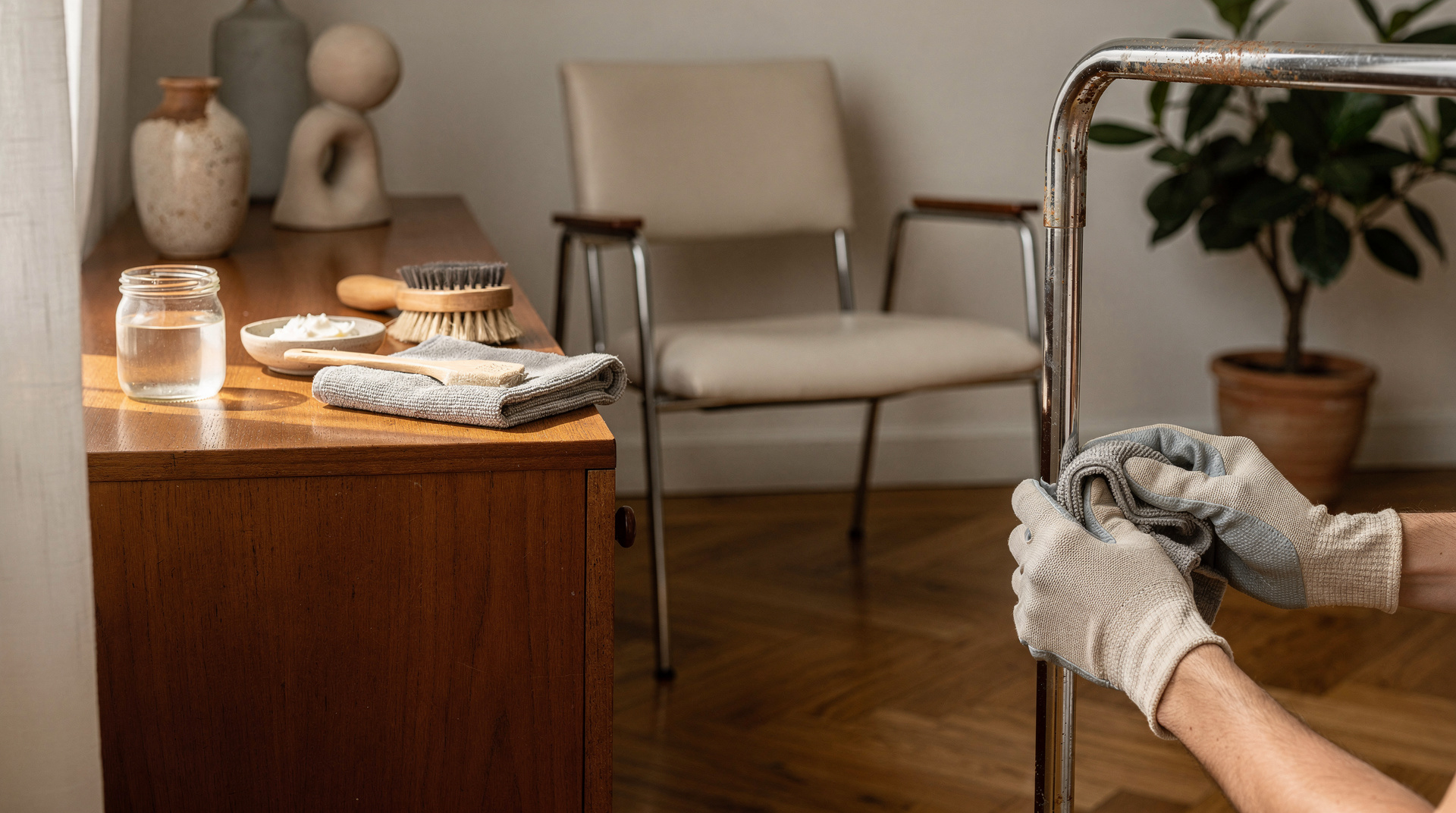
Polishing and de-rusting chrome: A guide to cleaning and restoring chromed parts on vintage furniture and design objects
Chromed steel tubes, brackets and frames are part of the visual grammar of classical modernism. What began at the Bauhaus in the 1920s as an industrial material with a mirrored surface became a defining element of countless chair, table and lamp designs in the mid-century era. If you have an original piece from that period in front of you, you are almost always confronted with a galvanically applied chrome layer sitting on an intermediate layer of copper and nickel. This layered structure is crucial: it explains why aggressive polishing does more harm to an original than a patinated coating, and why real rust almost always means the chrome layer has already been breached.
The following notes are intended as guidance for handling pieces in original condition, not as an invitation to carry out a full restoration. A cantilever chair by Marcel Breuer, Mart Stam or Mies van der Rohe loses value the moment the tube is re-chromed. The aim is therefore to stabilise existing chrome, remove surface rust and preserve the characteristic, slightly warmer reflection of old galvanic plating.
1. Characteristic materials and their treatment
Chrome in mid-century furniture construction is almost always hard chrome plating on seamlessly drawn precision steel tube, typically with wall thicknesses between 1.5 and 2 mm. Beneath it lie thin layers of copper and nickel, which serve as an adhesion base and corrosion protection. This becomes visible at worn-through areas: if it shimmers with a yellowish warmth there, you are looking at the copper layer — a clear sign of original galvanic plating from the 1920s to the 1960s.
A graduated approach is recommended for cleaning. Begin with distilled water and pH-neutral soap to dissolve dust, nicotine films and wax residues. For superficial surface rust, fine aluminium foil with a drop of water has proven effective: the foil is softer than chrome but harder than iron oxide, removing rust without scratching the plating. Light, circular movements are sufficient. For more heavily affected areas, use a mild chrome polish with the lowest possible abrasive content (Autosol Classic, Peek or Never Dull have been standards in collector care for decades). Apply sparingly with a cotton cloth, work in the direction of the tube’s length, and buff with a second, clean cloth.
What you must absolutely avoid: steel wool of any grade, sandpaper, rotary polishing machines, hydrochloric acid-based rust removers and ultrasonic baths. All of these remove material irreversibly. After cleaning, a thin layer of microcrystalline wax (Renaissance Wax) protects the surface for years.
2. Regional schools and designers whose chrome work you should know
The use of chrome is historically closely linked to specific workshops, and the condition of the plating often allows conclusions about origin and dating.
Germany and Central Europe: The early tubular steel designs by Marcel Breuer (B3, B32, B64, from 1925 at Standard-Möbel, later Thonet), Mart Stam (S33, S43) and Ludwig Mies van der Rohe (MR10, MR20, Barcelona) were chrome-plated by Thonet-Mundus, Berliner Metallgewerbe Josef Müller and Bamberg Metallwerkstätten. Original pre-war plating is usually thinner and today displays a slightly bluish depth. Post-war productions by Thonet and Gavina appear cooler and more uniform.
France: Jean Prouvé used chrome more sparingly, more often on details such as foot caps and fittings. Le Corbusier, Pierre Jeanneret and Charlotte Perriand developed the LC series from 1928, originally through Thonet, later through Cassina from 1965. Early Cassina editions carry numbers stamped into the chrome layer.
Italy: Gio Ponti, Franco Albini and later Joe Colombo worked with chromed frames, executed by Arflex, Zanotta and Kartell. Italian plating from the 1960s is often particularly brilliant, as thicker nickel underlayers were used.
USA: Charles and Ray Eames (Aluminium Group, Wire Chair) as well as Florence Knoll, Harry Bertoia and Warren Platner used chromed steel wire and rod in large quantities. Herman Miller and Knoll maintained their own plating partners, whose quality was consistently high.
3. Authenticity and condition for collectors
Three inspection steps apply when assessing a piece. First, the layer check: Hold the tube in oblique daylight. Original plating shows a slight texture — minimally wavy, with a warm undertone. Re-chroming appears mirror-flat and often bluish-cold. Blistering, milky hazes or sharp edges at weld seams indicate later reworking.
Second, provenance traces: Embossed stamps, stickers and impressed numbers sit directly in or below the chrome layer. If they disappear or appear over-polished, the piece has been reworked. On Thonet classics, you will frequently find round paper labels under seat frames; on Knoll and Herman Miller pieces, embossed metal plaques.
Third, condition classification: Four grades have become established for the market. Preserved condition denotes original chrome with even patina, small point discolourations, without rust penetration. Carefully maintained original means professionally cleaned, not re-chromed. Partially restored indicates replaced individual parts or partial re-chroming. Fully restored stands for complete re-chroming, which significantly reduces collector value while preserving functional value. For most icons the rule applies: an honestly aged original with minor chrome flaws is more valuable than a perfectly re-chromed example.
At mid-centurydesigns.com we examine every chromed piece for layer structure, provenance features and signs of reworking before it is accepted into curation. Every description transparently states the condition of the plating and identifies any restoration work carried out. This allows you to decide whether to add an untouched historical witness or a professionally refurbished, ready-to-use piece to your collection.