Chrome on Mid-Century Furniture: Care Between Material Knowledge and Conservation Ethics
Chrome-plated steel tubes, flat steels and fittings belong to the visual grammar of classical modernism. They combine industrial manufacturing with sculptural lightness and carry a large part of the formal tension in cantilever chairs, stacking chairs and table frames. Handling them is correspondingly delicate: chrome is hard, but applied as a thin galvanic layer over a copper or nickel intermediate layer, and therefore sensitive to mechanical abrasion, chlorides and standing moisture. Anyone who polishes a vintage frame like a modern alloy wheel risks, in the worst case, removing precisely those micrometres that identify a piece as an original surface.
The approach we take with chromed fittings and frames is therefore conservational, not cosmetic. The goal is not a flawless mirror finish, but a stable, authentic surface that is allowed to show age without continuing to corrode. This means: remove as little material as possible, stop rust spots early, consistently keep moisture away, and clearly distinguish between high-gloss chromed and matt nickel-plated or satin-chromed sections. For designs by Breuer, Mies or the Thonet workshops, this distinction is not a minor detail — it determines the legibility of the design.
Characteristic Materials and Surfaces
The classic Mid-Century chrome build-up consists of a steel core, a thin copper layer for adhesion and levelling, a load-bearing nickel layer and a very thin chrome coating as a top protective layer. This layer sequence explains two phenomena familiar to collectors: the slightly warmer, yellowish tone of older plating comes from the nickel showing through, and so-called rust blooms are generally not corrosion penetrating through the steel, but pitting in the chrome layer through which air and moisture reach the nickel and ultimately the steel.
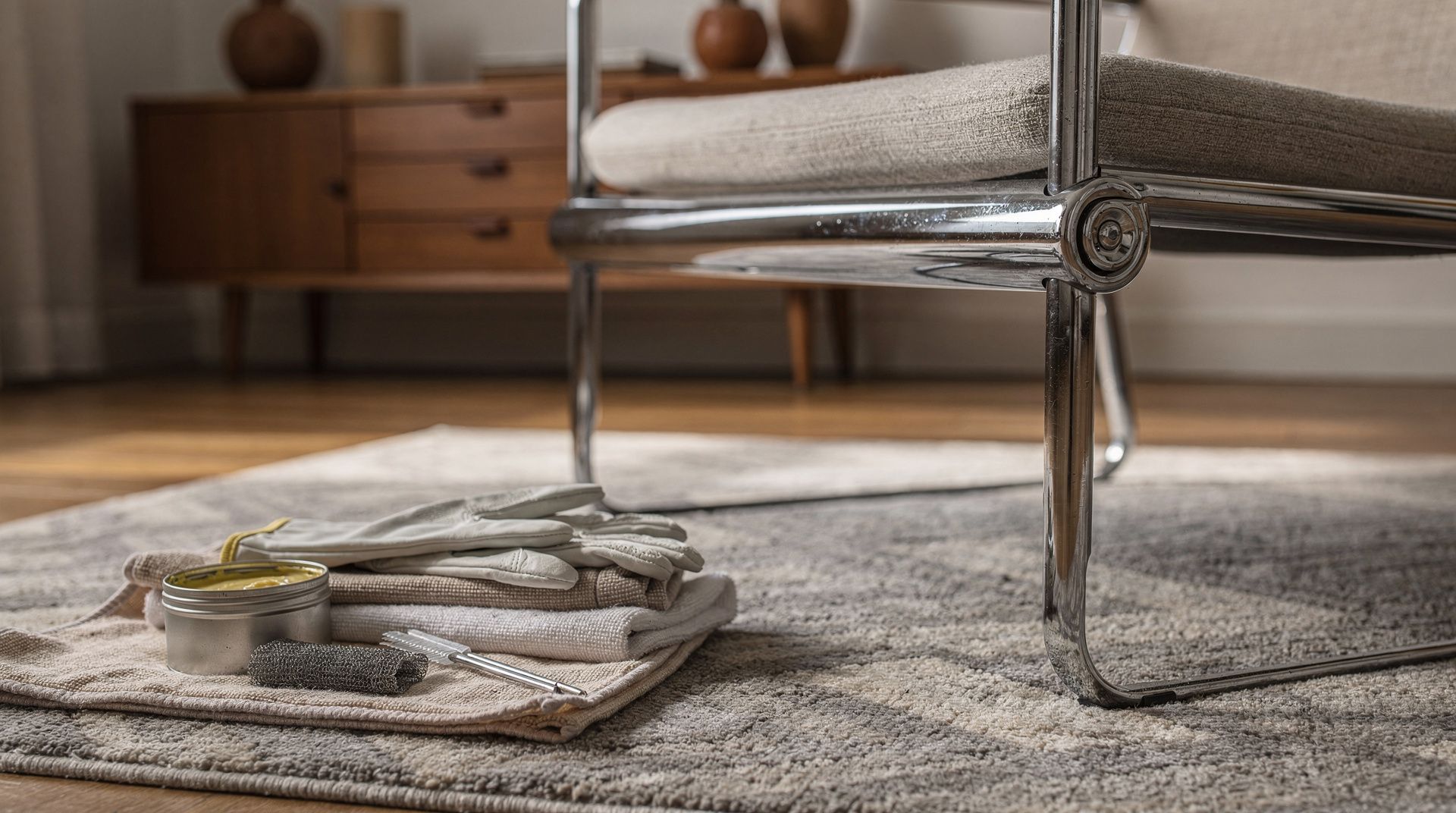
This results in a clear sequence for care. First, a mild cleaning with lukewarm water, pH-neutral washing-up liquid and a soft microfibre cloth to remove dust, skin oils and chloride residues. Then thorough drying, as standing moisture at welds, plugs and fastenings is the most common cause of later corrosion. Only when flash rust remains visible are mild agents applied selectively: aluminium foil with a little water removes surface rust very gently by mechanical action, as aluminium is softer than chrome. Special chrome polishes are applied sparingly, in the direction of the grain and only on high-gloss chromed surfaces. Satin or brushed surfaces, as found on some frames and fittings, must never be treated with abrasive pastes, as any polishing evens out the brushed texture and optically falsifies the surface. As long-term protection, a thin layer of microcrystalline wax has proven effective — as also used in the metal conservation of museum collections. It forms a breathable, reversible barrier that can be renewed every few years without attacking the substrate.
Scratches deserve a sober assessment. Fine hairline scratches in a high-gloss chrome surface can be reduced with a very mild polish; deeper scratches that already reach into the nickel or steel cannot be repaired without re-chroming the part. Re-chroming is a major intervention: it means stripping the chrome, grinding, complete re-plating and thus the loss of the original surface along with its patina. For collectible pieces, this is generally the last option, not the first.
Regional Schools and Designers
The use of chrome-plated steel tube is closely linked with the Bauhaus and its circle. Marcel Breuer’s model B3, the so-called Wassily Chair of 1925/26, and his cantilever chairs B32 and B64 used seamlessly drawn precision steel tube that became industrially available in the 1920s from Mannesmann. Mart Stam developed the first rear-leg-free cantilever chair in 1926; Ludwig Mies van der Rohe followed with the MR Chair and later, in 1929, with the Barcelona Chair, whose flat steel frame was executed in high-gloss polished chrome. The production of these designs by Thonet and later Knoll continues to define the image of high-quality Mid-Century metalwork.
In France, Jean Prouvé preferred to work with folded and lacquered sheet steel; chromed elements play a lesser role here. Eileen Gray, on the other hand, used chromed tube sculpturally in her table E 1027 of 1927. In the United States, Florence Knoll, Charles and Ray Eames, and Warren Platner translated the European steel tube concept into their own formal language: Platner’s Wire Series for Knoll from 1966 consists of hundreds of nickel-plated and chromed steel rods, where any thoughtless polishing can damage the delicate surface structure. In Italy, Gae Aulenti, Joe Colombo and Afra and Tobia Scarpa returned to chrome in the 1960s and 1970s, often in combination with glass and leather. Scandinavian designs by Poul Kjærholm, in particular the PK series, use matt brushed stainless steel rather than classic chrome plating, which requires an entirely different approach to care and must not be treated with chrome polish.
Authenticity and Condition for Collectors
Three things are decisive when assessing a chromed vintage piece: the originality of the plating, the condition of the welds and joints, and the correspondence between the surface character and the design. An original chrome layer from the 1950s or 1960s typically shows a slightly warmer tone, fine traces of use at contact zones and localised signs of ageing at tube ends and under plugs. Re-chroming, by contrast, often looks cooler, more uniform and too perfect — especially in raking light. The transitions at weld points are also worth examining: if a piece has been re-plated, these zones are often over-ground and lose their original definition.
Manufacturer and dating stamps are often found on Thonet, Knoll, Cassina and other pieces on the underside of seat frames, on clamps or stamped directly into the tube. If they are absent, it is worth examining the diameter and wall thickness of the tube, the shape of the plugs and the type of seat and back attachment. Rust blooms at classic problem areas such as clamps, floor glides and internal tube ends are not a disqualifying criterion, but an indication that conservational treatment is due. Large-scale pitting, flaking chrome or already rusted-through sections significantly affect value and usability and should be openly stated in condition descriptions. For collectors, the rule holds: an honest, stable original surface with traceable patina is preferable to a cosmetically perfect re-chroming in almost every case.
At mid-centurydesigns.com, we examine every chromed piece before adding it to our inventory for the originality of the plating, the condition of the load-bearing connections and the consistency of the surface with the respective design. Cleaning and conservation are carried out with restraint, documented and using reversible materials. Later interventions such as re-chroming are transparently disclosed in the object descriptions, so that you as a collector or designer can make an informed decision.
This article was generated automatically by an AI system. Disclosure pursuant to Article 50 of the EU AI Act.