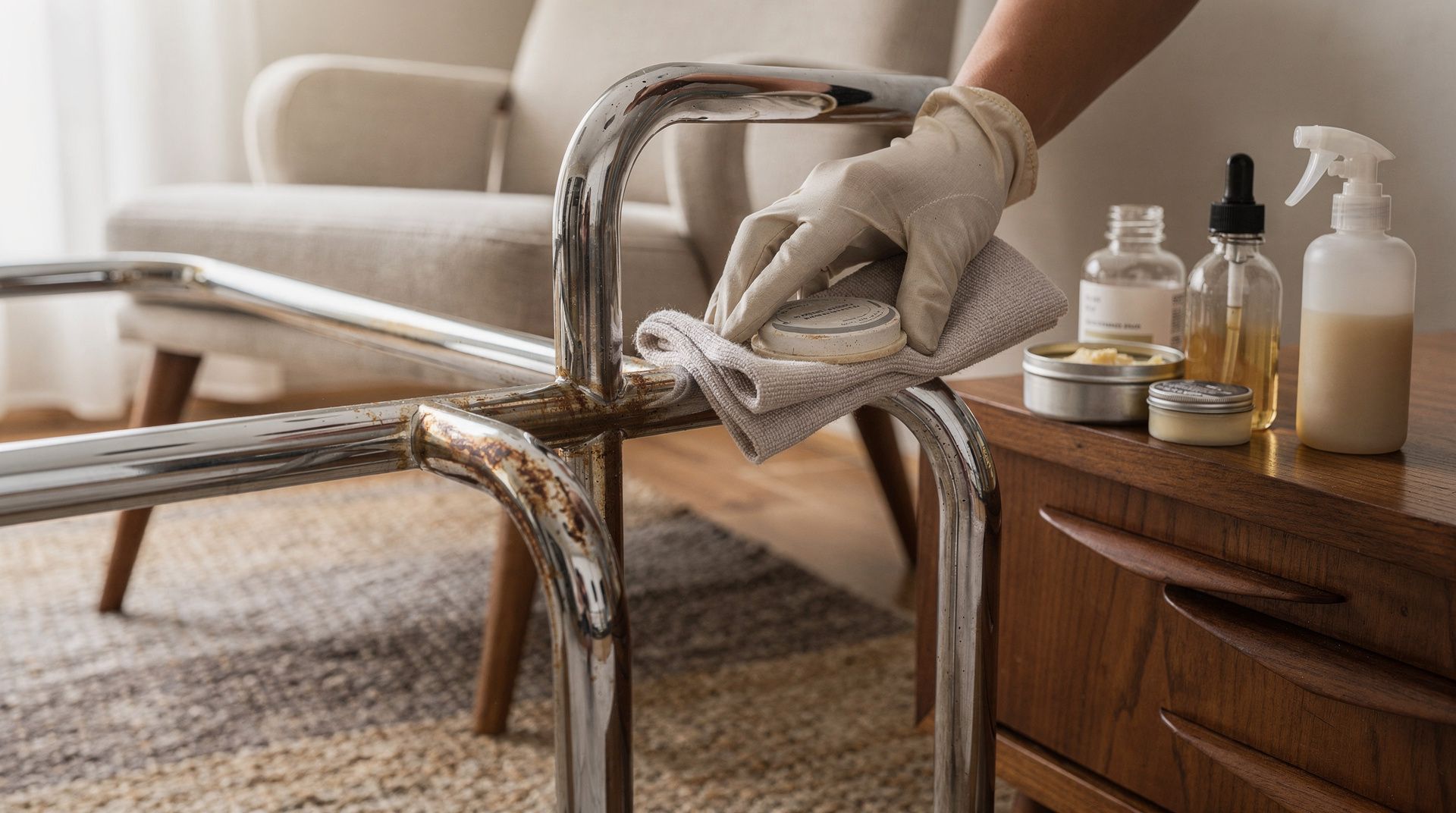
Polishing and preserving chrome: high-gloss surface finishing, removing rust spots and UV protection on chromed vintage furniture frames
Chrome is the quiet constant of classical modernism. Where Marcel Breuer experimented with bicycle-industry steel tubing in 1925, and where Knoll, Thonet and Cassina later carried the principle into industrial production, the electroplated chrome layer carries the visual idea: reflection instead of mass, precision instead of ornament. Yet this layer is thin — usually only a few micrometres — and it sits on a copper and nickel substrate that provides corrosion protection and depth of lustre. Anyone caring for chromed vintage frames is therefore not working on a solid metal surface but on a multi-layer system that responds unforgivingly to abrasive mistakes. A considered approach is therefore not a cosmetic detail but a matter of preserving substance. The following sections explain what materials you are actually dealing with, which workshops produced them and how you can read condition and authenticity before reaching for polish, rust remover or protective wax.
Characteristic materials: steel tube, nickel, chrome and their sensitivities
Classic Mid-Century chrome typically means bent precision steel tube that, after degreasing, was first copper-plated in an electroplating bath, then nickel-plated and finally chrome-plated. The chrome layer itself is often only around 0.3 to 0.5 micrometres thick; the nickel beneath carries the lustre. This is precisely why tarnished areas often look yellowish or milky: what becomes visible is not the chrome itself but the beginning of an attack on the nickel through micro-pores. For care, this implies three basic principles. First: clean initially only with lukewarm water, pH-neutral soap and a soft microfibre cloth to remove dust and grease films that would act like abrasive particles during any subsequent polishing. Second: for surface rust and localised corrosion spots, mild, low-acid chrome polishes based on the finest aluminium oxides have proven effective, applied with cotton wool in circular movements and with very light pressure. Steel wool — even grade 0000 — must not be used on intact surfaces, as it scratches the chrome layer and deposits iron particles that will later rust themselves. Third: polishing must be followed by preservation. Microcrystalline wax, as commonly used in museum conservation for metal surfaces, seals pores, is reversible and offers light protection against perspiration and humidity. For pieces that stand permanently in bright rooms, the UV aspect also needs consideration: chrome itself is UV-stable, but adjacent materials such as leather, canvas upholstery or lacquered wooden seats bleach out, and the resulting temperature gradients promote moisture condensation at the boundary line and thus edge corrosion. UV-reducing window films or a position away from direct sunlight therefore protect both frame and seating material equally.
Regional schools and designers: from Dessau via Paris to New York
Chrome aesthetics have several origins that can still be distinguished today by construction and tube diameter. At the Bauhaus in Dessau, Marcel Breuer — with model B3, later known as the Wassily, and the cantilever chair B32 — formulated the grammar of cold-bent steel tube. Mart Stam and Ludwig Mies van der Rohe simultaneously developed the collarless cantilever chair, whose springing derives solely from the elasticity of the tube. In France, Le Corbusier, Pierre Jeanneret and Charlotte Perriand worked for the 1928 collection with considerably heavier tube cross-sections and a visibly industrial jointing that was later continued by Cassina in the official edition. Eileen Gray formulated her own, softer line with the E1027 table and the Bibendum chair. In the United States, Florence Knoll, Warren Platner and Harry Bertoia translated the European vocabulary into American serial production, with Platner’s wire frames and Bertoia’s Diamond Chair conceiving chrome as a planar, almost textile structure. Italian positions of the 1960s and 1970s — by Gae Aulenti, Kazuhide Takahama or Willy Rizzo, for example — carried chrome forward in combination with glass, travertine and smoked mirrors. These origins are relevant to care: early German and French series often carry a deeper nickel substrate and can be polished more cautiously, while later mass-production series of the 1970s have thinner layers where aggressive polishing quickly breaks through to the nickel.
Authenticity and condition for collectors: reading patina, identifying interventions
An original chrome frame tells its story through details that are irretrievably lost through re-chroming. Look for original embossed stamps, labels and serial numbers at the tube ends or beneath seat surfaces — for example Thonet, Knoll or Cassina markings. Examine the seam line of the tube: early production pieces show finely visible draw marks at the bends and precisely ground transitions at the joints. A later re-chroming can be identified by an overly uniform, often slightly bluish sheen, by filled weld seams, by over-chromed screws and by a chrome layer that extends into inner radii and beneath brackets where it was never originally present. Small blisters — so-called chrome pustules — indicate under-rusting and are a serious sign, as the layer is being undermined from below. Mild, widespread cloudiness, on the other hand, is often preservable. For assessment, the rule is: an honestly aged original frame with light patina is almost always ranked higher by collectors than a re-chromed piece in showcase condition, provided the substance is stable. Document the condition photographically before any intervention, work in small test areas and refrain, when in doubt, from measures that cannot be undone.
The pieces offered on mid-centurydesigns.com are curated with exactly this perspective. Every chromed frame is checked for the originality of its plating, for embossings and labels, and for structural integrity; interventions from previous restorations are disclosed and the state of preservation is described transparently. When you add a piece to your collection, you receive not merely a piece of furniture but a reliable basis for its further care, conservation and value retention.
This article was generated automatically by an AI system. Disclosure pursuant to Article 50 of the EU AI Act.