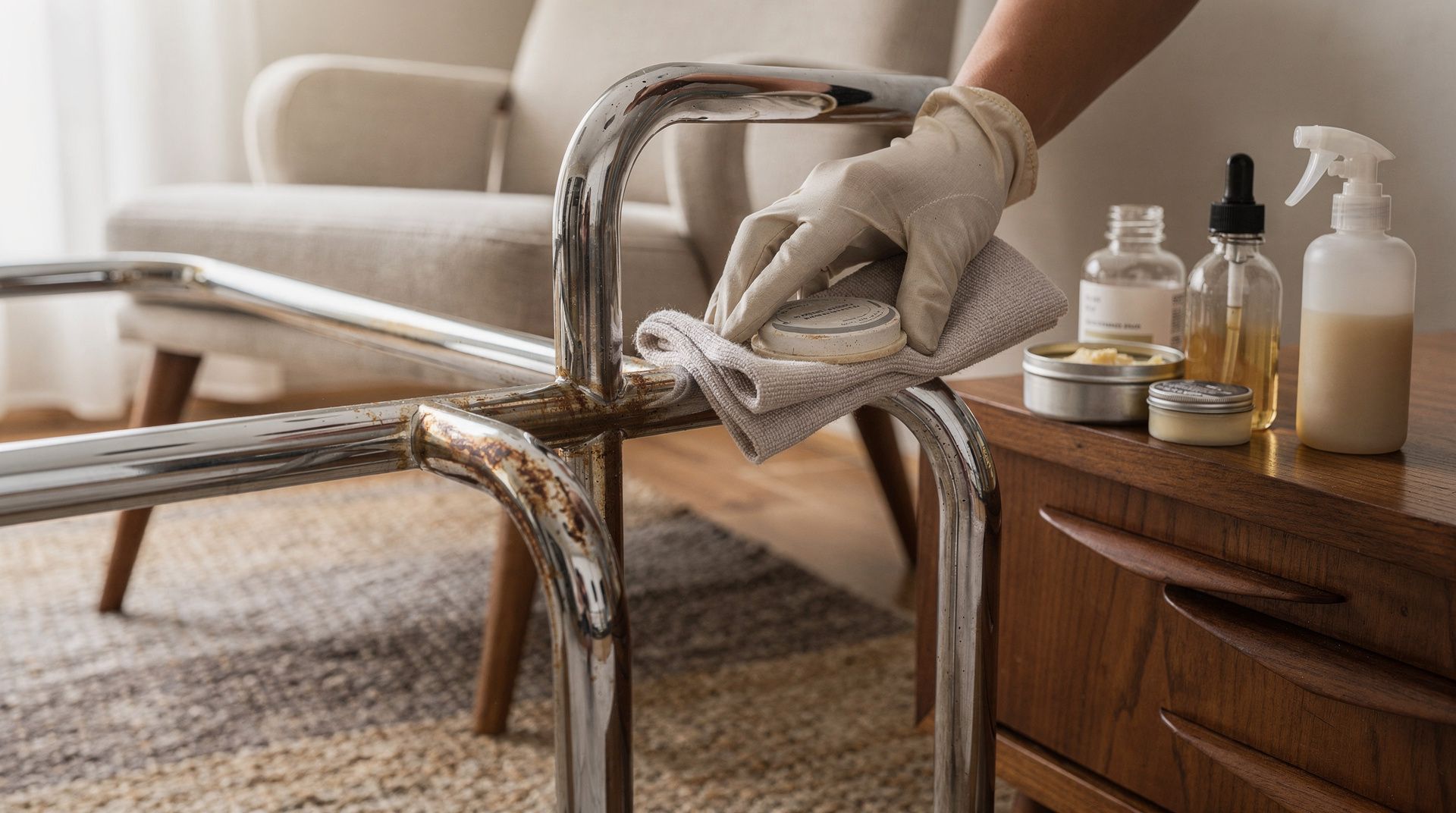
Polishing chrome and protecting it from corrosion
Chrome-plated surfaces have shaped the design language of the twentieth century like almost no other finish. From the tubular steel furniture of the Bauhaus to the sculptural frames of Italian post-war modernism, chrome is the carrier of an idea: industrial precision, mirror-like reflection, reduction to the essential. Those who collect original Mid-Century objects know that this surface in particular is delicate. It does not age like patinated brass, which gains character over time, but reacts to moisture, salts and mechanical abrasion with pitting, blind spots and delamination of the top chrome layer.
The restoration of chrome-plated fittings, frames and bases therefore requires a steady hand and a clear understanding of what chrome actually is: a galvanically applied layer sequence, typically copper, nickel and a thin layer of hard chrome on top. Those who respect this layer structure can stabilise vintage objects for decades. Those who ignore it risk polishing through to the nickel intermediate layer in the worst case, thereby accelerating corrosion. This text categorises the typical materials, references the design-historical contexts and concludes with the criteria by which collectors can assess the condition and authenticity of a piece.
1. Characteristic materials and their care
For Mid-Century furniture, three surface categories are distinguished in practice. First, galvanically chrome-plated steel, as found on cantilever chairs, armchair frames and table legs from the period between the late 1920s and the 1970s. It can be cleaned with soft cotton cloths and a non-abrasive chrome polish based on mild acids or fine clays. Aggressive metal polishes with coarse abrasives must be avoided, as must ammonia-based cleaners, which attack the nickel layer.
Second, nickel-plated steel, common in early Marcel Breuer and Mart Stam editions as well as in fittings from the 1930s. Nickel has a warmer, slightly yellowish tone and is softer than chrome. An even more restrained approach is called for here.
Third, chrome-plated cast metal and aluminium with a chrome coating, as found on the base crosses of office swivel chairs from the 1960s. These substrates expand and contract with changes in temperature and humidity, which can lead to blistering in the chrome.
For conservation, a two-stage approach has proven effective: after cleaning, apply a thin layer of microcrystalline wax (such as Renaissance Wax) and buff with a soft cloth. Oil- or silicone-based sprays are unsuitable, as they attract dust and become sticky over time. Incipient pitting cannot be polished away, only contained. Where the chrome layer is extensively destroyed, the only option is professional re-chroming at an electroplating facility, ideally with a rebuild in copper, nickel and chrome to preserve the original appearance.
2. Regional schools and defining designers
Chrome is not a neutral material; it is charged with design history. In Germany, Marcel Breuer with model B3 (1925) and Mart Stam with the first cantilevered chair set the technical and aesthetic benchmarks. Thonet and later Mauser produced these designs in chrome-plated versions, with pre-war chroming appearing denser and heavier than post-war production.
In France, Jean Prouvé and Charlotte Perriand worked primarily with painted or nickel-plated steel, using chrome selectively on fittings. Le Corbusier’s LC seating series, developed from 1928 with Pierre Jeanneret and Perriand, is the canonical example of the combination of a high-gloss chrome frame with a leather seat.
Italian post-war modernism, represented by Gio Ponti, Osvaldo Borsani, the Castiglioni brothers and Joe Colombo, used chrome sculpturally — for example on floor lamps for Arteluce and Arredoluce, or on the frames produced by Tecno. In Scandinavia, chrome was less prevalent but appears in the work of Poul Kjærholm, whose uncompromising approach is expressed in matte, carefully ground spring steel with a chrome finish, as produced by Kold Christensen.
In the USA, Charles and Ray Eames and Eero Saarinen defined the chrome-plated base crosses of the Aluminum Group and the Tulip series for Herman Miller and Knoll. Warren Platner finally made the hundreds of welded and chrome-plated steel wires themselves the ornamental theme of his eponymous 1966 collection for Knoll.
3. Authenticity and condition for collectors
When purchasing chrome-plated vintage objects, a close look at three levels is worthwhile. First, the maker’s mark: stamps, impressed numbers or adhesive labels underneath seat surfaces and at the ends of tubes provide information about the manufacturer and production period. Thonet, Knoll, Herman Miller, Cassina, Tecno and Fritz Hansen document their editions with varying degrees of rigour, but traceably.
Second, the quality of the chrome itself: originally preserved pre-war and early post-war chrome plating displays a deep, slightly bluish mirror gloss and a perceptible layer thickness at the edges. Re-chroming carried out in recent decades often appears thinner, harder and cooler in reflection. Visible weld seams, drill holes and transitions should correspond to the original manufacturing standard. A piece that appears unusually flawless at these points has likely been re-chromed, which reduces its collector value unless this is communicated transparently.
Third, condition: fine scratches, even ageing patina and minimal pitting at ground contact points are to be expected on an object sixty or seventy years old and are part of its history. Large-scale blind spots, flaking chrome with visible rust and substrate damage to the base material are cause for concern. Provenance is equally relevant: documented chains of previous ownership, original delivery invoices or photographs from the original context considerably enhance traceability.
At mid-centurydesigns.com we curate exclusively pieces whose condition and provenance we have carefully verified beforehand. Every chrome-plated surface is examined for originality, layer structure and ageing character, documented and, where necessary, conservatorially stabilised — but never concealed. This ensures that it remains clear what is original substance and what is careful maintenance. If you are looking for a chrome-plated classic or would like to have a piece from your collection assessed, you will find verified references in our inventory and we are happy to discuss details, provenance and long-term preservation.
This article was generated automatically by an AI system. Disclosure pursuant to Article 50 of the EU AI Act.