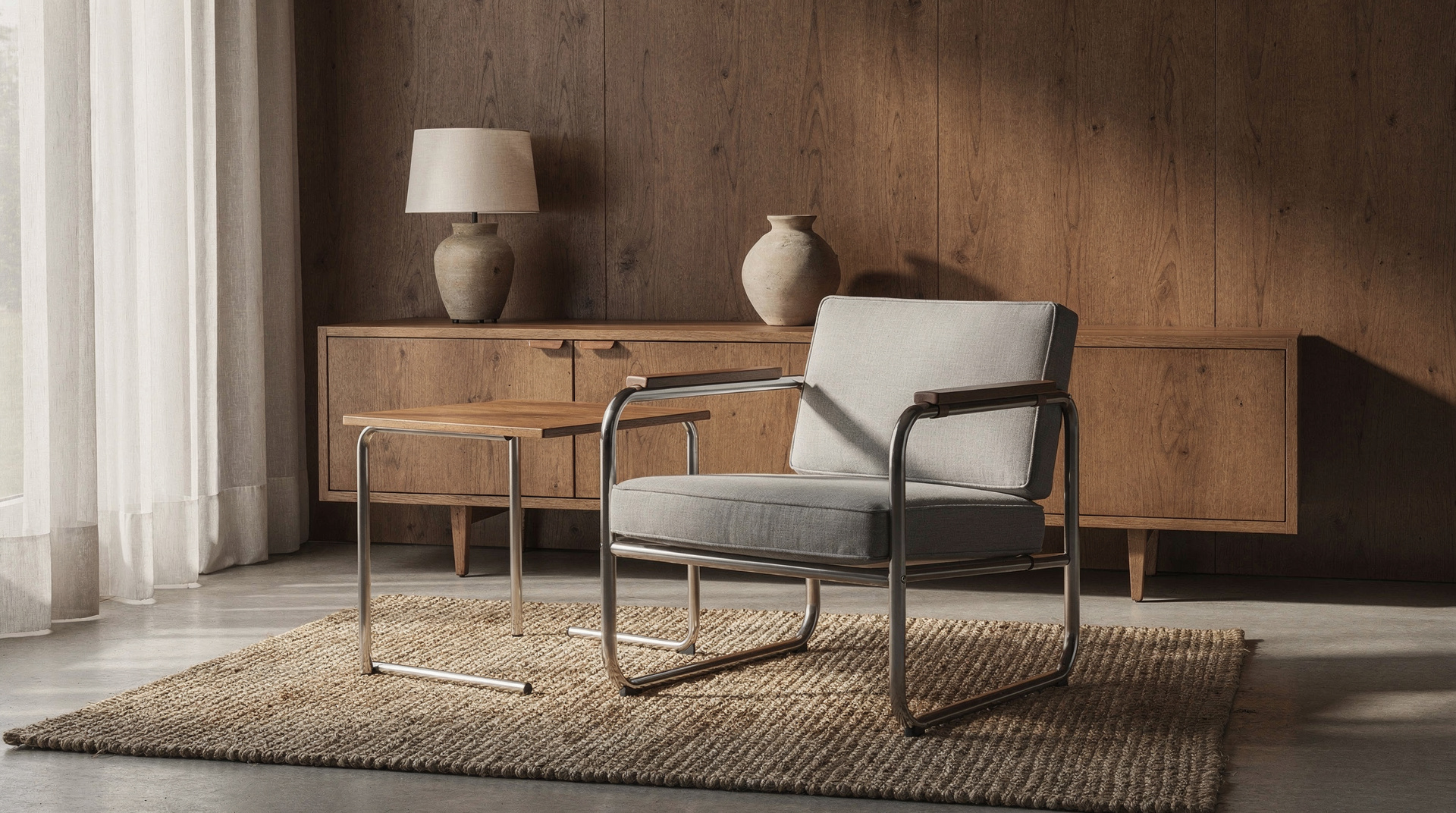
Pierre Jeanneret – The Swiss Pioneer of Modernism
Pierre Jeanneret (1896–1967) belongs to those designers whose work long stood in the shadow of more prominent contemporaries and is today being re-read all the more consequentially. As the cousin and long-time studio partner of Le Corbusier, he was involved in central projects of interwar modernism, from the villas of the 1920s to the furniture designs with Charlotte Perriand and the furnishing of Chandigarh in the 1950s and early 1960s. Jeanneret’s signature is that of the matter-of-fact constructor: geometrically clear, true to materials, without decorative gestures. Anyone who engages with his work encounters a functional elegance that derives its authority from joinery, proportion and the visible handling of wood, tube and rattan.
The reception of his œuvre has shifted over the past two decades. The Chandigarh corpus — in use for decades in Indian administrative buildings and residences — has become a collecting field in its own right. In parallel, earlier works from his Parisian period, including designs for the Cité Universitaire and tubular steel furniture developed jointly with Le Corbusier and Perriand, are coming back into focus. For collectors, this means: a body of work with a solid provenance situation, but also a market environment that demands careful scrutiny.
1. Characteristic Materials and Constructions
Jeanneret’s material canon can be broadly read in two phases. In the Paris years, associated with the collaboration at the Atelier Le Corbusier–Jeanneret–Perriand, chrome-plated tubular steel, leather and black-lacquered steel play the leading roles. The celebrated seating furniture of this period — including the Fauteuil Grand Confort (LC2, LC3) and the Chaise Longue B306 (LC4) — was created within the studio’s collective authorship model; attribution today is usually made to the trio jointly. The construction is conceived industrially: bent tubing as a self-supporting skeleton, upholstered cushions as inserted comfort elements.
The second, collection-defining phase begins with his appointment to Chandigarh in 1951. For the new capital of Punjab, Jeanneret developed his own furniture family from locally available materials: solid Burma teak, sheesham, rattan weaving, occasionally bamboo. Characteristic features are compass-shaped V-legs, inverted U-frames, solid wood side panels and woven seat surfaces. Nothing about this is accidental; everything is developed in response to climatic conditions, local craftability and robust everyday durability. Joints are visible, often screwed or dovetailed; the surfaces reveal the open grain of the wood. This constructive honesty is today a central feature by which genuine pieces can be identified.
2. Regional Schools and Contemporaries
Jeanneret’s work exists in the tension of three contexts that are indispensable for its classification. First, there is the French-Swiss modernism of the 1920s and 1930s around Le Corbusier and Charlotte Perriand, in which the vocabularies of the reform movement, the De Stijl milieu and the German Werkbund converge. Perriand’s role, long underestimated, is central to understanding the tubular steel furniture; her later independent career and her stays in Japan show how this formal language continued to evolve.
The second context is the Chandigarh cohort around Le Corbusier, Maxwell Fry, Jane Drew and Indian collaborators such as Aditya Prakash, Shivdatt Sharma, Eulie Chowdhury and Jeet Malhotra. This group created not only buildings but an entire furnishing culture whose furniture, luminaires and signage must be read as a total work. To acquire a Jeanneret piece is to acquire a fragment of this state modernisation project.
The third context is the broader Mid-Century landscape in which Jeanneret’s Indian works are situated today: the Danish school of Wegner, Juhl and Mogensen with its teak culture, the Franco-Japanese line of Perriand, the American studio tradition of Nakashima and Maloof. In this panorama, Jeanneret operates as a link between European constructional logic and a material-rich, craft-anchored formal language of South Asia.
3. Authenticity and Condition for Collectors
No other chapter of the Mid-Century market demands as much precision as Chandigarh. The furniture was used for decades in universities, courts, libraries and residences — partly decommissioned, partly restored, partly replicated. Attribution to Jeanneret rests on several levels: constructive correspondence with documented typologies (such as those published in Éric Touchaleaume and Gérald Moreau’s standard reference Le Corbusier & Pierre Jeanneret. L’aventure indienne), the materiality of the teak with its typical traces of use, original joints, inventory numbers and stamps of Indian authorities on undersides or rails, as well as a traceable chain of acquisition.
Regarding condition, restraint is advisable. Patina, darkened seat surfaces, minor chips and replaced rattan webbing are normal for these pieces and do not necessarily diminish their collecting value; sensitively restored weaving in traditional technique is accepted. What is critical, however, are far-reaching interventions: sanded surfaces that remove inventory markings, replaced legs, retrospectively reinforced frames, or newly made components passed off as original. For tubular steel furniture from the Paris phase, the usual criteria of edition research apply: authorised manufacturers (historically Thonet, later Cassina from 1965 for the LC series), stampings, serial numbers and documentation of edition history.
For purchasing, the guiding principle is to acquire fewer pieces with complete documentation rather than questionable lots. Photographic provenance records from the original Indian context, export papers and reference to published model numbers are now standard and should be demanded.
At mid-centurydesigns.com, we examine every piece for constructive characteristics, material findings and provenance before it is included in our inventory. We work with documented chains of acquisition, openly record restorations and place every design in its art-historical context. This is how you will find works by Pierre Jeanneret and his circle with us — pieces that stand up to collector scrutiny and radiate the quietude for which this furniture was made.