CATEGORY · ORIGINAL SUBSTANCE COLLECTOR'S VALUE RESTORATION PATINA

Original substance or collector's value: When restoration harms vintage furniture

Why patina stays, and what over-restoration costs

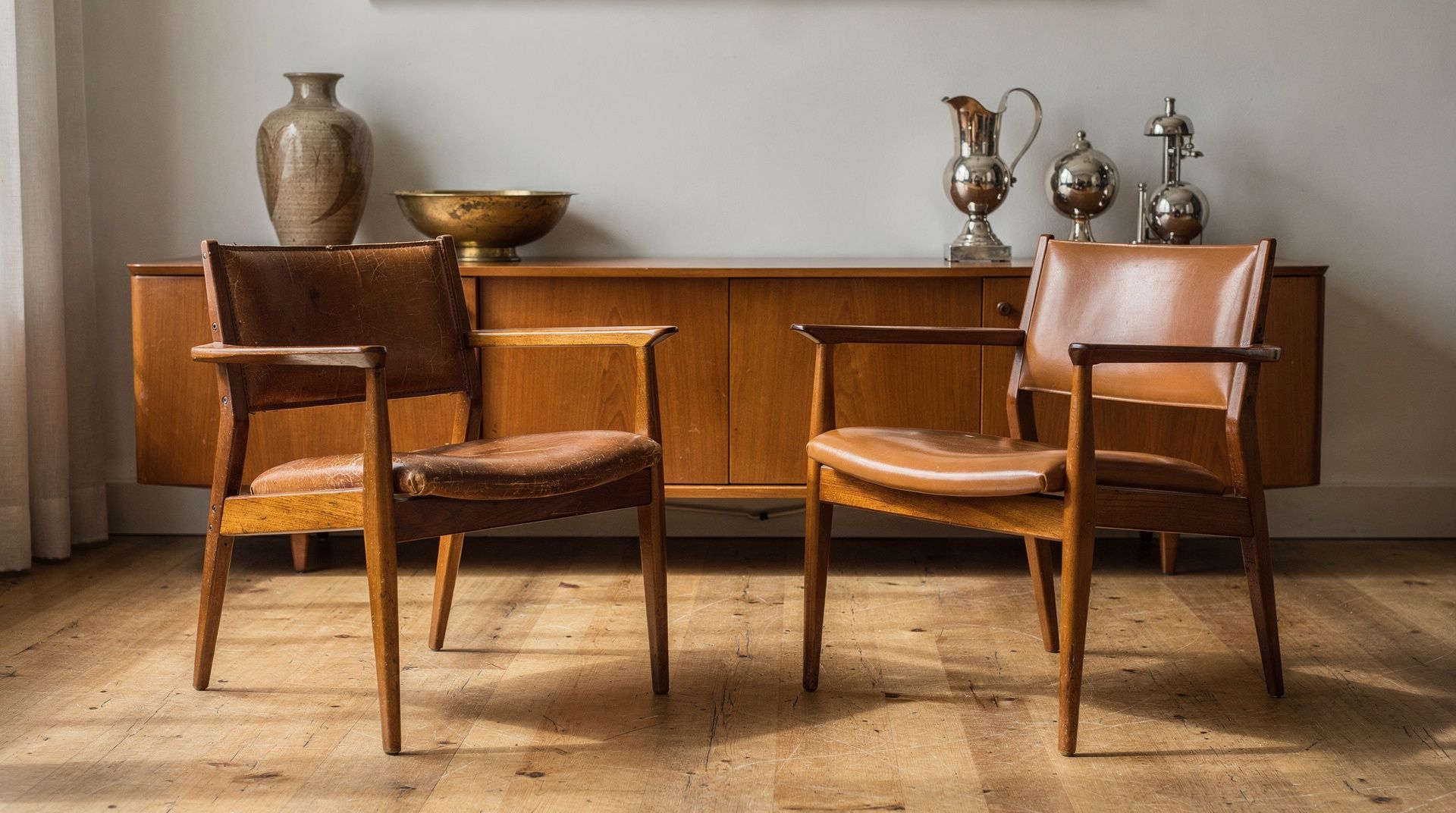
Patina, signs of use and original surfaces are not flaws in mid-century pieces — they are part of the provenance and frequently value-defining. Anyone who strips, repaints or completely reupholsters exchanges historical substance for cosmetic freshness and risks a measurable loss in collector's value. Conservative alternatives such as cleaning, wax or oil refreshing, reversible repairs and the preservation of original upholstery secure authenticity and marketability. We show you when restraint is the smarter investment and where a specialist workshop may sensibly intervene.

mid-century·designs

original substance collector's value restoration patina

ESSAY · 01

Work & Context

mid-century·designs

Original substance vs. collector’s value: When restoration does harm

There is a moment in the life of every vintage piece of furniture when a decision is made: preserve or renew. For collectors of Mid-Century Modern, this decision is not a matter of taste but an economic and cultural-historical one. The monetary value of an armchair by Finn Juhl, a cabinet by George Nakashima or a lamp by Serge Mouille is not measured by its proximity to new condition but by the degree of original substance retained. Auction houses such as Wright, Phillips and Sotheby’s have documented for years that over-restored pieces achieve lower hammer prices than comparable objects with intact patina — sometimes by 30 to 50 percent. Anyone who sands down an original rosewood surface removes not only oxidised cell layers but also the geometric precision of hand-plane marks and the depth of colour that only develops through decades of UV exposure. Freshly applied lacquer can be dated, smells different, ages differently. For the secondary market, this represents a break in provenance.

The approach that has prevailed among experienced dealers is therefore conservatorial, not cosmetic. Clean rather than sand. Wax rather than lacquer. Upholster using reversible techniques and historically correct materials rather than modern foam. The aim is not a youthful appearance but the stable continuation of an evolved condition. Those who collect buy time, not new goods.

Characteristic materials and their ageing behaviour

The classic materials of the mid-century era each respond in specific ways to time and intervention. Rio rosewood (Dalbergia nigra), CITES-listed since 1992 and therefore highly sensitively documented on the market, develops a warm reddish-brown tone with dark grain when exposed to light. Sanding destroys this zone irreversibly — beneath it lies lighter, unpatinated substance. Teak, defining for the Danish school, was traditionally not lacquered but oiled. A subsequent clear lacquer acts here as a time marker and value reducer. Walnut, the defining material of the American Studio Craft movement, displays butterfly joints and free-edge surfaces in the work of Nakashima or Phillip Lloyd Powell, whose tool marks form part of the signature.

The same applies to metals: the dark-brown patina on the brass feet of Paul McCobb or on the bronze frames of Poul Kjærholm is intentional. Polishing creates a new-condition look that is immediately recognised in auction photographs. Enamelled surfaces by Jean Prouvé or Charlotte Perriand frequently show chips down to the bare metal; these are conserved, not painted over. With natural leather — for example on Wegner chairs or Kjærholm loungers — crazing and colour shifts are part of the object. Saddle soap and colourless leather balm will care for it; reupholstering can, in some cases, halve the auction value.

Regional schools and the role of workshop culture

The question of restoration cannot be answered without knowledge of the originating workshops. The Danish school around Hans J. Wegner, Finn Juhl, Arne Jacobsen and Kaare Klint worked with manufacturers such as Johannes Hansen, Niels Vodder, Fritz Hansen and Rud. Rasmussen. Each of these workshops left characteristic joinery techniques, brand stamps and screws that a restorer must know in order not to overwrite them. A Wegner chair with replaced paper cord weaving is acceptable if Danish paper cord is re-woven in the original pattern and with correct tension; a chair with synthetic substitute material loses its collector status.

The American West Coast Modern, represented by Charles and Ray Eames, George Nelson for Herman Miller and Edward Wormley for Dunbar, is more industrially organised. Here, early production dates matter — for example on the zinc labels of the Eames Lounge Chair 670 or on the Herman Miller foil labels of the 1950s. The Italian line around Gio Ponti, Ico Parisi, Osvaldo Borsani (Tecno) and later Joe Colombo requires knowledge of the lacquer formulations of the 1950s and 60s, particularly in the case of Ponti’s polychrome works. The French post-war modern movement with Prouvé, Perriand, Jeanneret and Royère, on the other hand, is defined by the raw, visible construction principle: weld seams, rivet heads and exposed sheet-metal edges are form-giving elements — any smoothing is an intervention in authorship.

Authenticity and condition from a collector’s perspective

For condition assessment, an internationally established scale has emerged ranging from “untouched” through “sensitively conserved” to “restored” and “refinished”. Only the first two categories achieve top prices. “Untouched” means: cleaned, waxed, mechanically stabilised — nothing else. “Sensitively conserved” permits reversible interventions, documented in a conservation report. Once a piece has been sanded, re-lacquered or completely reupholstered, it is described as “restored”; “refinished” marks the strongest level of depreciation.

Collectors examine three levels. First, the substance: does the wood species match the documented workshop practice of the year of manufacture? Are the joints original, or have tenons been replaced? Second, the surface: UV light, raking light and simple solvent tests reveal later lacquer applications within seconds. Third, provenance: labels, brand stamps, goods-receipt numbers, exhibition histories, photographic evidence from earlier collections. A fully documented object in moderate condition often outperforms an immaculate-looking piece without a history at market. Conservative alternatives to restoration are well established today: climate stabilisation against cracking, microcrystalline wax on metal, retouching with watercolour and shellac rather than a full coating, and textile pads to protect seating surfaces. Reversibility is the guiding principle.

At mid-centurydesigns.com we assess every piece according to precisely these criteria: material identification, workshop attribution, condition description according to the international scale and, where possible, provenance chain. We prefer objects with original surfaces and communicate every conservatorial intervention transparently in the data sheet. Those who buy from us do not acquire a polished-up piece of furniture but a dated testimony to Mid-Century Modernism that retains its collector’s value because its history remains legible.


This article was generated automatically by an AI system. Disclosure pursuant to Article 50 of the EU AI Act.

FAQ · 02

Frequently asked about original substance collector's value restoration patina

5 Answers

01
Why does a complete restoration reduce the collector's value of a mid-century piece of furniture?
Original substance is the central criterion for collector's value. A complete restoration removes patina, original surfaces and signs of use that document authenticity and provenance. Buyers and auction houses rate significantly restored pieces considerably lower than originals, even when the restoration is of high craftsmanship quality. The material history of the object — comparable to the age and signature of works of art — is lost and cannot be reconstructed.
02
What is meant by patina and why is it relevant to market value?
Patina is the natural layer of ageing consisting of dust, fine scratches, discolouration and chemical changes that form over decades on wood, metal and textiles. It is not a defect but evidence of authenticity and history of use. High-end collectors and museums prefer patina because it makes the temporal continuity of the object legible. A gleamingly restored chair looks to the connoisseur like a forgery. Particularly with rare design classics, loss of patina can account for 30–50% of the estimated value.
03
What is the difference between conservation and restoration?
Conservation stabilises an object with minimal intervention: soiling is removed mechanically, loose joints are consolidated without working the surfaces. Materials remain unchanged. Restoration, by contrast, actively reshapes the object: detached veneers are re-glued, lacquers are sanded and reapplied, missing parts are reconstructed. For collectors, the conservation strategy is recommended — it preserves substance and value. Restoration is only sensible for functional everyday furniture without significant collector's value.
04
How should damage be dealt with without diminishing value?
Proper conservation relies on reversibility and visibility: cracks in wood are not filled but stabilised; loose veneers are secured with archival adhesives, not modern resins; scratches and discolouration remain visible. Moisture is regulated, UV radiation is minimised, pest infestation is controlled. All measures must be documented and, ideally, be reversible. This is known as reversible conservation and is the standard practised by museums and experienced collectors. It preserves market value while keeping the object durable.
05
Which over-restorations are most common and most damaging?
The most critical cases: complete sanding and re-staining of wood surfaces, which destroys original wood tones and patina; full reupholstering with modern materials instead of conserving repairs; metal surfaces polished to a high gloss instead of retaining patina; missing parts reproduced in a period style rather than documented as absent. Particularly problematic is over-staining with dark wax, which suggests false depth and makes age verification impossible. Connoisseurs immediately notice when a 1960s teak chair looks 'too dark'. Over-restoration cannot be undone at a later stage and significantly reduces both authenticity and residual value.

GLOSSARY · 03

Related Terms

10 Entries

Original substance
The unaltered original condition of a design object, including all original materials, surfaces and construction marks. For collectors and experts, the preservation of original substance is decisive for authenticity and collector's value, as every intervention diminishes that value.
Patina
The natural layer of ageing on surfaces (scratches, discolouration, wear marks) that develops over decades. In mid-century furniture, patina is proof of authenticity and increases collector's value by documenting the history of the object. Its loss through sanding or polishing is usually irreversible.
Over-restoration
Restoration measures that go beyond what is necessary and in doing so destroy original substance, material character or marks of craftsmanship. Over-restored pieces lose considerable collector's value, as authenticity and historical integrity are compromised.
Conservation
Preventive or stabilising measures that protect an object from further deterioration without altering or restoring it. Conservation preserves original substance and patina and is the value-retaining alternative to restoration.
Reversibility
The criterion that restoration measures can in principle be undone without damaging the original. Reversible procedures such as surface cleaning are value-neutral for collector's items, while irreversible interventions such as re-lacquering reduce collector's value.
Craft signature
Individually visible traces of handwork: scratches from sandpaper, brushstrokes, nail heads or sanding-machine grooves. These are marks of authenticity and quality of the original. Their removal through over-polishing destroys these historical documents.
Collector's value
The economic and historical value of a design object, determined by provenance, original condition, rarity and design significance. Collector's value decreases with every non-reversible change to the original substance or patina.
Provenance
The documented history of origin and ownership of an object. For mid-century furniture, verifiable provenance substantially increases collector's value and can establish authenticity, particularly in the case of renowned designers or manufacturers.
Surface finish
The original surface treatment of a piece of furniture (lacquer, oil, wax, polish). The original finish is an integral part of the design intention and contributes to authenticity. Re-lacquering or re-polishing destroys the historical surface layer irreversibly.
Conservatorial cleaning
Gentle, reversible cleaning procedures that remove soiling without altering the material. They are the only value-preserving restoration alternative and safeguard patina and original condition while stabilising the object functionally and aesthetically.