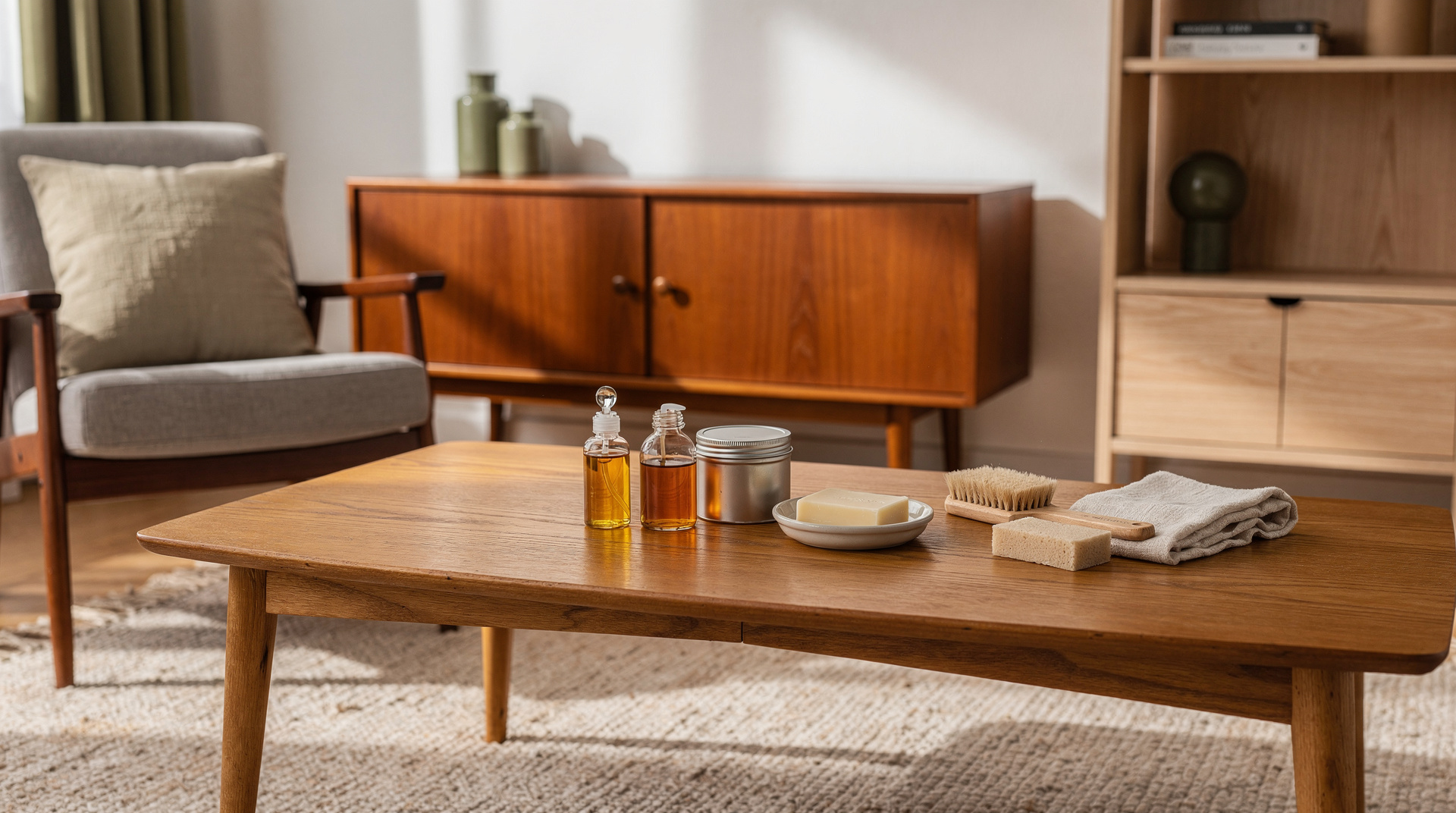
Oils, Waxes and Soaps for Wooden Furniture: Care as Part of Provenance
A mid-century piece of furniture is never just an object – it is always a surface with a history. Rosewood from the fifties, oiled teak surfaces from Danish workshops, soap-treated ash tables from Scandinavia: each of these surfaces follows its own logic, and each reacts differently to what we subject it to. Anyone who acquires a piece by Hans J. Wegner, Finn Juhl or Arne Vodder takes on not only a piece of furniture, but also responsibility for a surface that has often endured sixty years or more.
The most common damage to original mid-century pieces today is caused not by use, but by well-intentioned, poorly chosen care. A silicone spray on a soaped ash, a hard wax on an originally oiled teak, a furniture polish oil on a nitrocellulose lacquer surface: such interventions are only reversible with considerable effort and can permanently diminish patina, colour depth and, in the worst case, collector value. This page sets out which care belongs with which surface, which products have proven themselves in practice, and which mistakes are best avoided.
Characteristic Materials and Their Care
Teak is the defining wood of Danish modernism. Its high natural oil content makes it resilient, but this oil balance needs to be maintained. For originally oiled surfaces, a pure teak oil or a lightly pigmented furniture oil based on linseed or tung oil is suitable. Apply sparingly, rub in with a lint-free cotton cloth, and remove the excess completely after ten to fifteen minutes. One to two applications per year is sufficient. Important: oil-soaked rags are self-igniting and must be spread out to dry or disposed of in water.
Rosewood (both Rio and East Indian rosewood) calls for greater restraint. Its dense, oily structure absorbs little additional oil. A high-quality furniture wax based on beeswax and carnauba, applied thinly and polished, offers better protection here than any oil treatment. Re-oiling with linseed oil is not advisable for rosewood – it darkens the surface unevenly and can leave sticky residues.
Oak and ash, as frequently used by Børge Mogensen or the Swedish workshops, are often soaped or lyed and soaped. These surfaces should be treated exclusively with white furniture soap (wood soap), dissolved in lukewarm water, applied with a well-wrung cloth in the direction of the grain. Oil or wax will destroy the characteristically light, matt tone here and cause the surface to become blotchy and yellowed.
Walnut, common in American production (Nakashima, Wegner licences at Knoll, Nelson at Herman Miller), is usually finished with nitrocellulose lacquer, shellac or a thin oil finish. Lacquered surfaces need no oil – only a soft, dry cloth and occasionally a neutral furniture wax. Before any treatment, you should identify the finish: a cotton swab with a little ethanol on an inconspicuous spot will reveal whether it is shellac (which dissolves) or a harder lacquer (which remains stable).
Regional Schools and Their Workshop Practice
The Danish cabinetmakers of the Snedkerlaug exhibitions (1927 to 1966) worked predominantly with oil finishes, because these showed the grain deeply and vividly. Workshops such as Johannes Hansen (Wegner), Niels Vodder (Finn Juhl) and A.J. Iversen defined the standard we today associate with Danish surface culture: matt, warm, open-pored. For these pieces, oil is the historically correct care product.
The Swedish tradition, shaped by Carl Malmsten and later Josef Frank at Svenskt Tenn, cultivated the soap treatment in parallel, particularly for lighter woods. The Danish workshop Fritz Hansen also used soap finishes, including on Arne Jacobsen’s Series 7 in ash veneer. Anyone who oils such a piece fundamentally alters it.
American mid-century production – Herman Miller, Knoll, Dunbar under Edward Wormley – was more industrial in nature. Sprayed lacquer finishes predominate here, and they tolerate neither oil nor soap. A clean microfibre cloth and occasionally a neutral cleaning wax is all that is needed. Italian post-war modernism (Ico Parisi, Gio Ponti, Osvaldo Borsani) used shellac or polyester lacquers depending on the workshop; the same rule applies here: identify the finish first, then care for it.
Authenticity, Condition and Collector Value
For collectors, the surface is one of the most important value carriers. An original, merely re-oiled teak top of a Wegner table consistently achieves higher prices than the same piece after a complete re-coating. The reason lies in the patina: the fine, irreproducible interplay of light ageing, minimal traces of use and the historical finish structure. Aggressive restoration work – especially sanding down original edges and stamps – removes workshop marks, branded stamps and veneer thicknesses that are crucial for attribution.
Before any treatment, check: is the finish original? Are the screws, fittings and joints unchanged? Are there workshop stamps on the underside? A sensible guiding principle is: as little as possible, as much as necessary. Clean first dry, then damp with distilled water – only then decide on oil, wax or soap. As a rule, avoid silicones, coloured furniture polishes that conceal scratches but discolour veneers, and home remedies such as olive oil, which turns rancid and leaves a sticky film over time.
Two common mistakes deserve a mention: over-oiling (the surface becomes dull, dark and blotchy because excess oil oxidises on the surface) and mixing systems (wax on fresh oil does not bond, soap on wax beads off). Anyone who is unsure should work first on a concealed area and document every care application.
At mid-centurydesigns.com we curate original mid-century furniture with close attention to precisely these details. Every piece is assessed for provenance, finish and condition, documented, and – where necessary – restored by experienced restorers in the tradition of the original workshop, meaning oiled, soaped or waxed as the respective original dictates. With each object you receive a condition report and, on request, a care recommendation tailored to the surface of your piece.