MATERIAL · OILING TEAK

Oiling teak: A guide to the proper care and restoration of teak furniture

How to preserve the warm patina of your mid-century pieces

Teak is the signature wood of Scandinavian modernism: dense, oil-rich and dimensionally stable over decades. Whether it's a sideboard by Arne Vodder, a dining table by Hans J. Wegner or an armchair by Finn Juhl, maintaining its silky surface requires not aggressive refinishing, but calm, regular care with the right oil. In this guide, you'll learn how to clean, refresh and oil teak without losing the grown patina that defines the value of an original mid-century piece.

mid-century·designs

oiling teak

ESSAY · 01

Work & Context

mid-century·designs

Oiling teak: A guide to the proper care and restoration of teak furniture

Teak is the signature material of Scandinavian modernism of the 1950s and 1960s. Its high density, natural oil content and warm, honey-coloured to reddish-brown tone attracted generations of designers, from Copenhagen to California. Anyone who owns an original teak piece today is custodian of a fragment of design history. That is precisely why its care deserves a calm, methodical approach rather than quick cosmetic fixes.

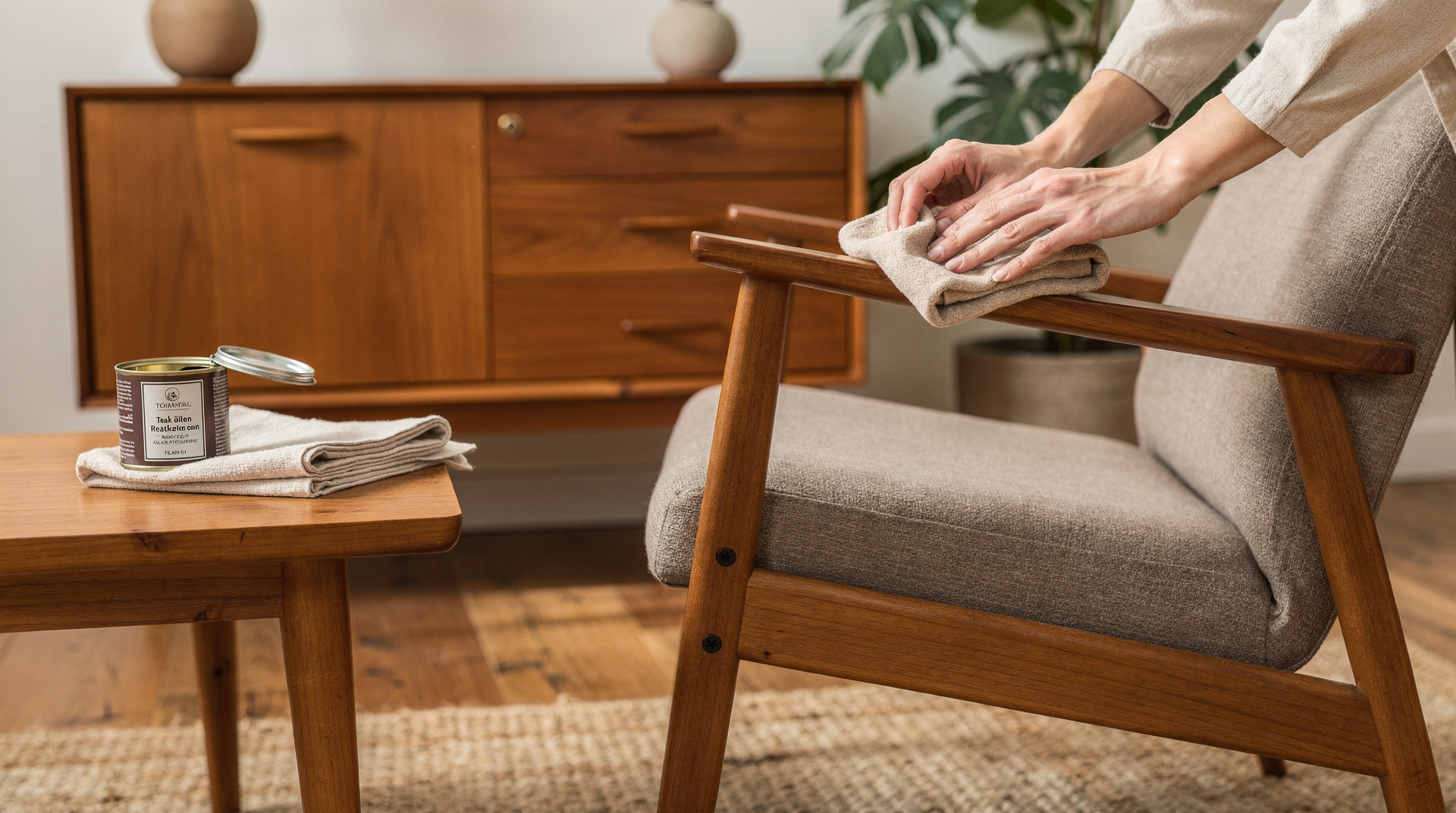
Proper care begins with a diagnosis: is the surface oiled or soap-treated? Does the wood simply look tired and dry, or are there water stains, sun bleaching or old wax layers present? Classic Danish teak was typically finished with pure teak oil or a thin linseed oil. Refreshing it then means: dust it off, wipe it down with a soft, lightly dampened cloth, allow it to dry completely, then work a small amount of teak oil into the surface with a lint-free cotton cloth in the direction of the grain, leave it to absorb for ten to fifteen minutes, and thoroughly remove any excess. Oil-soaked cloths should afterwards be spread out in the open air or placed in a sealed metal container, as they can ignite through self-heating. Less is almost always more with teak: two thin coats applied 24 hours apart provide more depth than one thick, sticky layer.

Characteristic materials

Teak (Tectona grandis) was available in the post-war period primarily from Burma and Thailand, and stood for dimensional stability, moisture resistance and a fine, even grain pattern. In combination with other materials, it gave rise to the visual language of the era: solid teak for legs and rails, teak veneer on blockboard for large-format carcasses, contrasting inlays of wenge or rosewood, handles of brass or turned solid teak. Seating furniture combined teak frames with paper cord, natural leather, wool from predecessors of Kvadrat, or hand-knotted seat surfaces. For maintenance purposes, the distinction between solid wood and veneer is crucial: veneer is oiled more sparingly to avoid edge delamination and swelling. On combined surfaces featuring cane, leather or textile upholstery, the oil must be applied precisely and any spillover removed immediately.

Regional schools and defining designers

The Danish school shaped the image of teak most lastingly. Finn Juhl developed sculptural seating whose construction made the material quality of teak visible. Hans J. Wegner used teak for classics such as the GE 290 for Getama, Arne Vodder designed expressive sideboards with coloured lacquered drawers for Sibast, and Kai Kristiansen created with Model 42 one of the best-selling teak chairs in Denmark. Peter Hvidt and Orla Mølgaard-Nielsen brought structural clarity with the AX series for Fritz Hansen. Working in parallel were Fredrik Kayser and Torbjørn Afdal in Norway, and Nils Jonsson and Yngve Ekström in Sweden. Outside Scandinavia, the German workshops of Wilhelm Renz and Bytom models, as well as Brazilian designers such as Jorge Zalszupin, set their own accents, frequently using jacaranda with similar treatment. Each workshop left a specific finish that should be respected when restoring.

Authenticity and condition for collectors

For collectors, what matters alongside design and maker is above all substance. Preserved brand stamps, metal plaques (such as Dansk Møbelkontrol, FDB, France & Søn) and model numbers are key evidence of provenance and must not be damaged during any maintenance work. Before oiling, a sober assessment is advisable: original joints, unaltered veneers, original fittings, historic upholstery. Aggressive sanding reduces the patina, removes workshop traces and can significantly diminish the value of a piece. A well-aged teak item with an even patina and intact construction generally stands above an excessively restored object. Anyone uncertain should first consolidate conservatorially and only make irreversible decisions after consulting an expert.

At mid-centurydesigns.com we curate original mid-century furniture with documented provenance. Every teak piece is assessed for construction, veneer condition, original fittings and historic surface treatment before being included in the selection. Restorations are carried out with restraint, in the direction of the grain, using appropriate oils and with the preservation of the grown patina. This is how you find pieces whose substance and history have been carried forward, rather than smoothed away by excessive restoration.

FAQ · 02

Frequently asked about oiling teak

5 Answers

01
How often should I oil my teak furniture?
For regularly used indoor furniture, an oil treatment every 6 to 12 months is sufficient. If your pieces are used outdoors, a cycle of 3 to 4 months is recommended, as UV radiation and weathering dry out the wood more quickly. Without care, teak develops a silver-grey patina that is characteristic but becomes rough over time. Regular oiling stabilises the natural wood structure and prevents cracking.
02
Which oil is the right choice for mid-century teak design?
For authentic care, ideally use pure teak oil or high-quality hard oils based on natural oils specifically developed for teak. These penetrate deep into the wood and nourish it from within, without leaving a plastic-like coating as lacquers do. Modern combinations of teak oil and linseed oil offer good protection. Avoid thick sealants, as these impair the authentic feel of classic furniture and make future refinishing more difficult.
03
Do I need to sand or clean teak furniture before oiling?
Yes, thorough preparation is essential. First, remove surface dirt and dust with warm water and a soft brush. For pronounced soiling, light sanding with fine sandpaper (180 to 220 grit) in the direction of the grain will help. Specialist teak cleaners can dissolve haze. Important: the wood must be completely dry before you oil, otherwise the oil cannot penetrate. Never work against the grain to avoid damage.
04
How do I tell whether my teak furniture needs refreshing?
Teak shows a need for care when the surface looks dull, dry or rough. A simple test: dampen an inconspicuous spot with water. If the wood absorbs the water, the protection is used up. Visible small cracks or heavily greyed areas are also signs of insufficient oil. High-quality mid-century pieces retained their supple feel and subtle sheen through regular refreshing. A neglected surface can, however, be regenerated relatively easily.
05
Can I oil teak furniture myself, or should I hire a professional?
For standard oiling you can do it yourself. The process is straightforward: apply oil thinly in the direction of the grain, leave it to penetrate briefly, then remove excess oil with a lint-free cloth. For large-format original pieces with complex surfaces, decorative details or valuable signatures, professional expertise is worthwhile to rule out damage. Furniture worthy of archival restoration should be entrusted to an experienced furniture conservator in order to preserve provenance and substance.

GLOSSARY · 03

Related Terms

8 Entries

Teak wood
A hard, oil-rich tropical hardwood from the deciduous tree Tectona grandis, originally from Southeast Asia. Resistant to moisture and weathering, making it ideal for furniture design and outdoor furniture. Mid-century designers prized teak for its stability and natural patina.
Patina
Natural surface change in wood caused by UV radiation and weathering over time. In teak wood, a silver-grey, characteristic discolouration develops. Patina is an authentic feature of aged furniture and not a sign of damage.
Wood oil
A penetrating care product that nourishes and protects wood fibres. For teak wood, specialist oils are used to preserve the natural oil structure and protect the surface from drying out, without forming a film as lacquers or resins do.
Surface treatment
All processes for cleaning and caring for wood surfaces. For mid-century furniture, this includes removing soiling, treating with oils and waxes, and where necessary restoring damaged areas in order to preserve the original expressive quality.
Weathering
The natural wear process of wood caused by moisture, temperature fluctuations and light exposure. In teak furniture, weathering leads to greying of the surface and possible cracking if no maintenance is carried out.
Bleaching
Loss of wood pigments through UV radiation and weather exposure. Teak wood characteristically turns silver-grey through bleaching. This process can be slowed by regular oiling, but is natural and reversible in authentic furniture.
Drying cracks
Surface or deeper cracks in wood caused by excessively rapid or uneven loss of moisture. Particularly common in vintage furniture. Their spread can be slowed by regular oiling.
Provenance
The origin and ownership history of a piece of furniture. For mid-century design furniture made from teak, provenance is decisive for authenticity and value, in particular the attribution to renowned designers and manufacturers such as Danish or Scandinavian furniture makers.