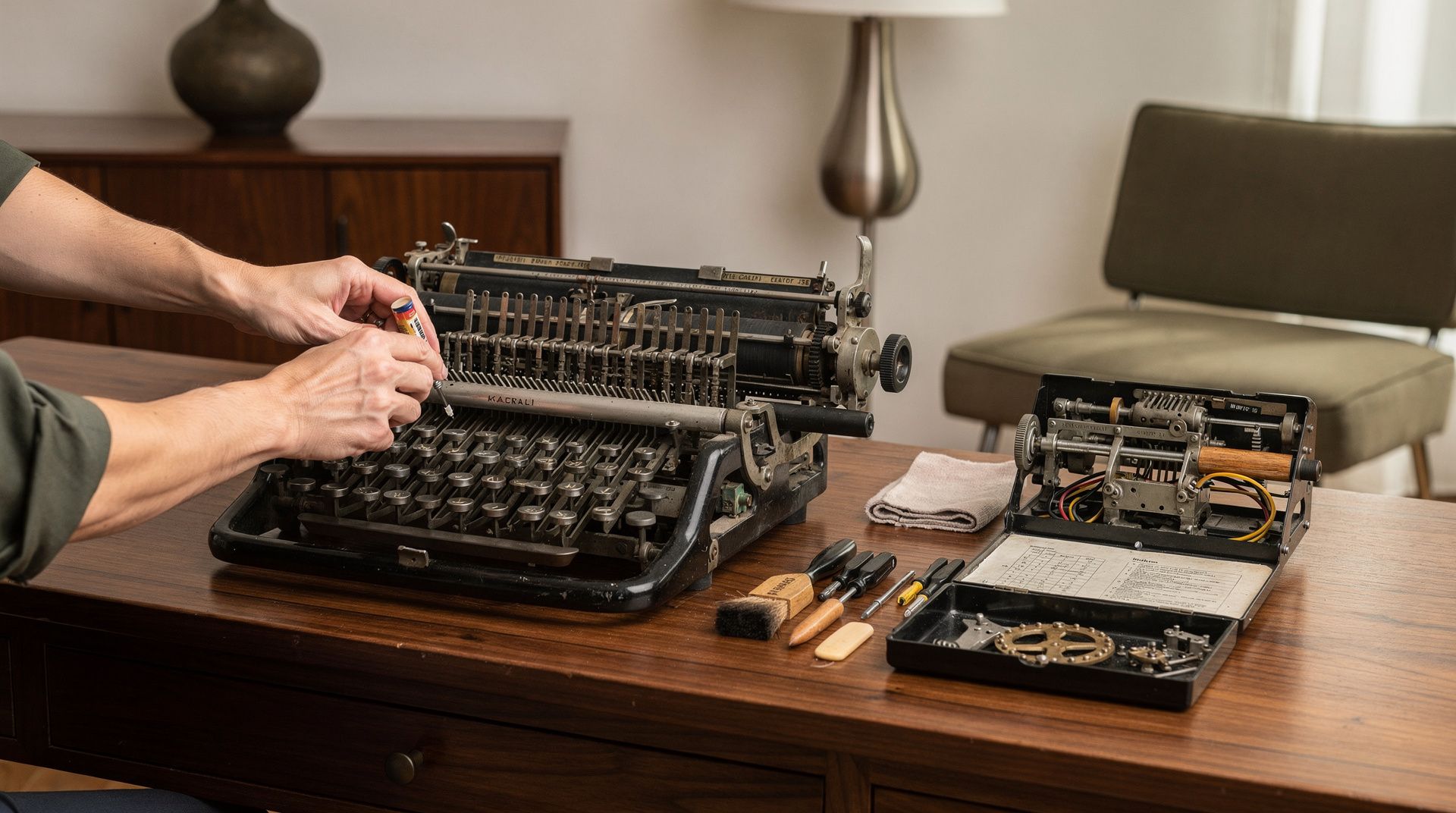
Oiling and lubricating a typewriter: Professional maintenance of typebars, shift mechanisms and platens
A mechanical typewriter is a precision instrument composed of several thousand individual parts, whose interplay was calibrated over decades. Anyone who places an Olivetti Lettera 22, an Olympia SM3 or a Hermes 3000 on the table holds fine mechanics in their hands — machinery that was the shared responsibility of engineers and designers alike. The care of these devices follows a clear rule that has long been established in the restoration community: as little oil as possible, as much cleaning as necessary. Viscous, resinified old oils are the most common cause of jamming typebars, sluggish carriage returns and uneven keystroke. Fresh oil applied in the wrong place accelerates exactly this process.
Anyone who regards a vintage typewriter as an object that carries both functional and design history at once will maintain it with restraint. The goal is not to return a machine to factory condition, but to keep its mechanics operational without compromising the patina, the labelling or the original surfaces. The following sections organise maintenance around the three central assemblies: the typebar segment, the shift mechanism and the platens including the carriage.
1. Characteristic materials and where they matter in maintenance
Typebars are generally made of hardened steel; the type heads carry soldered type blocks made of a harder alloy. The segment in which the bars are guided is a fine-mechanical precision part with tight tolerances. This is precisely where no oil belongs. The bars operate in dry guidance; any oil film will bind dust, paper fibres and ribbon pigment, and within a short time will turn into an abrasive compound. The correct approach is cleaning with a residue-free solvent such as white spirit or isopropanol, applied with fine brushes, followed by complete evaporation.
The shift mechanism — that is, the upper/lower case shift, the escapement and the ribbon transport — operates with axles, cams and springs. Targeted lubrication is appropriate here, but only with thin, resin-free oils of the kind familiar from watchmaking or sewing-machine servicing. Penetrating oils with additives, aerosol spray oils with propellant gas or universal oils in aerosol form have no place on a typewriter, as they can attack lacquered surfaces, Bakelite and early plastic parts. Platens made of lacquered sheet steel, chrome applications and the frequently used clear plastic covers on scales and paper guides are sensitive to solvents; work here with covers in place and use cotton swabs rather than cloths.
2. Regional schools, design logic and what this means for maintenance
European and American manufacturers pursued different design philosophies that have a direct bearing on maintenance. The Italian school around Olivetti in Ivrea, shaped by designers such as Marcello Nizzoli (Lexikon 80, Lettera 22) and later Ettore Sottsass with Perry King (Valentine, 1969), favoured light, open constructions with visible mechanics. These machines are accessible, but sensitive to incorrect lubrication because many springs and levers are exposed.
The German school, represented by Olympia in Wilhelmshaven and Triumph-Adler, worked with more robust, enclosed assemblies. An Olympia SM series tolerates neglect better, but requires more disassembly steps during a basic service in order to reach the shift mechanism. Swiss manufacture at Paillard (Hermes) and Japy placed great emphasis on particularly tight tolerances and quiet running; here, incorrect lubrication immediately manifests as a blurred keystroke. American manufacturers such as Royal, Smith Corona and IBM (up to the Selectric of 1961, designed by Eliot Noyes) built heavier and more generously, which makes repair easier. Anyone servicing a machine should be familiar with its constructional origins, because access routes, lubrication points and the sequence of work steps all derive from this.
3. Authenticity and condition from a collector’s perspective
For collectors, the condition of the mechanics determines value just as much as visual preservation. A machine that runs but shows clearly visible oil traces on the segment has already been treated improperly at some point and will develop consequential problems in the medium term. Points worth checking include: the even keystroke of all typebars, the clean engagement of the shift in both positions, a resistance-free carriage travel across the full line width, the defined triggering of the margin stop, and a ribbon transport that switches in both directions in sync with the keystroke.
Authenticity reveals itself in details: original key legends without reprinting, intact typebars without re-soldered heads, original lacquer without overpainting, matching serial numbers between the frame and base plate, and the period-correct case with intact lining and original locks. For iconic pieces such as the Valentine, the complete equipment including the red plastic housing and ribbon spools in their original colour is value-determining. Maintenance history should be documented; a professionally cleaned machine with a traceable service record is preferable to an unclear restoration.
The typewriters and related Mid-Century Modern objects offered on mid-centurydesigns.com are mechanically inspected before being added to the inventory, carefully cleaned and left in their original condition wherever this is justifiable. Provenance, serial numbers and the degree of preservation are transparently documented, so that you as a collector or designer have a reliable basis for your decision.
This article was generated automatically by an AI system. Disclosure pursuant to Article 50 of the EU AI Act.