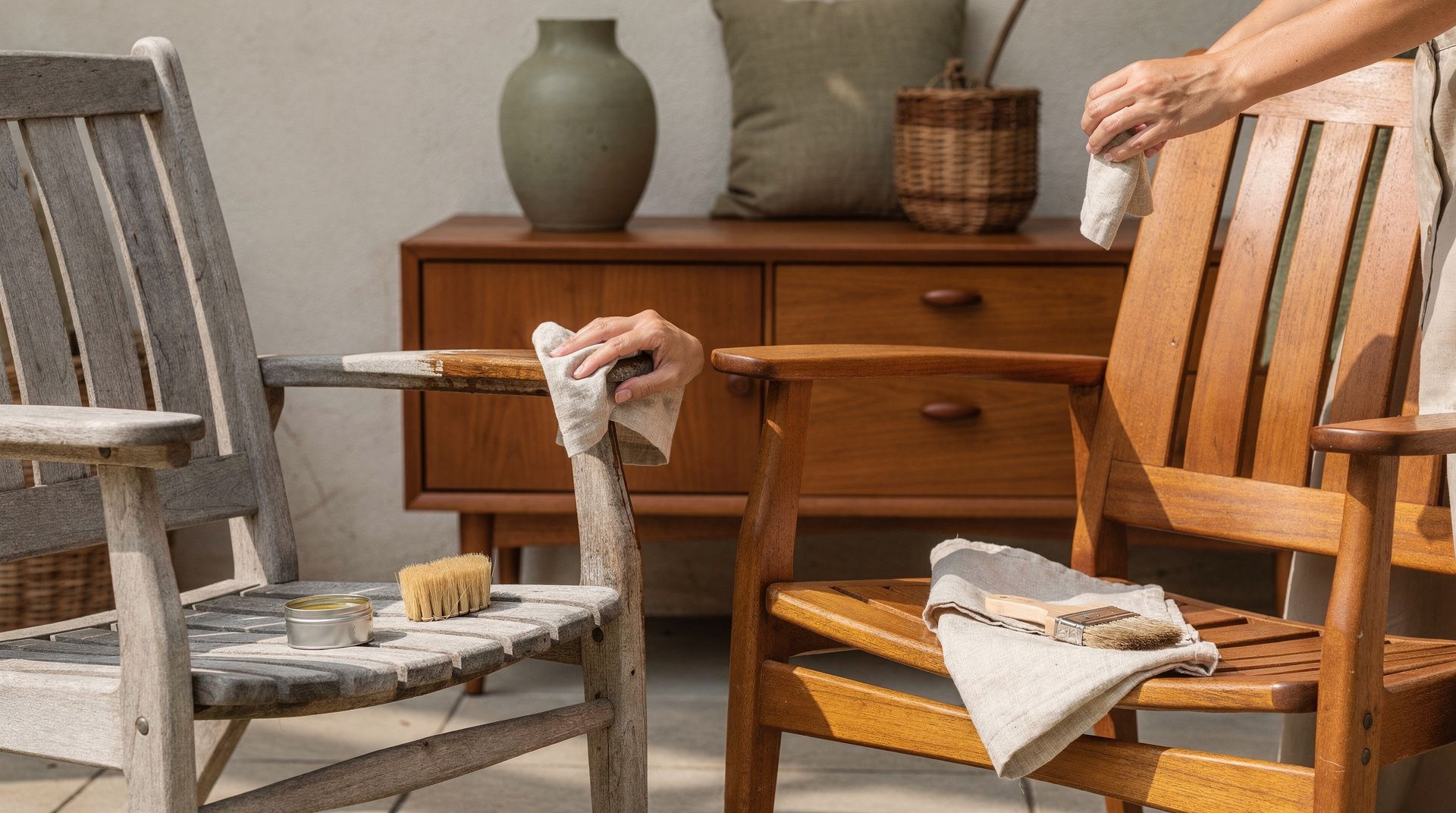
Oiling and caring for teak: oil treatment, preventing greying and refreshing
Teak is the defining material of Scandinavian and Anglo-Asian modernism, and it is also the material on which collectors most frequently burn their fingers. The wood of the species Tectona grandis naturally contains rubber and essential oils that make it durable, dimensionally stable and resistant to fungi and insects. This very self-impregnation is the reason why many historical workshops never lacquered teak, but merely sanded, soaped or applied it with a sparing coat of oil. Anyone caring for a piece by Finn Juhl, Grete Jalk or from the workshop of France & Søn today should therefore think less about restoration in the sense of refreshing and more about conserving an established condition.
The two most common mistakes are too much oil and the wrong oil. An overly generous application clogs the surface, attracts dust and darkens the wood unevenly. Aggressive cleaners or sandpaper below grit 240, on the other hand, remove the fine patina that has developed over decades and contributes to the material value of a vintage piece. Moreover, there is a world of difference between a garden bench exposed to wind and UV outdoors and a sideboard indoors: outside, the concern is weather protection and the question of whether greying is accepted or prevented; indoors, it is about subtle refreshing of dry spots and preserving the original surface treatment.
1. Characteristic materials and choosing the right oil
Not every teak responds the same way. Old Burma teak, as imported to Denmark in the 1950s and 1960s, is denser, oilier and darker in the heartwood zone than today’s plantation teak from Indonesia or West Africa. This density explains why many original pieces of furniture by Hans Wegner, Arne Vodder or Peter Hvidt survived for decades without any retreatment. For interiors, classic teak oil based on linseed oil or tung oil with a high solids content works well — applied sparingly with a lint-free cotton cloth, removed after twenty minutes and left to air out completely. Oil-soaked rags are self-combustible and should be laid out flat to dry or placed in a sealed metal container.
For Danish furniture that was originally treated with soap — such as many pieces in untreated oak or teak finish in the tradition of Wegner — mild furniture soap is the historically correct choice, not oil. For teak garden furniture, such as that designed by Kaare Klint for Rud. Rasmussen or later by Børge Mogensen, the rule is: those who want to preserve the warm tone oil once or twice per season with a UV-stabilised outdoor teak oil. Those who appreciate the silver-grey patina that develops through lignin breakdown at the surface forgo oil entirely and simply clean with a soft brush and water. Both are legitimate, both are reversible, provided no coarse sandpaper or pressure washer has been used.
2. Regional schools and designers that guide care practice
The Danish school centred around the Copenhagen furniture fair Snedkernes Efterårsudstilling shaped the approach to teak in a lasting way. Finn Juhl, associated with Niels Vodder from 1937, worked with sculptural teak surfaces whose transitions — edges and chamfers — depend on oil treatment to prevent drying out. Hans J. Wegner used soap treatment as standard at Johannes Hansen and PP Møbler, though for teak versions this was frequently varied in favour of a matte oil finish. Kaare Klint and his school at the Royal Danish Academy established teak for outdoor use, visible in the Deck Chair and related designs for Rud. Rasmussens Snedkerier.
In parallel, a somewhat more sober approach to teak developed in Sweden with Yngve Ekström and in Norway with Fredrik Kayser, often in combination with native beech or rosewood. In Great Britain, G Plan, Archie Shine and Robert Heritage adopted the Danish teak aesthetic from the late 1950s onwards, mostly using thin veneers on substrate panels. This construction is tricky to care for: veneers under one millimetre thick tolerate neither heavy sanding nor standing water. In the United States, Jens Risom and, in certain respects, the Finn Juhl models for Baker translated the Danish school into solid wood with thicker veneers, meaning pieces from there can generally be worked on more generously.
3. Authenticity and condition for collectors
For assessing a vintage teak piece, the condition of the surface is a central criterion. An original, evenly aged oil surface with a light wear patina stands considerably higher in value than a freshly re-sanded and sealed surface with modern clear lacquer. This can be checked at the edges and in the routed details: over decades, a fine, darker oil film accumulates there, which is almost always lost during a full restoration. If this film is absent and the edges look sharp and pale, the piece has been machine-processed.
Equally revealing is the reverse side: original brand stamps, paper labels from Cado, France & Søn, Vodder, Møbelfabrik or the FDB signet must still be legible after any restoration work. If they are coated over by new oil or have been removed during sanding, the piece loses a significant part of its provenance. For garden furniture, checking the joints is more important than the colour: brass screws, mortise-and-tenon legs and intact bottom edges matter more than a flawless surface. A greyed, structurally sound piece is in almost all cases preferable to a re-oiled but loose one.
At mid-centurydesigns.com we curate teak furniture for indoor and outdoor use with particular attention to original surfaces, documented provenance and structural integrity. Every piece is examined for veneer thickness, originality of fittings, workshop markings and the condition of the oil treatment before being included in the catalogue. Where refreshing is necessary, we work with reversible, historically appropriate methods and document every intervention. This way you can decide whether to take on a piece in its naturally aged state or in a carefully refreshed version.
This article was generated automatically by an AI system. Disclosure pursuant to Article 50 of the EU AI Act.