MATERIAL · MURANO GLASS VENETIAN GLASS ARTISTS

Recognizing Murano Glass: Authentication, Characteristics and Value of Venetian Glass Art

A collector's guide between artistic signature, provenance and market value

Venetian glass of the post-war modernist era combines centuries-old lagoon craftsmanship with the formal impulses of Mid-Century design. Anyone wishing to reliably attribute works from manufacturers such as Venini, Barovier & Toso, Seguso or Vistosi pays close attention to manufacturing traces, signatures, labels and documented provenance. This overview contextualizes typical techniques, color palettes and value factors, and helps you distinguish originals from later reproductions.

mid-century·designs

Murano glass Venetian glass artists

ESSAY · 01

Work & Context

mid-century·designs

Understanding Murano Glass: An Approach to Venetian Craftsmanship

Murano glass is not a stylistic movement but a workshop tradition that has grown over seven hundred years. Since 1291, the Republic of Venice concentrated glass production on the island of Murano in order to control fire hazards and technical knowledge. From this isolation emerged a canon of techniques that, in the 20th century, was translated into the language of modernism by designers such as Carlo Scarpa, Paolo Venini, Fulvio Bianconi, Napoleone Martinuzzi, Ercole Barovier and Flavio Poli. Those who collect vintage glass today navigate between the history of craft and design authorship. Reading both levels is the true skill of a collector.

The following sections outline the most important materials, the style-defining manufacturers of the post-war modern era, and the criteria by which the authenticity and condition of an object can be reliably determined. The goal is not to evaluate individual pieces, but to provide a framework with which you can critically examine attributions.

1. Characteristic Materials and Techniques

The basis of most Murano objects is soda-lime glass, which — depending on the recipe — remains soft and workable for a long time. On this foundation, specific techniques have developed over centuries that can be read from the finished object:

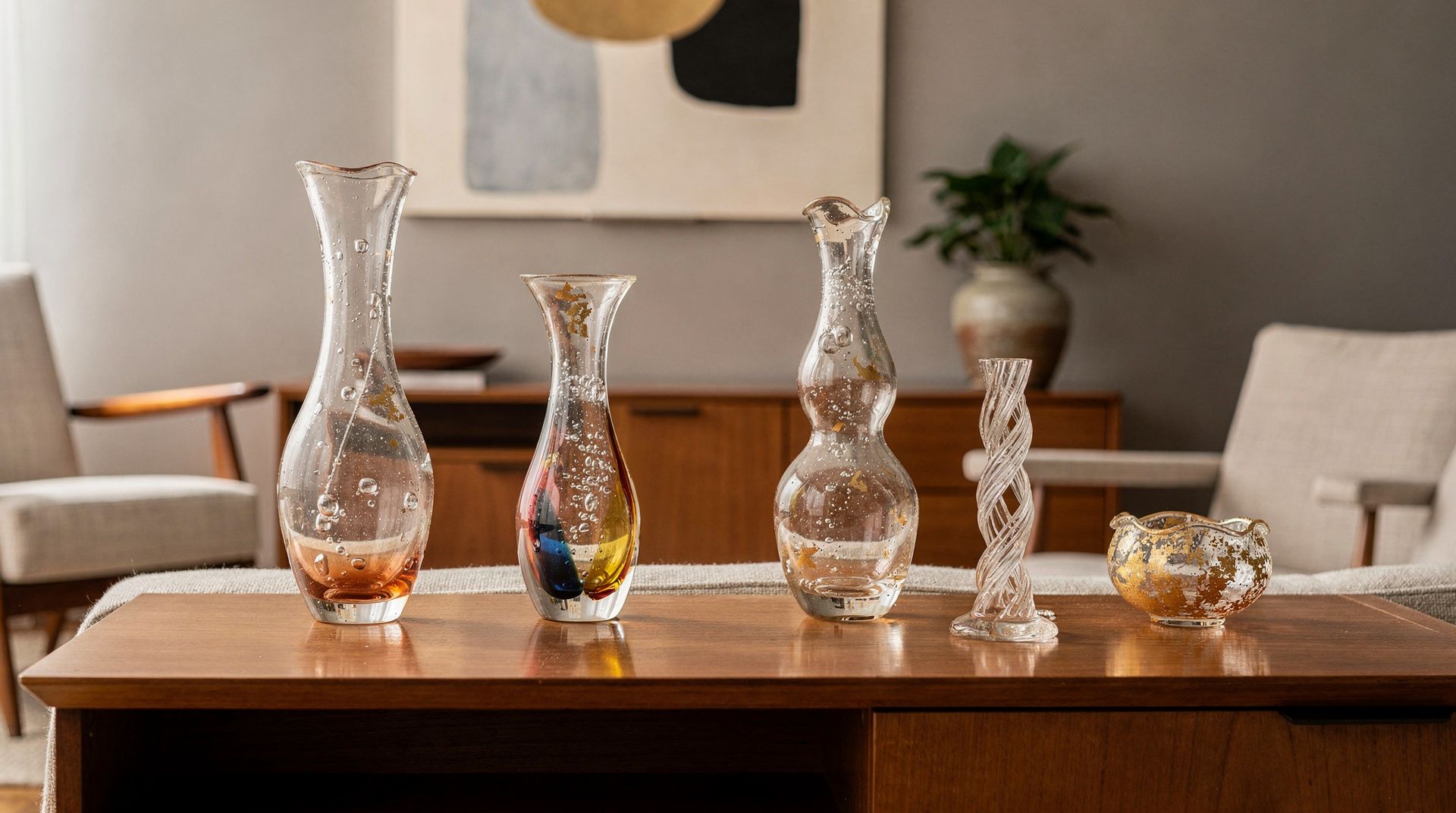
  • Sommerso: multi-layered color construction achieved by successively dipping into molten glass of different colors, often in contrasting tones such as amber and cobalt. Typical of Seguso Vetri d’Arte and Flavio Poli in the 1950s.
  • Murrine and Millefiori: cross-sections cut from drawn, fused colored rods, fused onto a base body. Carlo Scarpa developed the reduced variant known as murrine romane for Venini.
  • Pezzato: irregular patchwork of rectangular color fields, created by Fulvio Bianconi for Venini, 1950.
  • Battuto: facet-like depressions cold-ground into the surface, diffracting light diffusely. Carlo Scarpa, late 1930s to 1940s.
  • Corroso: chemically matted, pitted surface, also developed by Scarpa.
  • Filigrana, Zanfirico, Reticello: thread inclusions of opaque white or color, either parallel, twisted or fused as a net.
  • Pulegoso: glass deliberately suffused with bubbles, often heavy and opaque, shaped by Napoleone Martinuzzi at Venini, around 1930.
  • Incalmo: horizontal fusing of two separately blown color zones at a clean seam — technically demanding and a strong indicator of master workshops.
  • Vetro a mano volante: freely blown objects without a mold, identifiable by their asymmetry and tool marks on the base.

Color recipes are also essential for dating. Uranium-bearing yellow tones largely disappear after World War II, while specific turquoise, smoke and aubergine tones of the 1950s and 1960s are closely tied to individual houses.

2. Regional Schools and Defining Designers

Murano is a tight network of competing manufacturers whose signatures can be read when designer, period and technique are considered together.

  • Venini & C., founded in 1921 by Paolo Venini and Giacomo Cappellin. The artistic direction of Carlo Scarpa (1932 to 1947) and Fulvio Bianconi (from 1948) established its reputation as Murano’s most important design house. Signatures: etched or acid-matte “venini murano ITALIA”, sometimes with a year.
  • Barovier & Toso, descended from one of the island’s oldest glassmaking families. Ercole Barovier worked with techniques such as barbarico and rugiadoso — surface-rich and sculptural.
  • Seguso Vetri d’Arte, founded 1933. Under Flavio Poli, the canonical sommerso vases with their clear silhouette emerged from the late 1940s onward.
  • A.V.E.M. (Arte Vetraria Muranese), founded 1932. Known for polychrome murrine works, including pieces by Giulio Radi and Anzolo Fuga.
  • Vistosi, from the 1960s an important player in lighting, with designs by Alessandro Pianon (bird figures Pulcini, 1962) and later Gae Aulenti.
  • Mazzega, Vetreria Vistosi, Leucos and La Murrina shaped light object production in the 1960s and 1970s, often in collaboration with architects of Italian Rationalism.
  • Cenedese, with Antonio Da Ros from 1958, is known for massive, colored block forms and figurative sommerso works.

Important: many master glassmakers, known as maestri, moved between houses. An attribution based solely on technique is therefore rarely sufficient. Cross-referencing with catalogues raisonnés, Biennale di Venezia catalogues or publications such as those by Marino Barovier and Marc Heiremans is standard practice.

3. Authenticity and Condition from a Collector’s Perspective

With vintage Murano, value is determined not by mere origin but by a verifiable attribution. These criteria assist in the assessment:

  • Signatures and labels: Venini used different signatures over the decades, from paper labels of the 1930s to etched markings with year dates from 1980 onward. A missing label does not rule out authenticity, just as a present one does not guarantee it. Paper labels have been affixed retrospectively.
  • Pontil mark on the base: the ground or raw break-off point of the punty rod is an indicator of handwork. On high-quality pieces it is usually cleanly ground and polished.
  • Formal consistency: mouth-blown objects show minimal asymmetries, even wall thickness within a tolerance, and no mold seams. Press glass or semi-industrial glass is identifiable by sharp edges and seam marks.
  • Bubbles and inclusions: small, irregularly distributed bubbles are normal in mouth-blown glass. In pulegoso and similar techniques, they are part of the design.
  • Color stability and UV behavior: some recipes respond to UV light with a slight fluorescence, which can assist in dating.
  • Condition: chips on the rim, scratches on the base from normal use, and slight cloudiness of the inner wall in vases all diminish value to varying degrees. Re-polished rims alter the silhouette and should be assessed critically. Adhesive residue, filled cracks or reworked surfaces should always be disclosed.
  • Provenance: documented chains of ownership, auction records, exhibition lists or manufacturer invoices increase confidence in an attribution and have a direct impact on valuation.

For value development, authorship, rarity of the series, technical complexity, size and condition all count. A signed Bianconi Pezzato from the early 1950s moves in a different category from an unsigned sommerso vase of the same period, even if both were made on Murano.


At mid-centurydesigns.com we curate glass objects of the Italian post-war modern era with the commitment to support every attribution through literature, labels, catalogues raisonnés or provenance documentation. Condition, restorations and uncertainties in dating are disclosed so that you, as a collector or designer, can make your decision on a solid foundation.


This article was generated automatically by an AI system. Disclosure pursuant to Article 50 of the EU AI Act.

FAQ · 02

Frequently asked about Murano glass Venetian glass artists

5 Answers

01
How do I distinguish authentic Murano glass from imitations or industrial mass-produced goods?
Genuine Murano glass from the classic production period (1950s–1970s) shows characteristic signs of handwork: slightly asymmetric forms, fine marks within the glass body from the working process, and air bubbles distributed at random. Every piece has subtle variations in wall thickness. Smooth, perfectly symmetrical objects point to modern machine production. Authentic pieces often bear a signature from the artist or the studio, either engraved or fused into the glass. In-depth comparative study with catalogues from Aureliano Toso, Seguso or Barovier & Toso is indispensable.
02
What manufacturing characteristics are typical of Venetian glass artists and indicate quality?
High-quality Venetian works display several quality criteria: the millefiori technique (thousand-color pattern inclusions) with precise, clean mosaic patterns; the application of murrine (colored glass rods) in thoughtful compositions; and the sommerso technique with multiple layers of transparently differently colored glass. The finest artists also master pontil work (glass rod connection) without visible scars. Distinctive hallmarks are the characteristic weightiness (dense, heavy glass) and the optical depth created by colored layering.
03
How does color palette affect the value and authenticity of vintage Murano glass sculptures?
The color palette of a piece documents its period of origin and the workshop. Rich floral blues, ruby reds and greens are typical of the 1950s–1960s; pastel, lighter tones are more characteristic of the 1970s or later works. Particularly valuable are well-conceived multi-color combinations such as sommerso effects (colored layers over transparent glass) or murrine mosaics with high contrast richness. Uniformly colored, flat tones often indicate more recent production. Original patina and slight discoloration from storage are markers of authenticity, not flaws.
04
Which artists and studios shape the value of a Murano glass piece, and how can this be verified?
The great names are Aureliano Toso (known for abstract forms and murrine), Seguso (master of the sommerso technique), Barovier & Toso (historic prestige, elegant forms), Paolo Venini (innovative color combinations, including collaborations with Fulvio Bianconi), and Ercole Barovier. The increase in value is considerable when a signature or a verifiable studio mark is present. Provenance is documented through archival photographs, exhibition catalogues from the 1950s–1970s, or auction results. Reputable dealers and auction houses (Verona, Venice) can verify pieces against studio sample collections.
05
How can the financial value of a rare glass sculpture be realistically determined?
Value is derived from four factors: (1) artist/studio attribution with documented provenance, (2) time period (the 1950s–1960s typically achieve higher prices), (3) technical complexity and rarity of the technique (murrine and sommerso are more sought after than monochrome works), (4) condition free of scratches, cracks or corrosion. Comparable sale prices at European art auctions (Dorotheum Vienna, Christie's Italy, Sotheby's) reflect the current market. A signed sommerso piece by Seguso can range between €400 and €3,000; attributed Paolo Venini works are often priced at €1,500–€8,000. A written expert opinion from recognized Murano specialists considerably increases market confidence.

GLOSSARY · 03

Related Terms

10 Entries

Murano Glass
Art glass from the Venetian island of Murano, produced using techniques handed down since the 13th century. Authentic Murano pieces are distinguished by elaborate handwork, intense coloring and often signed artistic hallmarks. The production site of Murano has been the European center of glass art since 1295.
Avventurina
Venetian glass technique in which the finest mica or metal particles (traditionally copper) are worked into the glass mass, creating a sparkling, golden-brown effect. Authentication is carried out by microscopic examination of the particle distribution and their light refraction.
Millefiori
Patterning technique of Venetian glass in which colored glass rods are arranged in cross-section like a thousand small flowers (Ital. mille fiori). The regularity and precision of the patterns enable attribution to specific artists and periods of Murano production.
Signature and Artist Hallmarks
Authentication feature of Murano glass: artists impress their names or initials directly into the still-warm glass or engrave them subsequently. Well-known signatures such as 'Barovier & Toso', 'Seguso' or 'Archimede Seguso' are decisive for valuation and verifiable through specialist databases.
Sommerso Technique
Manufacturing process in which multiple glass layers of different colors are layered on top of one another and fused, with the inner layers remaining visible. The uniform layering and color transition are characteristic authentication features of high-quality Murano art objects.
Patina and Aging Characteristics
Natural changes in vintage glass caused by chemical decomposition of the glass surface over decades. Typical signs include fine cracks, matte patches or iridescent shimmering. Missing or overly perfect-looking patina points to later reproductions or chemical treatment.
Luster and Iridescence
Surface sheen of Murano glass that arises from the quality of the raw materials and the firing temperature. Vintage pieces often display a characteristic, diffuse shimmer. Modern glass, by contrast, appears too uniformly glossy; genuine aging produces subtle, wave-like light refractions.
Production Dating by Stylistic Features
Method of authentication through formal and color characteristics: organic, flowing forms and intense colors point to the 1950s/1960s; geometric forms with more subtle colors to the 1970s. This stylistic development enables reliable attributions even without a signature.
Weight and Density
Authentic Murano glass has a characteristic density higher than that of industrially produced glass. The weight of an object relative to its size is a reliable feature; genuine Murano pieces feel noticeably heavier than imitations. Comparative weighing is part of professional authentication.
Coloring and Pigment Use
Vintage Murano glass uses traditional metal oxides for intense but never perfectly uniform coloring. Particularly rare colors such as deep turquoise, ruby red or color-shifting green significantly increase value. Modern copies often display more artificial, uniform colorings without the fine color variations of genuine handcrafted production.