MATERIAL · MURANO GLASS PRESSED GLASS CLEANING

Safely cleaning Murano glass and pressed glass

Material knowledge, technique and care for vintage glass sculptures

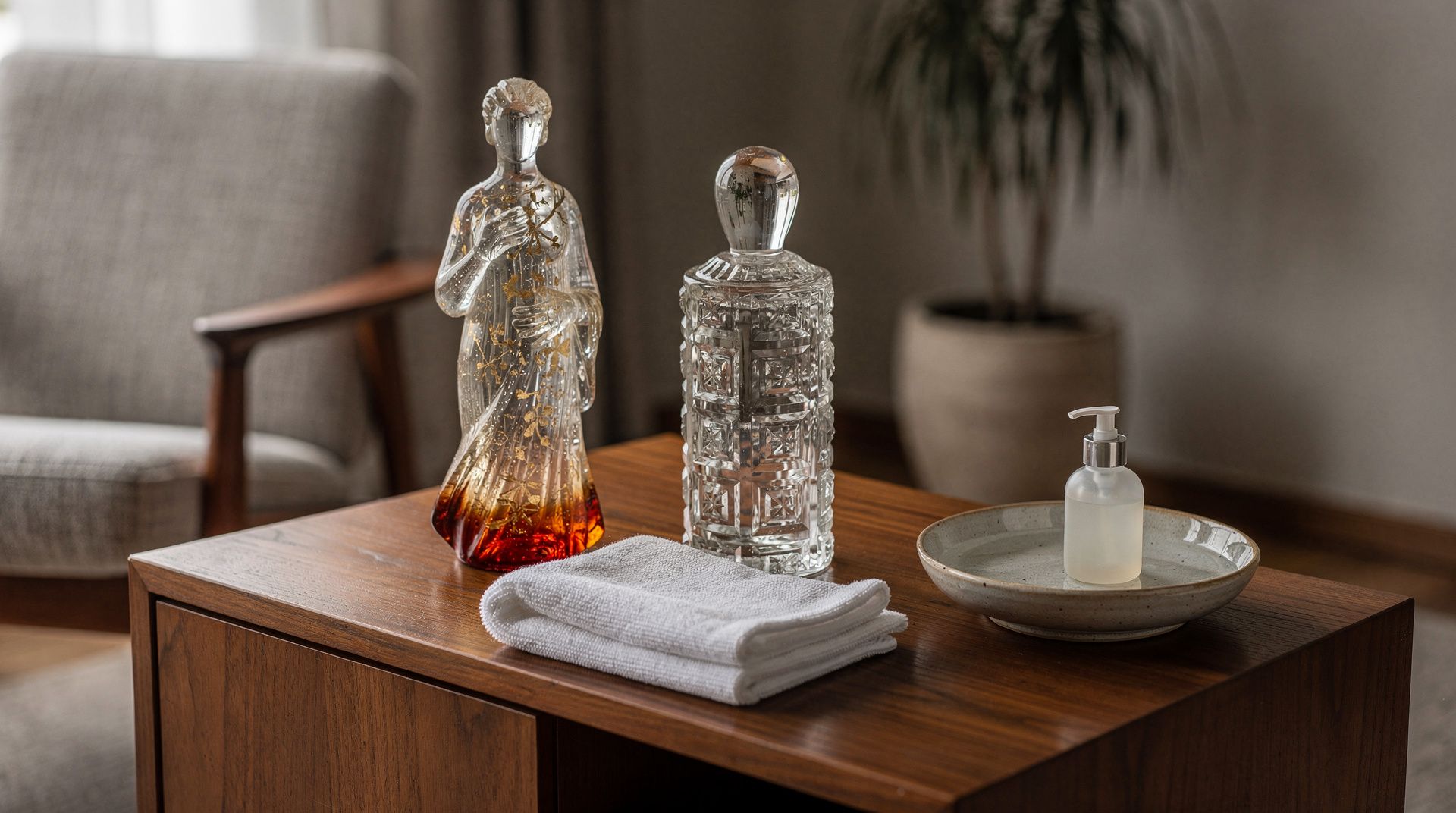
Mouth-blown Murano glass and machine-made pressed glass differ in wall thickness, surface structure and sensitivity, making every cleaning process a material-conscious decision. You will learn which mild cleaning agents work without scratching, how to treat surface decorations and gold coatings gently, and which techniques help you avoid water stains. A look at proper drying rounds off the care of valuable vintage glass sculptures and preserves their value for decades.

mid-century·designs

Murano glass pressed glass cleaning

ESSAY · 01

Work & Context

mid-century·designs

Two worlds of glass, two care protocols

Murano glass and pressed glass are among the most popular collecting fields of the 20th century, yet their care requires a clear distinction. Mouth-blown Murano glass is materially very heterogeneous due to free forming at the blowpipe end, embedded colour threads, gold leaf and techniques such as Sommerso, Battuto or Scavo. Pressed glass, by contrast, is created in a metal mould under pressure, features relief-like surfaces, mould seams and often an industrially uniform yet mechanically more sensitive texture. Anyone cleaning vintage glass sculptures is therefore not working on a uniform material, but on a layering of glass mass, surface treatment and decoration. Each of these layers reacts differently to water hardness, temperature changes and cleaning agents. The calm basic rule is: as little as possible, as targeted as necessary, and never apply more energy than the most sensitive spot of the object can tolerate.

Understanding material and structure before reaching for a cloth

Before cleaning, examine the object in raking light and with a weak magnifying glass. Look for hairline cracks, crazing in coloured inclusions, matte Scavo sections, Battuto grinds or applied gold leaf and platinum. Especially with Murano pieces by Vistosi, Venini, Barovier & Toso or Seguso Vetri d’Arte, surfaces are often deliberately structured, satinised or etched. What looks like dirt may be part of the decoration. Pressed glass from the 1950s and 1960s — from Scandinavian, Bohemian or German production, for example — shows sharp-edged reliefs in whose recesses dust and old grease films accumulate. Here, dry dusting with a soft natural-hair brush helps before any wet contact. As a general rule: no hot water, no dishwasher, no ultrasonic bath for objects with gold rims, enamel decoration or internal air bubbles. Temperature shocks can activate fine tensions in the glass that have been latent for decades.

Safe cleaning agents, techniques and drying

For wet cleaning, lukewarm, ideally soft water proves reliable, with a neutral, pH-close additive — such as a drop of clear washing-up liquid free of citrus content or abrasive microparticles. Avoid vinegar, citric acid, alcohol in high concentrations, and all window or all-purpose cleaners, as these can attack gold coatings, lustre decorations and painted sections. Clean Murano sculptures section by section with a soft cotton or microfibre cloth — not under running water, but over a bowl lined with a towel, to prevent a fall while the piece is wet. Pressed glass with deep relief can be cleaned in the recesses with a soft watercolour brush. Water stains form primarily through evaporating limescale residues. Therefore, finish with distilled water and dry immediately with a lint-free linen cloth, dabbing rather than rubbing. With objects that have a gold rim, never wipe across the edge — always wipe parallel to it. Afterwards, let the piece dry completely in the open on a soft surface before putting it back in place, as trapped residual moisture in cavities encourages cloudiness.

Special considerations for decoration, gold coatings and signatures

Gold leaf, platinum foils, Avventurina inclusions and cold-applied paintings are the most critical zones. They must not be rubbed, treated with alcoholic solutions or worked on with melamine sponges. Test every cleaning agent first on an inconspicuous spot on the base. Pay particular attention to etched signatures, paper labels and acid stamps from manufacturers such as Venini, Seguso or Mazzega. These are often value-determining, yet they detach immediately if exposed to too much moisture. Paper labels are ideally only dusted dry with a brush. For Scavo surfaces, which are deliberately rough and earthy in appearance, dry dusting is generally sufficient; wet cleaning can permanently alter their characteristic matte character. For Battuto and Inciso — finely ground surfaces — the same principle applies: the structure is part of the authorship and not a form of soiling.

At mid-centurydesigns.com, glass pieces are examined for signature, condition of decoration, stress cracks and original surface before being added to the inventory. Each piece is documented photographically, and the description openly names the manufacturing technique, attributed workshop and any visible signs of age and use. This allows you as a collector or designer to understand which care protocol an object can actually tolerate, and to decide on a sound basis which vintage glass is a long-term fit for your collection.


This article was generated automatically by an AI system. Disclosure pursuant to Article 50 of the EU AI Act.

FAQ · 02

Frequently asked about Murano glass pressed glass cleaning

5 Answers

01
What is the material difference between Murano glass and pressed glass, and why do they require different cleaning?
Murano glass is mouth-blown and has a denser, more homogeneous structure with often multi-layered colour inclusions. Pressed glass is created by pressure in moulds and features finer pores, grooves and microscopic irregularities. These structural differences mean: pressed glass absorbs water more readily and retains cleaning agents in its recesses. Murano tolerates light mechanical stress better. Pressed glass requires shorter soaking times, more thorough rinsing and faster drying to avoid water stains.
02
Which cleaning agents are truly safe for valuable vintage glass sculptures?
For both glass types: distilled or deionised water with a maximum of 2–3 drops of pH-neutral washing-up liquid (no vinegar, no citric acid). Never use abrasive cleaners, toothpaste or alkaline cleaners — these attack the glass surface irreversibly. For gold coatings or surface decoration: water with washing-up liquid only, no mechanical aids. Professional alternative for sensitive pieces: isopropyl alcohol (70%) on a lint-free cloth. Always test on a discreet spot first.
03
How do I clean gold coatings and surface decorations without damaging them?
Gold coatings and hand-painted decorations are fragile surface layers. Never rub directly with a cloth or sponge. Instead: brush the glass very gently under lukewarm water with a soft brush (natural-hair toothbrush), in one direction only — not in circles. For stubborn dirt: soak briefly (maximum 5 minutes) in distilled water with washing-up liquid, then rinse gently. Dry only with a lint-free cotton or linen cloth — dab, do not rub. Gold coatings demand the utmost care — their thickness is often only a few micrometres.
04
How do I prevent water stains on valuable pieces?
Water stains form from minerals in the water that remain after drying. Therefore: use exclusively distilled or deionised water — this costs little and is essential. After rinsing, dry immediately with a lint-free cloth (do not air-dry). For pressed glass with fine structures: polish with a second cloth dampened with isopropyl alcohol (70%) — the alcohol evaporates without a trace. For large-format or complex objects: allow to dry slowly in a warm room (20–22°C) with constant humidity (50–55%) before placing on a shelf.
05
Which technique is safe for cleaning pressed glass with deep ornaments and reliefs?
Pressed glass with fine ornaments stores dust and water in its recesses. Step 1: dry cleaning with a soft brush (hairbrush, toothbrush) in the direction of the bristles. Step 2: briefly immerse in lukewarm water with washing-up liquid (no longer than 10 minutes). Step 3: very important — gently work through the ornaments with a soft toothbrush to flush out any residue. Step 4: rinse several times with distilled water. Step 5: dab dry with a cotton cloth, using a second brush to trace the grooves and draw out any remaining water. Never use compressed air or a hair dryer — this drives water deeper into the structure.

GLOSSARY · 03

Related Terms

8 Entries

Murano glass
Handcrafted art glass from the Venetian island community of Murano, known for elaborate processing techniques such as Millefiori, Sommerso and Avventura. The material requires gentle cleaning, as it is often thinner-walled and more thermally sensitive than pressed glass.
Pressed glass
Industrially manufactured glass that is pressed into moulds and therefore features more uniform wall thicknesses than handcrafted glass. Its denser structure makes it more robust against mechanical stress, but susceptible to scratches in the surface structure.
Gold coating
An applied gold layer on glass surfaces, common on vintage drinking glasses and decorative objects. This coating is water-soluble and can be removed by incorrect cleaning; it requires exclusively dry cloth wiping without moisture.
Surface decoration
Painted, applied or engraved patterns on glass sculptures such as flowers, ornaments or figurative embellishments. On Murano pieces these are often built up in multiple layers and can be damaged by aggressive cleaning.
Water stains
Mineral deposits that form through the drying of calcareous water. They leave matte, pale marks on the glass and are particularly visible on vintage objects; they can be avoided by drying correctly with a soft cloth.
Microfibre cloth
High-quality, lint-free cleaning cloths made from synthetic fibres, ideal for the gentle cleaning of glass. They absorb moisture without leaving scratches or streaks and are particularly suitable for gold coatings and decorative paintwork.
Thermal shock
Stress cracks that arise from sudden temperature changes, especially in Murano glass with complex structures. During cleaning, alternating cold water and warm drying processes should be avoided.
Distilled water
Demineralised water free of lime and mineral content, ideal for cleaning vintage glass sculptures. Unlike tap water, it leaves no stains and minimises the risk of damage.