Mid-Century Sideboards and Credenzas: A Collector’s Buying Guide
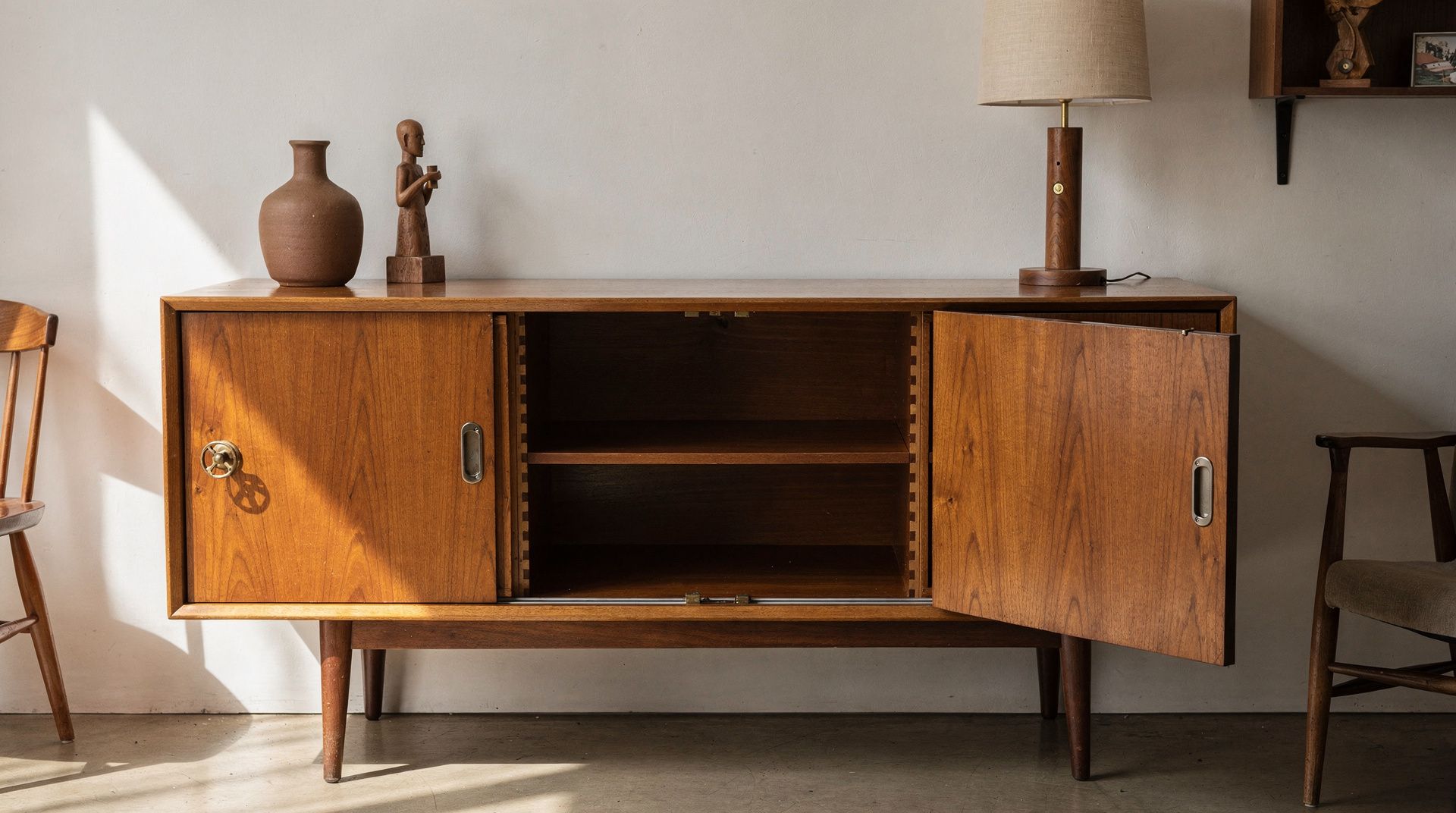
The sideboard is the defining furniture piece of post-war modernism. In the 1950s and 60s, it replaced the heavy credenzas of historicism and took on the role of the central storage piece in open living spaces, often combined with a dining table, lounge seating, or a music cabinet. Buying a vintage sideboard today means acquiring less a piece of furniture than a historical document: sliding doors of form-pressed plywood, tapered legs, rotating catches in brass or aluminium, and carefully mirrored veneer patterns all point to a brief era in which industrial production and artisanal precision still coexisted.
For collectors, the question is less about style than about substance. An original sideboard by Poul Cadovius, Arne Vodder, or from the workshop of Alfred Hendrickx can be identified by a wealth of constructional details that later reproductions rarely achieve. This guide covers the materials, the regional schools, and the key checkpoints that are decisive for preserving value.
Characteristic Materials and Construction Details
The material palette of the mid-century sideboard is limited but precisely conceived. Rosewood (Rio and later Indian rosewood), teak, walnut, smoked oak, and occasionally wenge dominate the carcass surfaces. Characteristic is the use of knife-cut veneer on a substrate of blockboard or core plywood, with veneer patterns frequently mirrored as book-match or slip-match arrangements so that the grain runs continuously across multiple sliding doors.
Two basic types of closure can be distinguished: sliding doors guided in routed grooves or on brass runner rails, and the tambour shutters typical of the Danish school, made of narrow solid wood slats glued onto a fabric backing. Rotating catches in solid teak or brass, such as those Arne Vodder designed for Sibast, often interlock and open multiple doors simultaneously with a quarter turn. Finger pulls are routed directly into the solid door panel rather than applied separately, which is a reliable indicator of originality.
The legs are usually executed as tapered round or square bars of solid wood, mortised into the carcass and only rarely screwed in. Back panels typically consist of thin, often veneered plywood slid into a continuous groove. A look at the interior fittings — oiled oak drawers with open dovetail joinery, felt-lined cutlery trays, removable cocktail compartments with mirrored back panels — reveals the quality of the workshop.
Regional Schools and Key Designers
The Danish school remains the reference point to this day. Workshops such as Sibast, Skovby, P. Olsen, Omann Jun., and the manufactory of Poul Cadovius (France & Søn, Cado) combined the precision standards of boat-building with serial production. Arne Vodder, Kai Kristiansen, Ib Kofod-Larsen, Johannes Andersen, and Hans J. Wegner shaped the type of the freestanding, all-round veneered sideboard that no longer needed to be placed against a wall. Identifying marks include branded stamps or embossed metal plaques with workshop numbers, frequently the addition “Made in Denmark”, and the inspection mark of the Dansk Møbelkontrol.
Swedish designs by Nils Jonsson, Yngve Ekström, or Svante Skogh lean more heavily on teak combined with light birch interiors. The Belgian school around Alfred Hendrickx (Belform) and Oswald Vermaercke (V-Form) often works with rosewood and geometrically contrasting metal bases. In Germany, Behr, Wilhelm Renz, Musterring, and the early programmes of Interlübke (such as the System 1200 by Walter Müller) produced precisely crafted, frequently modular sideboards whose hardware and hinges rank among the most technically refined of the era. Italian pieces by Osvaldo Borsani, Ico Parisi, or from the production of Dassi and La Permanente Mobili Cantù add a more sculptural formal language, often combined with brass and glass elements.
Authenticity, Condition, and Restoration
A systematic inspection before purchase is worthwhile. Provenance begins with markings: branded stamps, paper labels, embossed metal badges, or struck-in model numbers should be cross-referenced against documented catalogues or manufacturer archives. Absent markings do not rule out originality, but require a careful attribution based on constructional features.
Structurally, the carcass should be checked for warping. Gently lifting one corner shows whether the piece has retained its torsional rigidity or whether mortise-and-tenon joints have loosened. Sliding doors must run in the groove without binding; a trickling sound indicates broken beech guide strips, which can be competently replaced. On tambour shutters, the fabric backing is the weak point: once it becomes brittle, the tambour can only be re-strung by a specialist restorer. Hinges should be original, typically of brass-plated steel with a characteristic cylindrical form; replacement hinges from a hardware store significantly reduce a piece’s collector value.
Veneer damage is usually repairable. Small blisters can be pressed down with hot hide glue and a warm iron; losses can be filled with spliced veneer pieces sourced from period restoration stocks. Caution is warranted with surfaces that have been fully sanded and refinished: the original finish was almost always an open-pored oil or wax treatment that brings out the tactile quality of the rosewood. Refinishing with polyurethane lacquer is irreversible and value-diminishing. As a general rule: preservation before restoration, restoration before reconstruction.
At mid-centurydesigns.com we curate sideboards and credenzas that meet these criteria. Every piece is examined for attribution, construction, and condition, documented, and where necessary carefully worked on by experienced restorers — without overwriting the original substance. You will find with us not anonymous mass-produced furniture, but designs with verifiable provenance, for collections, interiors, and spaces where a piece of furniture should be more than just storage.
This article was generated automatically by an AI system. Disclosure pursuant to Article 50 of the EU AI Act.