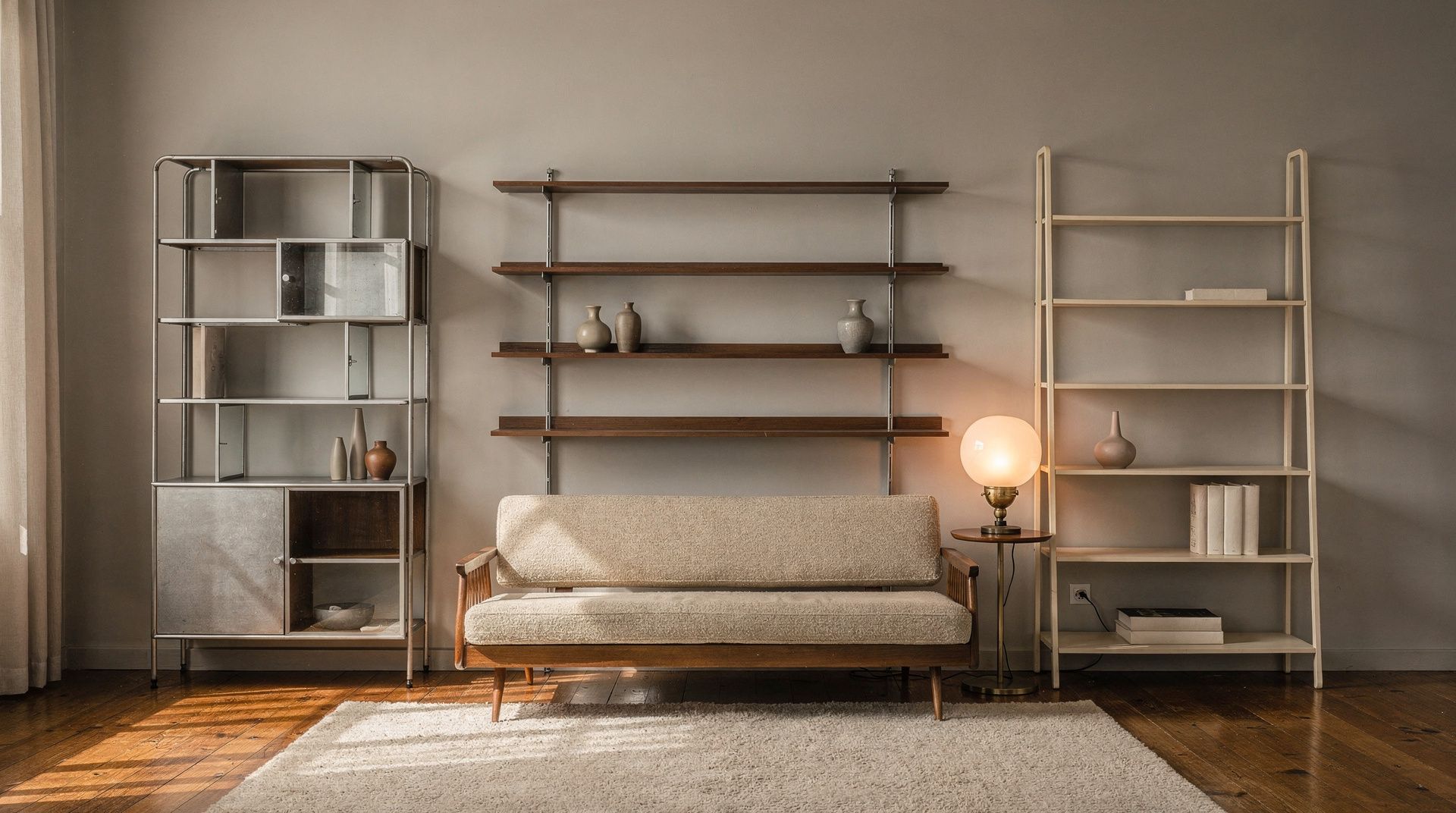
CATEGORY · MID-CENTURY SHELVING SYSTEMS MODULAR WALL SYSTEMS

Modular Wall Systems of Mid-Century Modernism: A Collector's Buying Guide

USM Haller, Vitsœ 606, String Shelving: Understanding Systems Before You Buy

Modular shelving systems are among the defining achievements of post-war modernism: Dieter Rams designed the Vitsœ 606 Universal Shelving System in 1960, Nisse Strinning the String shelf as early as 1949, and Fritz Haller, together with Paul Schärer, developed the USM Haller System from 1963 onwards. Each system follows its own constructional logic — from the E-track rail to bent ladder wire to the ball-and-tube connection. This guide helps you distinguish construction types, assess fixings and support frames professionally, and realistically evaluate expandability within an existing collection.

mid-century·designs

Mid-Century shelving systems modular wall systems

ESSAY · 01

Work & Context

mid-century·designs

Mid-Century Shelving Systems: Structure as a Design Principle

Modular wall and shelving systems are among the most intellectually ambitious contributions of post-war modernism. Where the freestanding piece of furniture asserts a closed form, Dieter Rams, Nisse Strinning and Fritz Haller conceived the shelf as an open system: a grammar of uprights, shelves and connectors that adapts to the space, the existing collection and the habits of the user. This attitude explains why original systems from the 1950s to the 1970s continue to circulate on the market today, remain configurable and form a resilient collector’s market.

For the buyer, this creates a dual task. On the one hand, you need to be able to read the constructional logic of each system — USM Haller, Vitsœ 606 and String Shelving follow fundamentally different principles of load transfer and expansion. On the other hand, the condition of the structural components matters far more than the cosmetic surface: a scratched shelf board is replaceable, a warped E-track or a stripped thread in a chrome-steel node is not easily so. Collectors buy the structure and source the cladding afterwards.

1. Characteristic Materials and Constructions

The three defining systems can be unambiguously distinguished by their materials and jointing techniques. The USM Haller System, produced since 1965 to the design of Fritz Haller and Paul Schärer, is based on a chrome-plated brass ball with six threaded bores into which steel connecting tubes are screwed. The panels consist of powder-coated sheet steel in a defined colour palette, with Pure White, Light Grey and Pure Black being the most common tones. On original pieces, the ball appears as a prominent node; later copies often feature visibly less precisely milled threads or deviating ball diameters.

The Vitsœ 606 Universal Shelving System, designed in 1960 by Dieter Rams for Vitsœ+Zapf, works on an entirely different principle: vertical aluminium profiles tensioned between wall and floor — the so-called E-tracks — accept brackets, shelves and cabinets via inserted pins. The aluminium surface is anodised rather than painted, and ages accordingly to a matt finish rather than yellowing. Early shelf boards were initially available in elm, later in various veneered and lacquered versions.

The String Shelving by Nils Strinning, designed in 1949 in Malmö and awarded the Lunning Prize in 1954, is the lightest of the three systems. The characteristic ladders of plastic-coated steel wire support hooked-in wooden shelves, typically in beech, birch, walnut or rosewood. Early examples show thinner wire and visible ageing of the plastic coating, which darkens or can become brittle when exposed to sunlight.

2. Regional Schools and Their Designers

The three systems also mark three European schools of thought. The Swiss line around USM stands in the tradition of the Solothurn School and post-war commercial architecture; Haller conceived the shelf from the perspective of the hall — a constructional principle scalable from furniture to building. Related are the steel-tube works of Hans Eichenberger and the industrial vocabulary later continued by Wogg and Röthlisberger.

The German Ulm influence is most evident in Vitsœ. Rams, trained at the Hochschule für Gestaltung Ulm and shaped by his collaboration with Braun, understood the 606 as an open, lifelong system. In parallel, further modular systems emerged in the German-speaking world, including Montana by Peter J. Lassen from Denmark and CADO by Poul Cadovius, whose Royal System had already introduced the principle of the wall-mounted bracket in 1948. Cadovius and Kai Kristiansen with the FM Reol system represent the Danish school, which favoured wood and brass over steel.

The Scandinavian line around String, Strinning and later Kajsa Strinning brought the principle into the private home. Related are the works of Nisse Strinning for String Design AB as well as the Swedish systems by Elfa. Collectors should not mix regional origins: a Danish teak shelf does not complement a Vitsœ but dilutes its constructional clarity.

3. Authenticity and Condition for Collectors

Inspection begins with the markings. USM has used embossed stamps at defined positions on tubes and panels since the late 1960s; earlier batches show different stamps than later production. Vitsœ has relocated manufacturing several times — from Frankfurt via Zapf to Vitsœ Ltd. in England — which is reflected in profile cross-sections and bracket geometries. Original String shelves carry a paper label sticker on early examples; later series were embossed or stamped.

When assessing condition, the structural frames are paramount. On USM, check the balls for chrome flaking and the threads for stripped turns, which becomes immediately apparent when applying torque. The powder coating of the panels can be restored, though re-coating measurably alters both colour tone and surface texture. On Vitsœ, bent or oxidised E-tracks are the most common problem, as are missing or incorrectly shortened wall brackets. On String, check the wire ladders for breaks in the plastic coating at the crossing points and the shelf edges for chips at the hanging slots.

Expandability is the decisive value factor. A system whose components can still be sourced compatibly today — such as USM Haller and Vitsœ 606 — retains its collector’s value more stably than systems whose production has been discontinued. Early colour tones or discontinued sizes are correspondingly sought after: an original USM in Golden Yellow or Gentian Blue from early production, a Vitsœ in elm or a String with rosewood shelves from the early 1960s are among the pieces where provenance and documentation of the existing configuration define the price.

At mid-centurydesigns.com, we curate shelving systems exclusively on the basis of documented provenance and verified condition of the load-bearing structure. Each system is checked for compatibility and configurability, batch numbers and production periods are stated, and any restorations to shelves or coatings are disclosed. This way, you are not buying a random lot but a system that can be thought further.


This article was generated automatically by an AI system. Disclosure pursuant to Article 50 of the EU AI Act.

FAQ · 02

Frequently asked about Mid-Century shelving systems modular wall systems

5 Answers

01
How do I recognise a genuine USM Haller shelving system from imitation systems?
USM Haller shelving systems are identifiable by their characteristic chrome-plated steel ball joints, fastened with a size-6 screw. The original system uses exclusively high-quality steel profiles with precise tolerances and the proprietary ball-joint construction. Genuine pieces bear the USM signature and are factory-numbered. Copies frequently use simplified fastening systems or less accurate profile thicknesses. Play in the joints should be minimal — any wobbling indicates inferior workmanship.
02
Which modular wall system is better suited for collector's pieces: String or Vitsoe?
Both systems suit collectors with different priorities. String impresses with its Scandinavian minimalism, delicate wooden shelf boards and discreet wall fixings. The system is flexible and timelessly aesthetic. Vitsoe (formerly Vitsoe Zahradnik) relies on geometric precision and a robust metal construction. The larger spans allow for more versatile uses. For small spaces and decorative pieces, String is ideal; for extensive collections with heavier objects, Vitsoe is the more solid choice. The fixings on String are more discreet, on Vitsoe more visible.
03
What should I check regarding the fixing technique on used shelving systems to ensure safety?
First check whether the wall fixing uses plugs and screws or relies on spring clips. The anchoring must reach into load-bearing wall material (at least 8 to 10 centimetres); for partition walls, special plugs are required. Examine the backs of the support frames for wear, rust spots or deformation. On ball-joint systems, these should sit without play. Old fixings may be corroded, particularly on chrome-plated systems. If in doubt, fixing elements should be replaced with high-quality new hardware to meet safety standards.
04
Can I expand an older modular shelving system with new elements, and what should I look out for?
Expandability depends on the system. USM Haller, String and Vitsoe were all developed with modular principles and offer spare parts as well as expansion elements. The crucial point is knowing the exact generation version and profile dimensions, as manufacturers have subtly evolved their systems over time. With USM, differences range from the early 1960s to the present day. String has various cabinet heights and upright variants. Contact the manufacturer with serial numbers or photographs to verify compatibility. New elements should match the existing stock both visually and structurally — otherwise the expansion will look amateurish.
05
How do I properly restore corroded or deformed support frames on an older shelving system?
Surface corrosion on chrome-plated parts can often be treated with a fine steel wool pad and chrome polish. Deeper rust spots require professional restoration through stripping and re-nickel-plating or re-chroming. Bent profiles or joints are frequently unsatisfying to straighten, as reworking compromises precision. An alternative is to replace individual elements with original parts or high-quality reproductions. The load-bearing structure must not be compromised, so restoration should be carried out in a manner appropriate to the materials and documentation. Contact specialist workshops for mid-century systems or the manufacturer directly.

GLOSSARY · 03

Related Terms

9 Entries

Modular Shelving System
A constructional principle of prefabricated, combinable individual elements (shelf boards, uprights, frames) that enables flexible spatial configurations. Mid-century systems such as String or USM use standardised interfaces for unlimited expandability without changing tools.
Support Frame
Vertical or horizontal steel-frame construction that carries the total weight of a shelving system. In quality mid-century design systems, conceived in welded or bolted form — decisive for longevity and load distribution.
Fixing Technique
The method of connection between shelf components and the load-bearing structure, e.g. plug edge, comb extension or screw joint. Mid-century systems differ significantly: String uses snap connectors, USM Haller connecting brackets, Vitsoe plastic clips. Determines reversibility and durability.
Cantilever Construction
A projecting principle in which shelf boards extend from vertical uprights without additional intermediate supports. Enables freestanding wall installation and visual lightness. Characteristic of String and later Vitsoe generations.
Restorable Design
A design approach that allows for dismantling and material replacement without damaging the structure. A distinguishing feature of high-quality mid-century systems: original components can be replaced, paint finishes sanded back, metal parts restored, without compromising the load-bearing structure.
USM Haller System
Swiss modular system (from 1963) of lacquered steel tube with characteristic 90-degree connecting brackets and corner plates. Defined by its combinable room-divider function, extreme load stability and continued Swiss original production to this day without design variation.
String Shelving
Swedish wall shelf (from 1949, Nisse Strinning) of hardwood frames with concealed metal supports and steel-bracket consoles. Economically constructed, visually minimalist, later available in aluminium variants. Prototypical for Scandinavian modular design.
Vitsoe Architecture
British system by Dieter Rams (from the 1960s), developed in two main generations: 606 (steel frame, comb extension) and 620 (clip system). Reductionist principle with plastic elements, continuously revisable and combinable. An icon of functional design.
Patina and Objectivity
With mid-century shelving systems, a distinction must be drawn: genuine signs of use (scratches, chips) attest to authenticity and craft character, while artificial ageing points to preparation for sale. Collectors assess patina according to storage condition and the restoration requirement of the support frame.