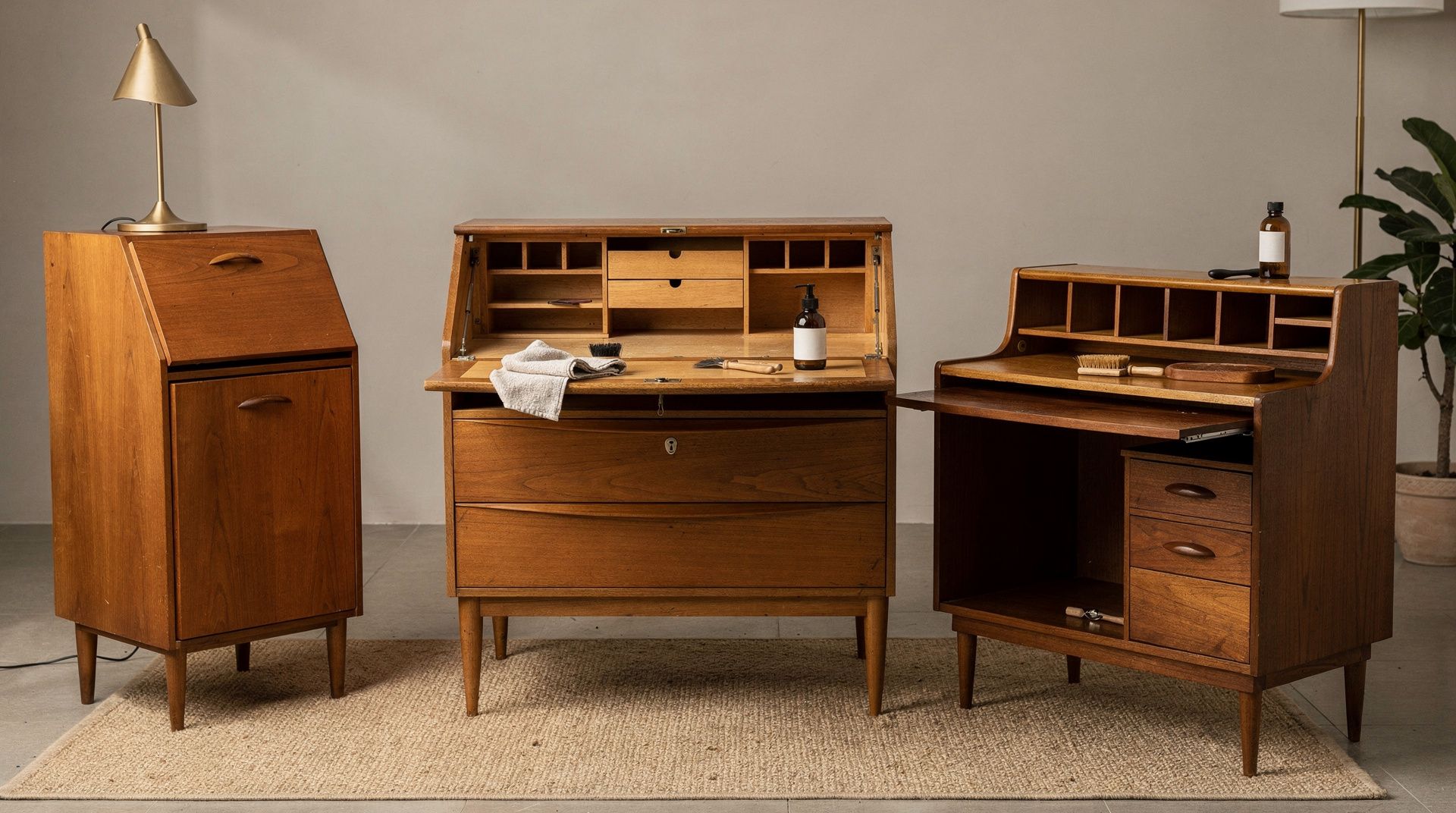
Mid-Century Secretaries and Writing Furniture: A Collector’s Buying Guide
The secretary is a furniture archetype that underwent a remarkably multifaceted reinterpretation during the Mid-Century Modern era. Between 1945 and the late 1960s, designers moved away from the representational heaviness of older bureau traditions and translated drop fronts, cylinder roll-tops and transformation mechanisms into a reduced, functionally conceived formal language. What remained was the core idea: a piece of furniture that unites writing, storing and organising within a single closed volume. What changed was the attitude. Instead of façade and ornament, proportion, material honesty and the precise choreography of moving parts took centre stage.
For collectors and designers searching for an original piece today, a calm and critical eye is worthwhile. A Mid-Century secretary is always also a mechanical object: hinges, pull-outs, flaps and internal compartment frameworks must not only look beautiful after sixty or seventy years — they must also work. The following guide categorises the material language, the relevant schools and designers, and the central questions of authenticity and condition. It is intended as a checklist, not a purchase order. A good writing piece from this era can usually be recognised by three things at once: a clear silhouette, a precisely crafted interior, and a surface that carries its history without concealing it.
Characteristic Materials: Woods, Veneers and the Logic of Drop Fronts
The material palette of the era is manageable, but worth reading by type. Scandinavian work is dominated by rosewood — above all Rio rosewood (Dalbergia nigra), which was widely used until its CITES Appendix I listing in 1992 — as well as East Indian rosewood, teak and oiled oak. German and Italian workshops frequently used walnut, and sometimes cherry, maple and ash. American designers worked with walnut, less often with rosewood, and in the case of George Nelson, with lacquered surfaces on plywood carcasses.
With secretaries, veneer work counts doubly, because the drop front forms a comparatively large, calm surface. Look for mirror-matched veneer patterns (book-match), continuous grain running across several drawer fronts, and clean solid-wood edge banding protecting the veneer edge. One quality indicator is the construction of the flap itself: high-quality pieces have a multi-layered laminated carrier board, often with a counter-veneer on the inside to compensate for wood movement. Warped, cupped flaps point to missing counter-veneer or climatic stress.
The mechanism is the second material test. Classic elements include brass hinges, stamped flap retainers with a damping function, cylinder roll-tops made from narrow wooden slats glued onto canvas, and pull-outs on wooden runners waxed for smooth operation. Metal pull-outs only appear late in the decade. Interior compartments in light maple or birch — often in deliberate contrast to the dark exterior veneer — are a conscious design choice, not a coincidence of the workshop.
Regional Schools and Designers: From Copenhagen to Grand Rapids
The Danish school shaped the image of the modern secretary most enduringly. Arne Vodder designed a series of writing pieces for Sibast with characteristic, colour-glazed drawer fronts. Kai Kristiansen worked for Feldballes Møbelfabrik on compact ladies’ secretaries with a fold-out writing surface. Gunni Omann developed models for Omann Jun with sculpturally routed handle rails. Bodil Kjær designed the often-cited desk in 1959 that became famous as the office table of the sixties in cinema. For assessing production quality, the workshops are just as important as the names: Sibast, France & Søn, Omann Jun and Feldballes stand for documented production standards.
In Germany, the workshop culture around Behr, Wilhelm Renz and the early WK Möbel produced bourgeois, restrained secretaries in walnut. The Italian line is more heterogeneous: Gio Ponti and Ico Parisi designed sculptural one-off pieces, while serial manufacturers such as La Permanente Mobili Cantù translated the architectural formal language into larger production runs. In the United States, the concept of the writing piece is closely associated with George Nelson, whose Home Office Desk and Thin Edge series for Herman Miller deliberately staged the separation of carcass and compartment. Edward Wormley for Dunbar and Paul McCobb for Winchendon represent a more residential, conservative variant of American modernism. Those who collect with regional precision look for workshop marks, brand stamps, struck model numbers and, on Danish pieces, the quality control marks of the Møbelfabrikantforeningen (Dansk Møbelkontrol), which were awarded from 1959 onwards.
Authenticity and Condition: What Collectors Should Check
Provenance begins at the back. Originally stapled or nailed back panels of thin plywood, paper labels from the manufacturer, cabinetmaker’s stamps and handwritten model numbers are primary evidence. If all markings are absent, construction logic helps: drawer joinery (open or half-concealed dovetails), wood species of the rails, thickness of the bases and the type of drawer runner all allow a reliable classification.
The transformation mechanism is the critical point. Check the flap in the open position for play, the flap retainers for function and damping behaviour, and the roll-top for torn canvas and dried-out adhesive. A slightly stiff drawer is normal and can usually be fixed with wax; a sagging base, on the other hand, is a structural warning sign. Look for subsequent drill holes for replacement handles, exchanged fittings and veneer retouching on the edges of the flap — where hand contact and friction are greatest.
Regarding the surface: an aged original patina adds value, while a piece that has been fully sanded down and re-lacquered loses not only character but often veneer thickness as well. Sensible restoration means cleaning, partial retouching, refreshing oil or shellac surfaces and making mechanisms operable again. Not sensible: colour changes, stripping polish with nitro thinner, or replacing original fittings with reproductions. Finally, check the smell: musty secretaries point to prolonged damp storage and often mean substantial work on the carcass.
On mid-centurydesigns.com, secretaries and writing furniture of this era are offered as a curated selection, with documented attribution, verified condition of drop fronts and roll-tops, and transparent information on wood species, restoration steps and provenance. Those looking for a piece that not only makes a statement but also holds up will find a well-ordered selection there and advice that asks the right questions before purchase.
This article was generated automatically by an AI system. Disclosure pursuant to Article 50 of the EU AI Act.