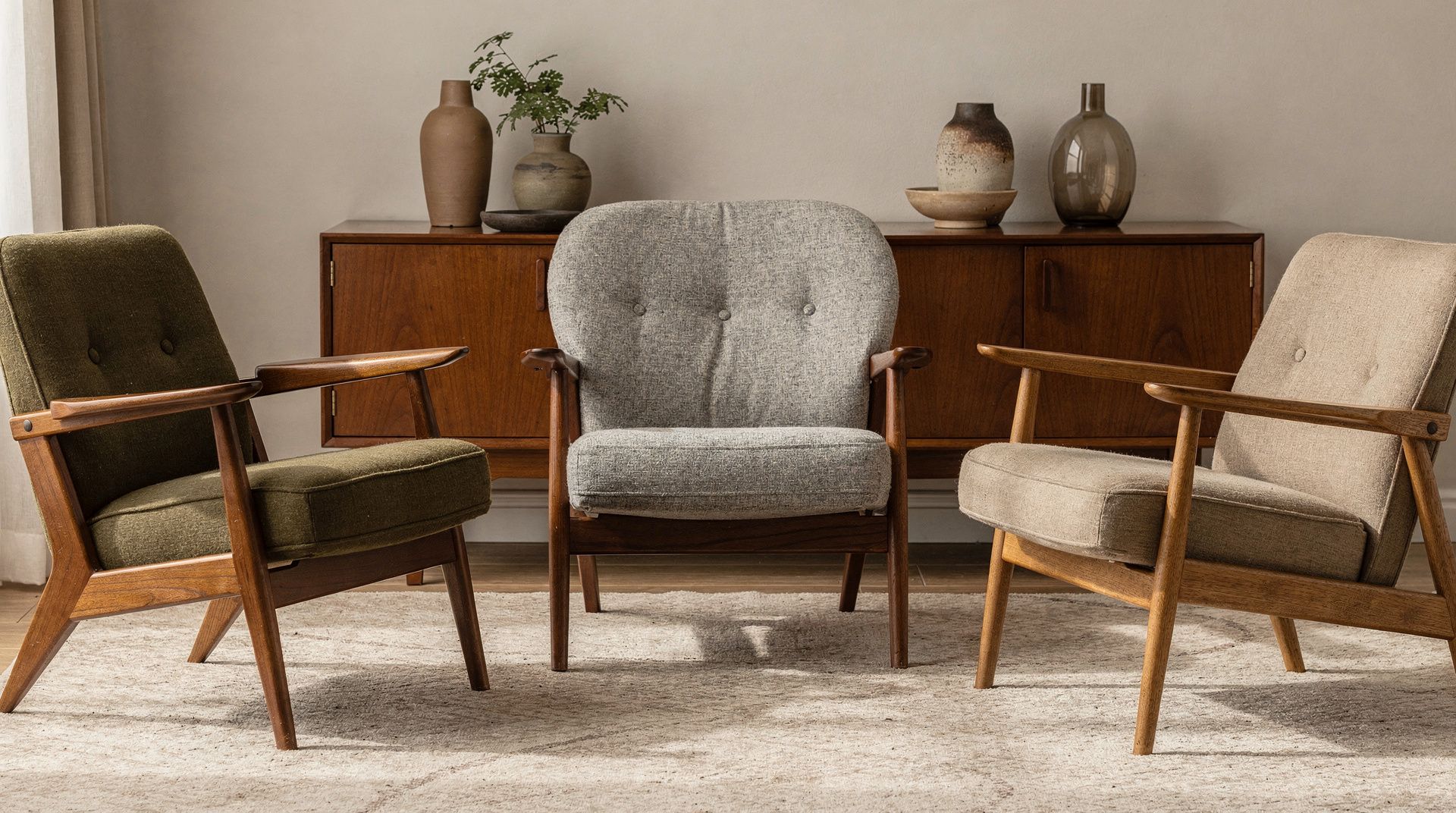
Mid-Century Lounge Chairs and Armchairs as Collectibles
The lounge chair is perhaps the most personal category of postwar modernist furniture. Between the late 1940s and early 1970s, the armchair became a testing ground: for new plywood technologies, for fiberglass shell forms, for the rediscovery of sculptural solid-wood frames in teak, rosewood, and walnut. Buying an original mid-century armchair today means acquiring not merely a seat, but a document of industrial and craft transformation.
This buying guide is aimed at collectors and designers seeking unique pieces and early production runs — not later reissues. Three questions are central: How do you recognize material quality? Which regional schools define form and construction? And how do you read authenticity and condition before you commit? We write from the perspective of a dealer who prefers pieces in their original state, understands patina as testimony, and discloses restorations rather than concealing them.
Characteristic Materials and Construction Methods
Mid-century armchairs can be broadly categorized by their material pairings. Scandinavian work of the 1950s and 1960s frequently employs solid teak, rosewood, or oak in finely profiled frames, with joints executed as mortise-and-tenon, dovetail, or concealed dowels. Edges are chamfered, transitions hand-sanded, surfaces traditionally treated with soap or sealed with oil. A look at the underside often reveals the true wood species, as neither sunlight nor polish has altered the color there.
American designs of the era instead adopted early bent-laminate plywood, fiberglass-reinforced polyester shells, and chrome or powder-coated steel. An original shell chair from the 1950s shows the typical fiber structure of fiberglass laminate on its reverse side, while later reproductions often present a smoother, more deeply colored surface. In upholstery, horsehair, coconut fiber, latex, and early cold foam dominate the period; webbing is made of jute, linen, or elastic textile straps. Covers in wool (such as Kvadrat predecessors, Hallingdal, Tonus) or vegetable-tanned saddle leather are period-typical. Vinyl and Skai covers do exist but were frequently added later.
Regional Schools and Defining Designs
Scandinavia, and Denmark in particular, offers the densest canon: Hans J. Wegner worked for Johannes Hansen, Getama, AP Stolen, and Carl Hansen & Søn; Finn Juhl for Niels Vodder and Bovirke; Arne Jacobsen for Fritz Hansen; Poul Kjærholm for E. Kold Christensen. Characteristic features include visible wood joinery, woven paper cord seats in Wegner’s work, and forged flat steel profiles in Kjærholm’s. Sweden and Norway are represented by Bruno Mathsson, Yngve Ekström, and Fredrik Kayser, often with a focus on bent wood and leather straps.
In the United States, the canon is defined by Charles and Ray Eames for Herman Miller, George Nelson, Eero Saarinen for Knoll, and the shell furniture of Charles Pollock. Italy strikes its own chord: Gio Ponti, Ico Parisi, Osvaldo Borsani (Tecno), and later Afra and Tobia Scarpa brought sculptural formal language and refined textiles. France is represented by Pierre Paulin, Pierre Guariche, and rationalist precursors such as Jean Prouvé. German postwar modernism — often underestimated — encompasses Egon Eiermann, Herbert Hirche, and work from the circles of the HfG Ulm and Wilkhahn production. Each school has its own construction details that aid in attribution.
Verifying Authenticity, Condition, and Provenance
An original vintage armchair typically bears traces of its manufacture: maker’s marks, burned signatures, paper labels, metal plaques, or stamps on the frame, webbing, and foam core. On Danish pieces you often find the mark of the quality control body Dansk Møbelkontrol; on Herman Miller pieces, a label that varied over time; on Knoll International pieces, sewn labels on the cover. Missing labels do not rule out originality, but they demand careful examination of construction, wood species, hardware, and screws. Phillips-head screws, for instance, are unusual in European furniture before the mid-1960s.
On condition: patina is welcome; structural interventions must be disclosed. Check joints for play, webbing for fatigue, foam cores for deterioration, and veneers for bubbles. Re-upholstery is standard for armchairs in daily use; what matters is whether the original construction was respected — that is, whether horsehair was replaced with horsehair rather than cheap foam. Covers in non-period-typical materials diminish collector value unless documented as a deliberate, reversible re-upholstery. Ask about provenance, previous owners, restoration reports, and — where possible — invoices or photographs from earlier use.
At mid-centurydesigns.com we curate original mid-century armchairs with documented provenance. Every piece is examined for wood species, construction, hardware, and upholstery structure; restorations are named; labels and signatures are documented photographically. This allows you as a collector to make decisions on a solid foundation, rather than having to take attributions on faith.
This article was generated automatically by an AI system. Disclosure pursuant to Article 50 of the EU AI Act.