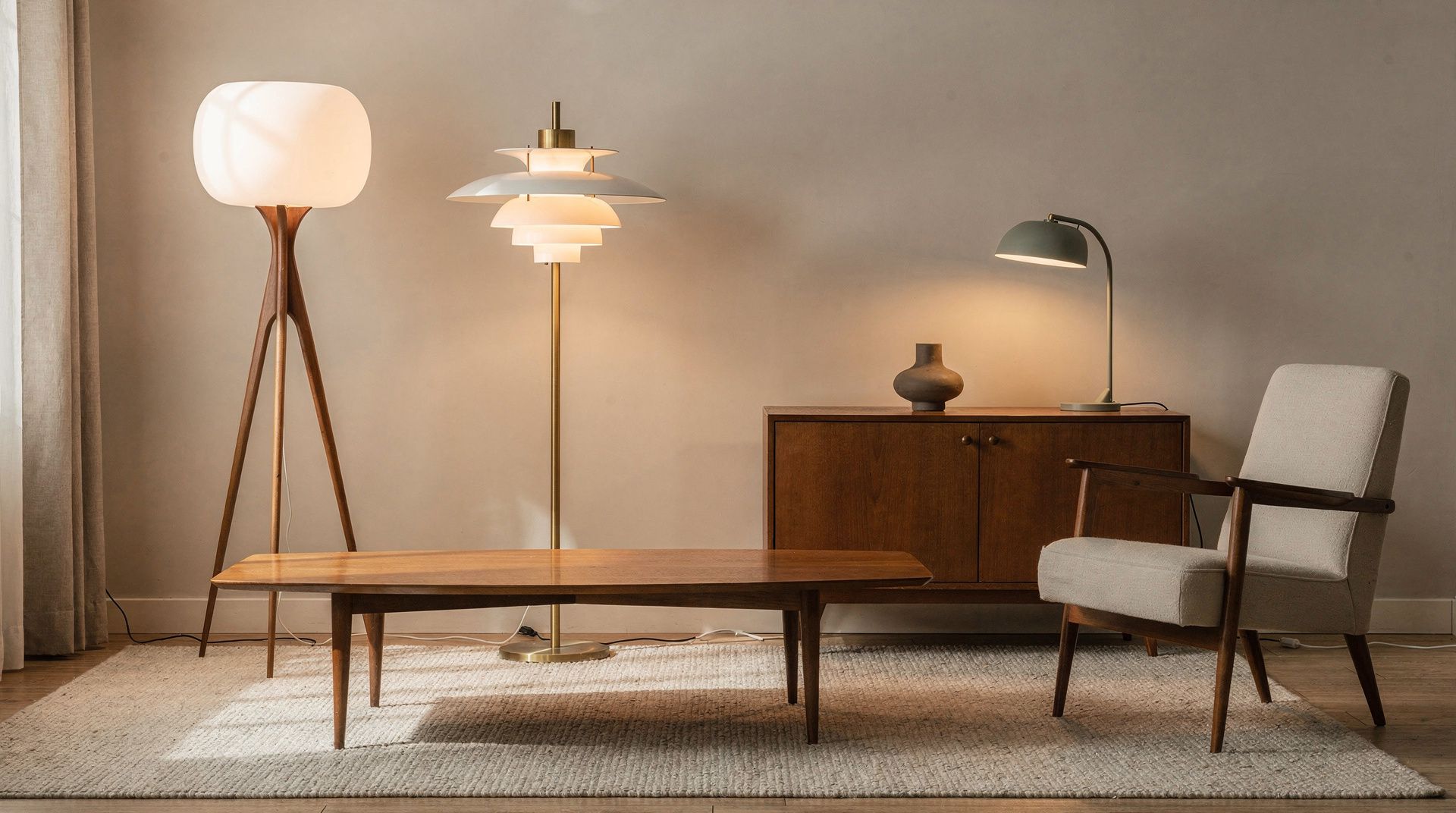
CATEGORY · MID-CENTURY FLOOR AND TABLE LAMPS

Mid-Century Floor and Table Lamps as Collector's Items

Buying Guide for Original Modern Light Classics

George Nelson designed his Bubble Lamps from 1952 for Howard Miller, Poul Henningsen developed the PH system from 1925 for Louis Poulsen, and Greta Grossman shaped California Modernism with the Grasshopper and Cobra from 1947. Collectors examine shade materials and stand constructions just as carefully as stamps, sockets and original wiring. In this guide you will learn how to verify attributions, assess condition and distinguish proper electrification from damaging rework.

mid-century·designs

Mid-Century Floor and Table Lamps

ESSAY · 01

Work & Context

mid-century·designs

Mid-Century Floor and Table Lamps: Buying Guide for Collector’s Items

Mid-Century lamps are more than light sources. They are small architectures of brass, opal glass, lacquered steel and turned wood that in the nineteen-fifties and sixties rethought the relationship between space, light and form. Anyone who acquires a floor lamp by Poul Henningsen, a Bubble Lamp from the circle of George Nelson or a Grasshopper by Greta Magnusson Grossman today is not merely buying furniture, but a documented piece of design history. A careful look at materiality, construction and provenance is therefore well worth the effort. This guide compiles what you should look out for when examining, comparing and restoring a lamp before it enters your collection or a demanding interior.

The good news: many classics of the era are so precisely constructed that original condition, later interventions and reproductions can be clearly distinguished on close inspection. The less good news: the market is full of conversions, replaced sockets and new editions declared as vintage. A calm, expert eye for detail protects against mistaken purchases and secures long-term value.

Learning to Read Materials and Construction

The central examination work begins at the shade and the stand. Spun aluminium, as used by Louis Poulsen for the PH series from the late nineteen-twenties and for the later post-war variants, shows fine concentric turning grooves on the inside and a uniformly thin wall thickness. Powder coatings on modern reproductions, by contrast, appear more matt and harder at the edges. Opal glass from the nineteen-fifties and sixties typically has a warm, slightly yellowish tint in transmitted light, while more recent glass looks cooler and often more uniform.

With stands it is worth reaching for a torch. Originally drawn brass shows a fine turning mark in the transitions to the socket and, over the years, a lively, uneven patina. Chrome-plated steel tubes of the era are often uncoated inside and show minimal burrs at drill holes that are smoothed away on industrially produced replicas. Cast iron feet, such as those Grossman used for the Grasshopper, are compact and heavy; modern variants tend to rely on thinner sheet metal with added weight. Always check whether the shade, joint and base match in finish: a freshly lacquered shade on an old stand is a clear signal of intervention.

Textile cables, Bakelite pull switches, ceramic E27 or E14 sockets, and in early American pieces Mogul E39 sockets: all of these are indicators, but not guarantees. Cables are almost always replaced at some point for safety reasons. What matters is that the socket types match the factory specification and that the internal strain reliefs are properly executed.

Regional Schools and Their Signature Style

Three centres define the market for Mid-Century lamps: Scandinavia, the USA and Italy. In Denmark, Poul Henningsen with the PH series for Louis Poulsen stands for a scientifically conceived glare-free principle of multiple shades whose curvatures are based on logarithmic spirals. Models such as the PH 3/2, PH 4/3 or the PH Snowball carry stamped or embossed manufacturer’s marks, usually on the upper shade rim or at the suspension. Later classics such as the AJ by Arne Jacobsen for the SAS Royal Hotel in 1960 or Verner Panton’s VP Globe and Panthella each have their own well-documented construction characteristics.

In the USA, the circle around George Nelson and his office produced the Bubble Lamp series for Howard Miller from 1952, whose shell consists of sprayed, self-extinguishing plastic over a steel wire frame. Post-war originals show the wire frame in an even grid and a warmly yellowed, never pure-white surface. Isamu Noguchi’s Akari, made from washi and bamboo, were manufactured in Gifu from 1951 and bear the artist’s red sun-and-moon stamp. Greta Magnusson Grossman, rooted between Sweden and California, designed the Grasshopper in 1947 and the Cobra in 1950 for Ralph O. Smith — both slender, asymmetrically balanced pieces with characteristically inclined, adjustable shades.

Italy brings its own formal language with Stilnovo, Arredoluce, Arteluce and later FLOS: Gino Sarfatti, Angelo Lelii and the Castiglionis work with lacquered steel, brass and marble in compositions that often combine several light sources in a single object. Manufacturer’s marks are usually found at the base or on the diffuser, frequently as an embossed label or lithographed plaque.

Authenticity, Condition and Restoration

For collectors, the triad of original substance, documented provenance and safe function is paramount. Begin with the substance: are the shade, stand, joints and sockets from the same production phase? Do patina and surface condition match one another? A shade that looks too pristine on a worn base is just as suspicious as subsequently polished brass that has abraded the factory engravings. Manufacturer’s marks, model numbers and labels are important, but not everything. Many lamps of the era were delivered without permanent marking; here catalogue illustrations, factory photographs and contemporary advertising help with attribution.

Electrification is the most sensitive point. Vintage lamps should be checked before use: insulation measurement, protective conductor test for metal housings, visual inspection of the internal wiring, replacement of brittle cables and strain reliefs, and substitution of defective sockets with components of the same type. Textile-sheathed cables in a period-appropriate look are now available in tested quality and preserve the appearance. What matters is that interventions are carried out reversibly and with care for the original substance: no new drillings, no glued-in sockets, no over-lacquered surfaces. A good restorer documents every step with photographs so that you can trace the condition before and after the work.

On the subject of bulbs: heat output and colour temperature should correspond to the historical design. Henningsen’s PH logic, for instance, is calculated for a single, warmly glowing source; modern LED retrofits with an E27 base at 2,200 to 2,700 Kelvin come close to this ideal while also protecting light-sensitive materials such as washi or lacquered interior surfaces.

At mid-centurydesigns.com, every piece passes through a multi-stage examination: attribution via catalogue references and contemporary sources, assessment of original substance, professional electrification to current technical standards and comprehensive condition documentation with photographs of markings, sockets and surfaces. This way you are not simply buying a lamp, but a traceable history that you can continue to write for decades to come.


This article was generated automatically by an AI system. Disclosure pursuant to Article 50 of the EU AI Act.

FAQ · 02

Frequently asked about Mid-Century Floor and Table Lamps

5 Answers

01
How do I tell an original George Nelson Bubble Lamp from the many replicas?
An original George Nelson Bubble Lamp (1952+) has a consistently seamless plastic construction with a characteristic manufacturing process. Check for the manufacturer's label or signature in the lower shade area, which on authentic pieces comes from Herman Miller or Hay. The shade form shows exact symmetry without scratches or distortions from inferior plastic. Genuine examples have a specific weight and surface texture that replicas find difficult to imitate. Ask the seller for documentation, provenance and whether the piece is catalogued in a recognised collection.
02
Which shade materials in Mid-Century lamps hold their value and stand the test of time?
High-quality original shades are made of plastic (acrylic, fibreglass composite as used by Poul Henningsen), treated paper, linen or parchment. Fibreglass shades from Henningsen lamps are particularly robust and are distinguished by their characteristic heat tolerance. Plastic shades should show no discolouration, cracks or embrittlement, as these cannot be reversed. Paper shades are more vulnerable but retain their shape with dry storage. To be avoided are synthetic fabrics or plastic films added later over original shades, as they diminish design value and destroy collector's value.
03
What do I need to look out for when electrifying a vintage lamp to use it safely?
Professional electrification is essential. First check the shade construction for heat resistance. In lamps from the nineteen-sixties, the original wiring is often porous or may contain asbestos. Have a certified electrician renew the wiring, particularly where ceramic sockets or plastic components are involved. Modern LED technology can reduce heat output, which protects original shades. Electrification should be reversibly documented so that collector's pieces can later be returned to their original state. Do not forget inspection by an authorised testing body (VDE mark) if you wish to sell or rent the lamp in Germany.
04
How do I assess the stand and base construction of a Mid-Century lamp for stability and originality?
The stand is the structural core of every floor or table lamp. On original pieces by designers such as Charles & Ray Eames or Robert Grossman, materials and proportions are precisely documented. Check for cracks, weld seams and wear at contact points. Brass bases should show no corrosion or repainting, as these indicate improper restoration. Turn the lamp upside down: original fixings have specific mounting holes and thread markings that reference examples can clarify. A wobbly or reinforced construction points to repairs that affect collector's value. Document the exact condition photographically in order to support price negotiations later.
05
Can I restore a Mid-Century lamp with its original shade myself, or will I lose value by doing so?
Restorations should be reversible and documented. Light cleaning with distilled water and a soft cloth is unproblematic. Avoid abrasives, solvents or paint coatings on original shades, as these significantly reduce value. For fibreglass or plastic shades: visible scratches can at most be minimised with very fine polishing. For a damaged paper shade, professional restoration by a specialist is more likely to preserve and insure value than a DIY attempt. Important: document all measures in writing and photographically. Collectors and appraisers value transparent restoration histories more highly than invisible, undocumented interventions.

GLOSSARY · 03

Related Terms

9 Entries

Tripod Stand
Three-legged floor construction made of wood or metal, typical of Mid-Century floor lamps. Characterised by curved or straight legs, often with pointed feet or glides. Allows the lamp head to be tilted and makes for easy handling without the shade touching the floor.
Paper Fibre Shade
Traditional shade material made of pressed paper or paper fibres, often in earth tones (cream, beige, brown). Typical of Nelson and Henningsen lamps from the 1950s and 60s. Diffuses light evenly but is susceptible to moisture and insect damage.
Arc Floor Lamp
Arched floor lamp with a curved steel tube and a shade at head height that spans over a seating area. The construction minimises floor space and creates indirect light. A classic Mid-Century Modern typology, popular from the 1950s onwards.
Original Electrification
Preservation and restoration of the original electrical installation of a vintage lamp, including power cable, socket and switch following a historically correct pattern. The aim is to preserve constructional intent and authenticity while complying with current safety standards.
Design Drawing Signature
Distinguishing characteristic of a designer such as Poul Henningsen, George Nelson or Ralph Grossman in the formal language of the lamp: specific choice of materials, proportions, joining techniques and colour concepts. Enables attribution and authentication of individual pieces.
Joint Mechanism
Moveable connection of ball joint, hinges or pivot arms between stand and shade. Enables light direction through tilting and rotation. In Mid-Century lamps often made of metal and engineered for stable positioning.
Patina and Surface Ageing
Natural change in metal and wood surfaces over time, through light and environment: oxidation, scratches, discolouration. In collector's lamps an indicator of authenticity and provenance. During restoration, a careful distinction should be made between damage and characteristic age patina.
Functional Testing of Vintage Electrics
Systematic checking of current flow, insulation resistance, switch action and socket contact in historical lamps before use. Necessary to rule out short circuits, electric shock and fire hazard. Should be carried out by a qualified professional.
Shadow Cast and Light Cone
Quality characteristic of lamp optics: how sharp or diffuse the shadow cast by a lamp is and what area is illuminated. Mid-Century designers calculated this precisely through shade angle, material and bulb position to achieve a specific room atmosphere.