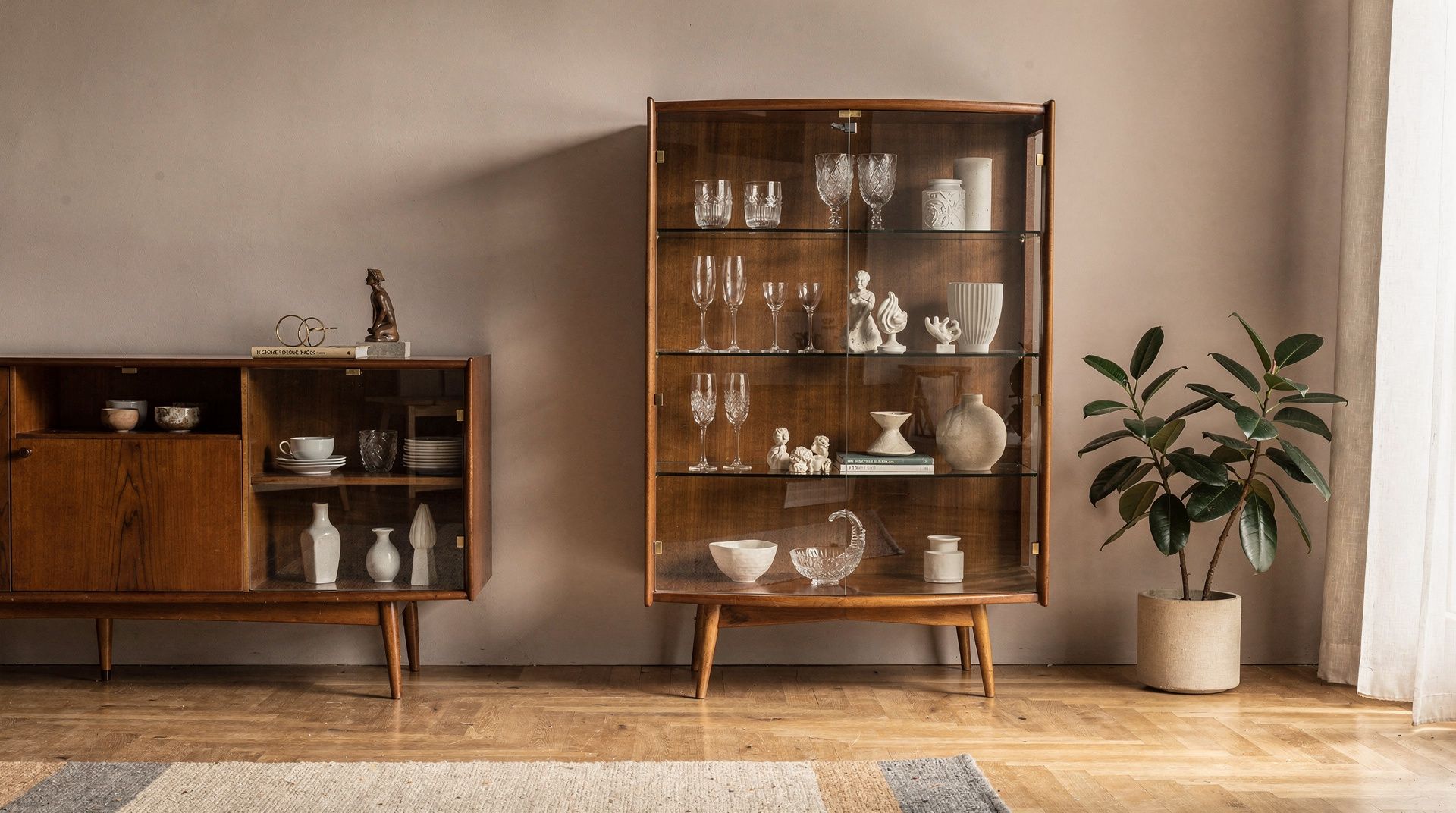
Display Cabinets and Glass Cabinets of Mid-Century Modernism: between Presentation Furniture and Collector’s Object
The display cabinet underwent a remarkable transformation in post-war modernism. The representative crystal cabinet of Historicism gave way to a light, structurally transparent piece of furniture that frames rather than shows off. Between roughly 1948 and 1972, typologies emerged that remain defining to this day: the freestanding highboard vitrine with a divided carcass, the wall-mounted glass cabinet as part of modular shelving systems, the low sideboard vitrine with sliding clear-glass doors, and the fully glazed collector’s cabinet with aluminium or brass frames. Anyone acquiring such a piece today rarely buys just a container. You acquire a concept: the idea that objects — whether studio ceramics, Scandinavian silver or a collection of Murano glass — may inhabit a piece of furniture that speaks their language. This guide categorises the most important typologies, materials and schools, and shows what you should look for in terms of authenticity, condition and placement.
Characteristic Materials and Construction
The material palette of the Mid-Century display cabinet is limited but precisely coded. Predominant are solid hardwoods and veneers of teak, rosewood (Rio and Santos), American walnut, cherry, and smoked or limed oak. Carcasses are mostly constructed as frame-and-panel or as veneered blockboard, with veneer patterns frequently book-matched in Danish production and more often run-through in Italian production. Joints are traditionally cabinetmaking: dovetails, tongue-and-groove, screwed metal brackets in industrial serial production.
For glass, three qualities dominate: plain float glass (increasingly standard after the introduction of the Pilkington process from 1959), polished mirror glass for back panels and shelves, and textured patterned glass — such as chinchilla, wired or ribbed glass — which appears primarily in German and Italian production of the early 1960s. Doors run on brass or nickel-silver rails, slide in routed timber grooves or open on concealed hinges. Interior fittings typically include adjustable glass shelves on nickel-plated shelf supports, often with rear illumination via small fluorescent tubes. Handles in brass, brushed aluminium or turned rosewood are among the most reliable dating aids.
Regional Schools and Influential Designers
The Danish school provides the canonical examples. Kai Kristiansen designed delicate vitrines with sliding glass doors for Aksel Kjersgaard, Poul Cadovius integrated glass cabinets into his wall system Royal System (1948), and Kurt Østervig and Johannes Andersen worked with expressive rosewood carcasses. Characteristic features are a floating appearance, minimal plinths and the control stamps of the Møbelfabrikanten typical of Denmark, as well as the label of the Dansk Møbelkontrol.
In Sweden, Nils Jonsson for Troeds and Carl Malmsten shaped a quieter formal language rooted in craft tradition. Italy favoured sculptural contrasts: Ico Parisi, Osvaldo Borsani (Tecno), Paolo Buffa and Gio Ponti designed vitrines in which brass legs, coloured interior back panels and mouth-blown glass form a stage of their own. German post-war production — for example at Wilhelm Renz, Behr, WK Möbel or the programmes of Georg Nelson for the German Herman Miller distributor — was more strongly oriented towards shelving wall systems; here, high-quality glass cabinet modules appear as part of larger compositions. In the United States, George Nelson (Thin Edge Cabinet for Herman Miller, 1952), Paul McCobb (Planner Group) and Edward Wormley for Dunbar defined the typology of the display cabinet with glazed vitrine tops on low carcasses.
Authenticity, Condition and Restoration of Glass Elements
For collectors, verifying authenticity is the first duty. Look for original manufacturer’s marks: burned-in stamps, nailed metal plaques, paper labels inside drawers or on back panels. On Danish pieces, Møbelfabrik marks and designer signatures are common on the underside of drawers; on Italian works, embossings on metal fittings or gallery invoices serve as secondary sources. Check the consistency of veneer, solid-wood edges and hardware: a rosewood carcass with modern Phillips screws and DIY-store hinges is a warning sign.
With glass, a distinction must be made between original material and later replacements. Original float glass from the 1960s often shows a slight green tinge at the edge, minor waves and inclusions. Modern replacement panes are flatter, more colour-neutral and frequently carry an ISO stamp. Replacement patterned glass is difficult to source; it is worth contacting specialist glaziers who hold historic stock. Small edge chips can be professionally reground; deep cracks cannot be remedied by conservation means. Silver-mirror back panels typically age with localised black spots (foxing); careful re-silvering is possible but reduces originality. When assessing condition, veneer bubbles, sun bleaching on one side, worn sliding tracks and replaced shelf supports are the most common issues. Proper restoration preserves the original surface, works with shellac or oil rather than synthetic lacquer, and documents every intervention.
For placement: avoid direct sunlight, as rosewood and teak will darken or bleach respectively; maintain a relative humidity of between 45 and 55 per cent; do not place cabinets against exterior walls with thermal bridges. Use low-heat LEDs, ideally with a CRI above 90, to render the colours of ceramics and glass correctly. In a composition with other vintage objects, the vitrine works best as a quiet standalone piece against a neutral wall, flanked by a low sideboard or an armchair whose wood tone picks up the carcass.
At mid-centurydesigns.com we curate display cabinets and glass cabinets exclusively from documented sources. Every piece is assessed for provenance, original substance and condition of glass elements; restorations are carried out reversibly and disclosed in the object report. This is how you find collector’s furniture whose history remains traceable and whose quality justifies the standards you apply to an original of Mid-Century Modernism.
This article was generated automatically by an AI system. Disclosure pursuant to Article 50 of the EU AI Act.