Understanding and Buying Mid-Century Dining Tables
A dining table from the mid-twentieth century is rarely just furniture. It is a piece of construction history in which post-war optimism, new adhesive and veneer technologies, and a changed understanding of living all converge. Buying a vintage dining table today means choosing an object that was used daily for decades, whose value derives from the sum of design, craftsmanship, provenance and condition. Unlike reissues, every detail of an original piece is legible: the milling on an apron, the direction of a veneer grain, the fit of an extension runner.
This guide sets out what you should look for when buying, if you want to distinguish between a solid everyday piece and a collectible design. It is aimed at everyone who wants to know more than period labels and who judges a table not by looks alone, but by construction, origin and substance. Because a mid-century dining table is always both: an everyday object and a documented design.
Characteristic Materials, Bases and Extension Systems
The material choices of the 1950s and 1960s follow a clear logic: visible solid woods for load-bearing and stressed parts, high-quality veneers for the tabletop surfaces. Common species are teak, rosewood (often Rio or East Indian rosewood), walnut, oak and cherry. Scandinavian pieces typically feature oiled surfaces, while American and Italian designs also include open-pore lacquered or polished surfaces. Check the veneer thickness: original knife-cut veneers of the era are usually significantly thicker than today’s industrial veneers, which is what makes resanding and restoration possible at all.
Bases often provide the clearest indication of design quality. Typical forms include conically turned round legs with brass sabots, sharply milled square legs with a soft chamfer, cross-shaped star bases in cast aluminium or steel, and load-bearing runners in laminated plywood. Pay attention to the joint between leg and apron: mortised, bolted or metal-bracket constructions vary by workshop but should be clean and free of play. Wobbly legs are rarely a material problem – they are usually a sign of worn joints.
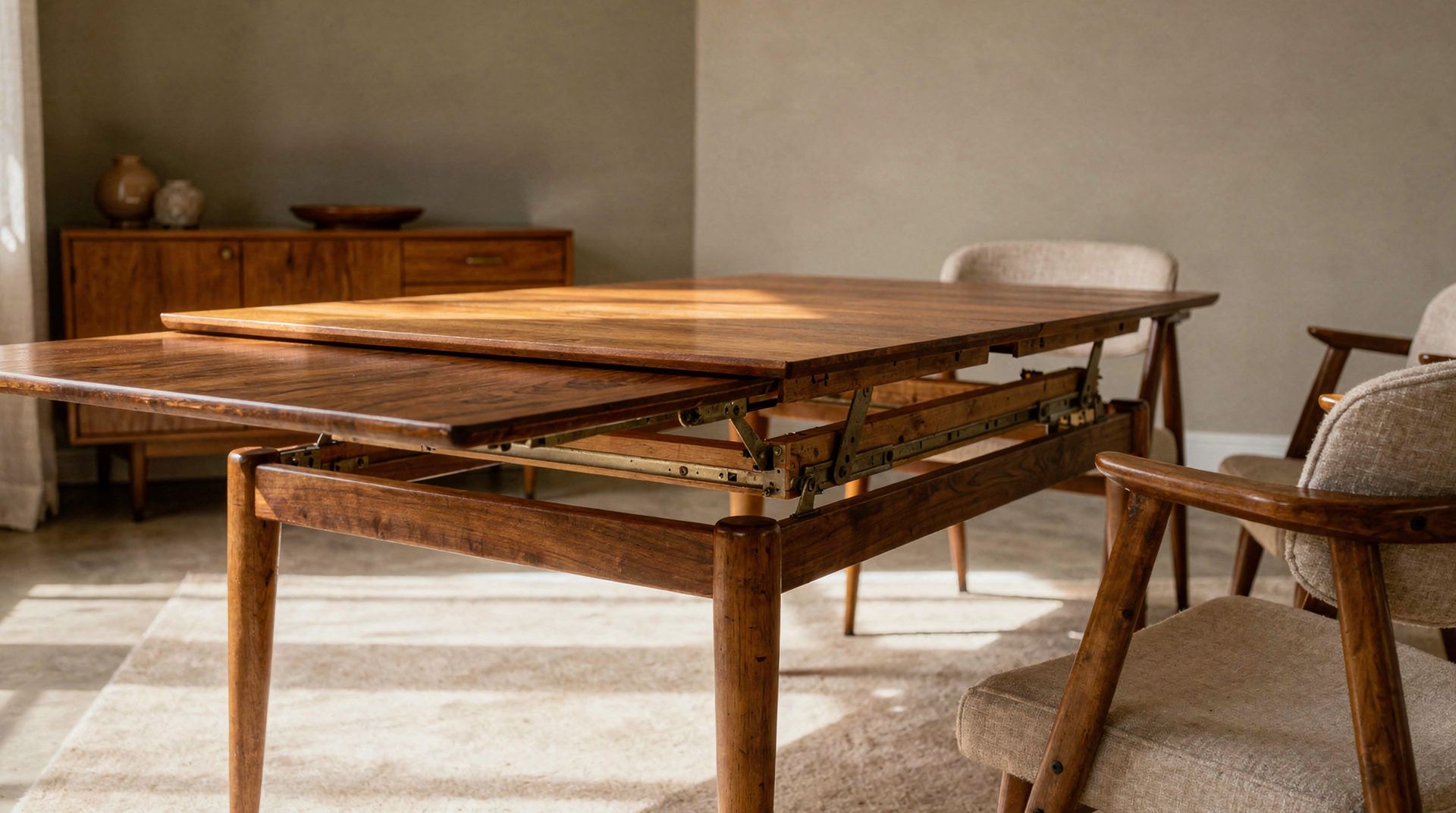
Extension systems fall broadly into three families: classic pull-apart leaves on wooden runners with one or more insert leaves, butterfly extensions with an additional surface folded beneath the top, and segment or rotating extensions such as those refined in Danish workshops. Always check the runners in the extended position: they should slide evenly without tilting. The insert leaves must come from the same veneer flitch as the main top; otherwise a later addition is indicated. In tilt and fold mechanisms, springs, bolts and stops are wear parts that can be restored but are relevant to inspection.
Regional Schools and Their Signatures
The Danish school remains the reference for constructive precision. Arne Vodder for Sibast, Niels Otto Møller with the models from the Møller workshop, Hans J. Wegner for Andreas Tuck, and Johannes Andersen stand for exact mortise-and-tenon joints, calm veneer patterns and extension systems that still function after sixty years. Scandinavian tables frequently bear burned or embossed workshop marks on the underside of the apron, along with model numbers and sometimes cabinetmaker’s signatures. Swedish and Norwegian designs – for example from Nordiska Kompaniet or Bruksbo – are stylistically related, often with a higher proportion of oak.
In Italy, a different sensibility prevailed: sculptural bases, marble, coloured laminates and brass characterise work by Ico Parisi, Osvaldo Borsani for Tecno, Gio Ponti or Carlo di Carli. Here, proportion and material contrast matter more than extension mechanics. French post-war designs – such as those by Pierre Jeanneret for Chandigarh or Charlotte Perriand – work with teak and solid angle joints, and are today independent collecting fields with specific provenance questions. German and West German production, with manufacturers such as Wilhelm Renz, Lübke or Wilkhahn, offers solid, often underestimated designs that are constructively close to their Danish counterparts. In the United States, George Nakashima with his live-edge solid-wood tops, Charles and Ray Eames for Herman Miller, and Florence Knoll each defined their own formal language between craft and industrial production.
Authenticity, Condition and What Collectors Check
The first step in any assessment is attribution. Look for manufacturer’s marks, paper labels, burned signatures or embossed stamps – usually on the underside of the apron, on the extension rails or on the underside of the top. Missing marks do not rule out originality, but they require comparative research in trade catalogues, sales archives and period manufacturer brochures. Historic photographs, invoices or records of previous ownership significantly increase documentary value.
Condition has three dimensions: substance, surface, mechanics. Hold the top against a raking light and check for warping, open joints and veneer bubbles. Small scratches and patina are to be expected on oiled surfaces and can usually be addressed with re-oiling. More critical are sanded-through veneers, broken edges, water damage with dark tide marks, or overpainted original surfaces that permanently alter the intended material appearance. For rosewood pieces, the CITES situation should be noted: Rio rosewood (Dalbergia nigra) is listed under Appendix I; other Dalbergia species under Appendix II, with implications for trade and cross-border movement.
Restorations are not a flaw if carried out professionally and documented. Re-glued aprons, replaced felt glides or refreshed oil finishes are normal maintenance. Problematic are replaced legs, replacement insert leaves with non-matching veneer, modern stains or thick-film lacquers that mask the ageing process. Ask directly when buying: what is original, what has been added, which materials were used. A reputable dealer answers this in detail and provides photographs before and after restoration.
On mid-centurydesigns.com, dining tables are curated exclusively according to this inspection framework. Attribution, manufacturer’s marks, construction and material findings are documented, restoration steps disclosed, and CITES certificates provided where relevant. Buying from us means receiving not an anonymous vintage piece of furniture, but a design with a traceable history and verified substance.
This article was generated automatically by an AI system. Disclosure pursuant to Article 50 of the EU AI Act.