CATEGORY · MID-CENTURY COUCHES & SOFAS

Mid-Century Couches & Sofas: A Collector's Buying Guide

From Vladimir Kagan to Cesare Paolini: what connoisseurs look for

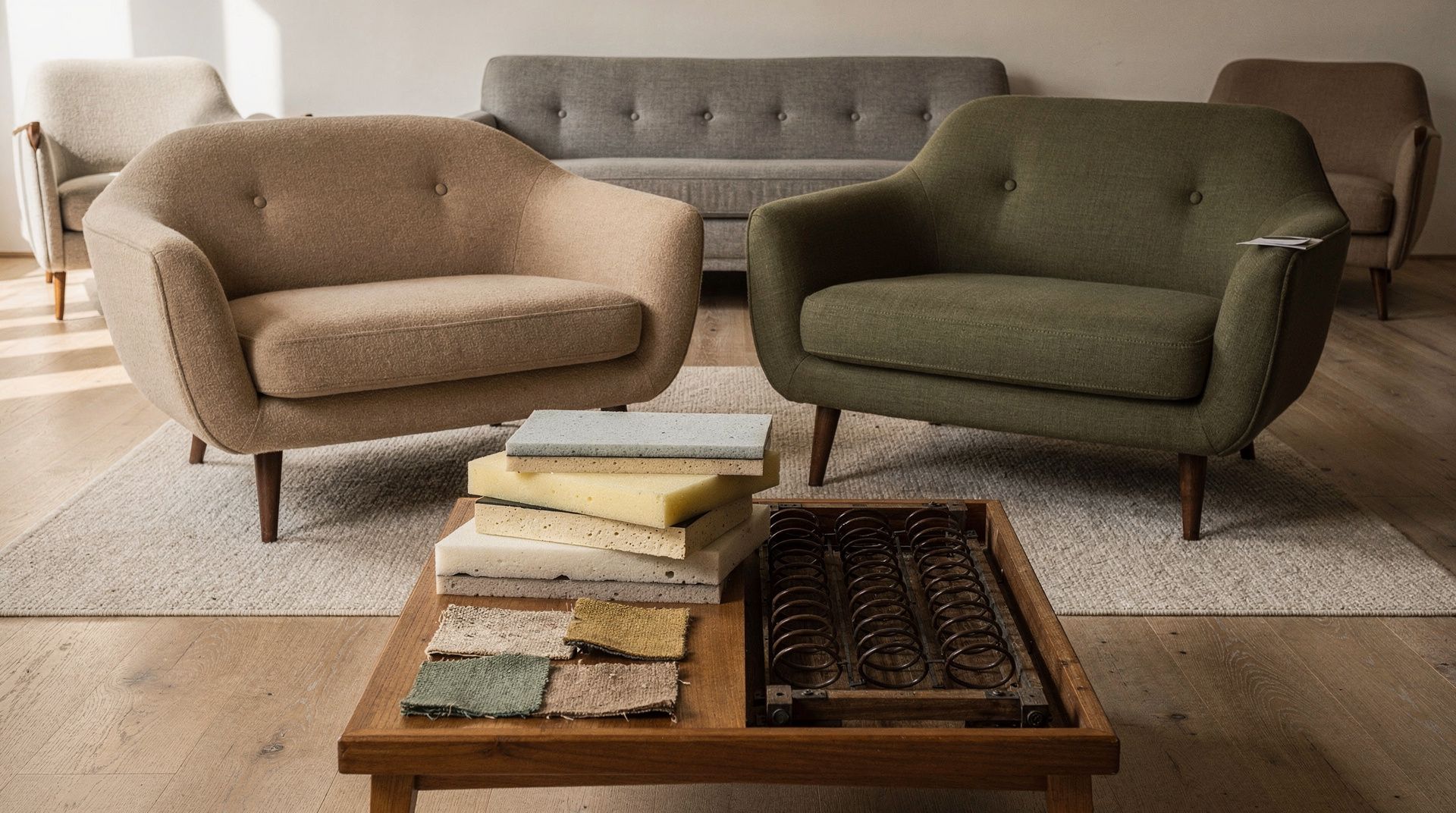
A sofa from the 1950s to 1970s is more than a piece of seating furniture: it is a testament to a design language that brought together organic lines, sculptural frames and experimental upholstery architecture. This guide shows you how to recognise characteristic designs, assess the quality of foam and spring cores, and weigh up whether original upholstery or professional re-upholstery best serves the value of your piece – so you can make decisions that hold up both as a collector and as an investment.

mid-century·designs

Mid-Century Couches & Sofas

ESSAY · 01

Work & Context

mid-century·designs

Mid-Century Couches & Sofas: What Really Makes a Collector’s Piece

A sofa from the mid-twentieth century is not just any upholstered piece of furniture – it is a testament to a paradigm shift in design. Between the late 1940s and early 1970s, designers in the USA, Scandinavia, Italy and France broke away from the heavy, over-upholstered conventions of the interwar period and developed a new grammar of seating: deeper seat surfaces, floating volumes, exposed frames, and textile covers that consciously incorporated colour and tactility. Anyone buying a mid-century sofa today acquires that sensibility along with it – or acquires a copy of it. The difference lies in details that cannot be read from a buzzword, but from the material, the construction and the provenance.

This guide addresses the most important questions to consider before buying: what upholstery structures and spring-core systems are typical, how do you recognise the signature of a particular workshop, and how do you assess condition on the spectrum between original patina and necessary restoration. This is not about chasing trends, but about the ability to read a piece in the context of its time and its market.

Materials and Construction: Foam, Spring Core, Webbing

The technical foundation of a mid-century sofa determines its comfort, ageing characteristics and restorability. Three construction principles are relevant.

First, the classic steel spring core with coil springs, often combined with jute webbing, a horsehair layer and a thin layer of cotton wadding. This system dominates in earlier US designs and in European workshops that still operated by hand. It is durable, can be re-tensioned and allows for professional rebuilding without losing the seat geometry.

Second, elastic webbing made from rubber straps (Pirelli straps and equivalents), which began supporting many Italian and Scandinavian sofas from the 1950s onwards. The straps age as a result of their material: after thirty to forty years they lose tension, become brittle and must be replaced. Replacement is standard work for a qualified upholsterer and is value-neutral as long as the frame remains untouched.

Third, cold foam or latex, which increasingly replaced horsehair and cotton from the 1960s onwards. Original foam from this era is in most cases beyond saving: it crumbles, compresses, loses its resilience and smells. Replacing the foam cores is unavoidable in almost all pieces from this generation and does not diminish collector value, provided the outer form and – where present – the original cover are treated with care.

With the covering fabric, it is worth taking a close look at the weave types of the period: bouclé, coarse wool felt, mohair velvet, Kvadrat precursors such as Hallingdal (from 1965), Italian chenille and velvet qualities. The fibre composition can often be verified by touch and by a small burn test on a concealed seam.

Regional Schools and Defining Designers

Mid-century upholstery design has no single language, but dialects that can be assigned geographically.

In the USA, Vladimir Kagan stands for sculptural, often asymmetrical sofas with sweeping floor plans, slender legs and opulent upholstery volumes floating on walnut frames. Edward Wormley for Dunbar works with greater restraint, with precise proportions and a classically modern linearity. Harvey Probber brings modular seating landscapes to the luxury market. George Nelson and Charles & Ray Eames develop systemic solutions for Herman Miller in which frame and upholstery are clearly separated.

In Italy, figures such as Gio Ponti, Ico Parisi, Marco Zanuso (Lady and Sleep for Arflex) and later Cesare Paolini, Franco Teodoro and Piero Gatti (Sacco for Zanotta, 1968) define the range between architectural rigour and radical experiment. Osvaldo Borsani developed the D70 for Tecno – an ingeniously adaptable sofa that remains a reference point to this day.

Scandinavia contributes a design language through Hans J. Wegner, Finn Juhl, Arne Jacobsen and Illum Wikkelsø that treats wood, upholstery and textile as equal elements. Finn Juhl’s Model 57 or Wegner’s GE series for Getama are examples in which the frame construction is openly displayed.

France brings its own, often low-slung and sensuous line through Pierre Paulin, Michel Ducaroy (Togo for Ligne Roset, 1973) and Pierre Guariche. German contributions, from Herbert Hirche or Walter Knoll for instance, tend to operate in a more sober, engineering-oriented vein.

Assigning a sofa to one of these schools is the first step in valuation, because the design language, typical woods and typical fittings serve as criteria for assessment.

Authenticity, Condition and Market Assessment

For collectors, the complete legibility of a piece is paramount. Assess systematically:

Signatures and labels. Herman Miller, Knoll, Dunbar, Arflex, Cassina, Fritz Hansen, Getama and Zanotta used paper, metal or branded labels, often on the underside of the frame or beneath the seat cushion support. Missing labels do not rule out authenticity, but require additional evidence: dealer invoices, catalogue photographs, responses from company archives.

Frame and joints. Original pieces display period-typical screw types, dowel joints and wood species. Solid walnut, teak or rosewood (on pieces predating the CITES convention) are common; later reproductions frequently use veneered panels or MDF cores.

Upholstery layers. Where possible, open an inconspicuous seam or have the upholstery examined by a professional. Horsehair, jute, cotton wadding and original webbing are indicators of an untouched interior structure. A complete rebuild using modern materials is standard and market-accepted for everyday-use sofas, but must be communicated transparently.

Original cover vs. re-cover. A preserved, intact original cover significantly increases the value of collector pieces, provided it is not faded or severely damaged. A professional re-cover using a period-correct fabric quality (not necessarily identical, but true to the era) is the second-best option. Covers in synthetic fashion fabrics from later decades diminish value.

Market trends. The market for iconic mid-century sofas is stable to rising, particularly for documented designs by Kagan, Juhl, Borsani, Paulin and the Italian protagonists. Production pieces without a clear attribution, by contrast, move sideways. The decisive factors for investment value are certainty of attribution, condition of the frame, quality of restoration and traceability of provenance.

At mid-centurydesigns.com we curate sofas and couches according to precisely these criteria: every piece is assessed for frame, upholstery structure, cover history and attribution, documented, and – where necessary – carefully restored by specialist workshops. For every object you receive a clear account of what is original, what has been professionally renewed and what evidence exists regarding provenance, so that your decision is based on facts rather than assumptions.


This article was generated automatically by an AI system. Disclosure pursuant to Article 50 of the EU AI Act.

FAQ · 02

Frequently asked about Mid-Century Couches & Sofas

5 Answers

01
How do I recognise an original Kagan sofa, and how important is the original upholstery for its value?
Vladimir Kagan's sofas from the 1950s and 60s display characteristic features: sweeping, organic forms, wide armrests and an asymmetrical silhouette. Genuine signed examples are often accompanied by manufacturer markings. Original upholstery increases collector value by approximately 30–50 percent compared to re-upholstered pieces. Authentic Kagan is distinguished by precise craftsmanship and innovative spring-core constructions. When buying, you should request provenance documentation and inspect the frame construction, which in originals consists of wood or plywood.
02
What are the differences between foam and spring-core systems in mid-century sofas, and what should I look out for when buying?
Mid-century classics typically use spring cores (1940s–60s) or early foam layers (from the mid-1960s onwards). Spring-core structures offer better longevity and are repairable today; foam from this era tends to compress and break down. When viewing a piece, check the elasticity of the seat and inspect the frame for woodworm or cracks. Original foam from the 1950s is difficult to replace. Spring systems allow for authentic restoration. This is a key purchasing factor for long-term value retention.
03
How do high-quality Paolini sofas differ from reproductions, and what design features are typical?
Paolini designed primarily for Italian manufacturers such as Arflex. Genuine Paolini pieces display characteristic low, geometric floor plans and integrated cushion design. Reproductions lack the precision in proportions and the quality of upholstery detailing. Documentation through exhibition catalogues, design museum registers or provenance records is essential. Original Paolini sofas sell on the international market for over €8,000, depending on condition and documentation.
04
Is a full restoration better than preserving the original upholstery, and how does this affect the market price?
For authentic collectors, preserving the original upholstery is preferable, even if it shows signs of wear. It documents the design intention and the craft heritage. In price terms, a re-upholstered sofa loses 25–40 percent compared to a comparable example in original condition. Exceptions apply to damage such as broken-through seats or structural damage to the frame. Professional restoration that retains the frame and materials (springs, jute underlays) is a compromise that preserves value better than a complete re-cover.
05
Which mid-century sofas are currently rising in collector value, and what do current market trends indicate?
Sofas by Gianfranco Frattini, Charles and Ray Eames, and Scandinavian designers (Arne Vodder, Knoll associates) are showing stable price growth. Small, modularly usable sofas and lounges are becoming more sought after due to increasingly limited living space. Pieces by Herman Miller and Dunbar with authentic provenance are holding their values. The market segment is differentiating: documented originals with certificates are rising 3–5 percent annually, while mass-produced variants and reproductions are stagnating in value. Single-layer upholstery storage and inferior frame constructions are declining in value.

GLOSSARY · 03

Related Terms

10 Entries

Spring-Core System
A support system for upholstered furniture in which spiral steel springs are arranged within a unit. In mid-century sofas, a distinction is made between sinuous springs, Bonnell springs and figure-eight springs. An undamaged spring core is considered a quality feature and has a significant influence on investment value.
Original Upholstery
The preservation of the original padding materials and covering fabric from the time of manufacture. In collector's pieces such as mid-century sofas, the original upholstery (such as linen, cotton or early synthetic fibres) is assessed as authentic even when wear is visible. It attests to provenance and age.
Foam Quality
The differentiation of upholstery foams by density (kg/m³) and resilience. High-quality foam in mid-century designs (mostly from the 1960s onwards) shows stable recovery and lower wear. Cheap foam hardens or disintegrates, which is a factor to assess when purchasing.
Kagan Design
Upholstered furniture by the designer Vladimir Kagan, characterised by flowing, organic curved forms and innovative frame structures. His sofas from the 1950s to the 1970s are regarded as classics of Mid-Century Modern and show strong collector value development.
Spring-Core Rebuild
The restoration-technical renewal of a damaged or worn spring-core system through replacement or repair. A professionally restored spring core increases usability but, in the case of rare collector's pieces, diminishes authentic provenance.
Paolini Upholstery
Characteristic upholstery work and formal design associated with the Italian designer and manufacturer. Paolini sofas combine a sculptural formal language with artisanal upholstery craft, typical of Italian mid-century design from the 1950s to the 1970s.
Vintage Sofa Classic
Sofa models from the mid-century period (approximately 1930s–1970s) that have attained the status of collector's pieces through design quality, manufacturer reputation and rarity. They are subject to market trends and value appreciation, particularly in the case of limited or renowned designer productions.
Investment Potential
An assessment criterion for mid-century sofas based on designer prestige, condition, rarity, provenance and demand in the collector's market. Original condition, signed frames and documented provenance and age demonstrably increase investment potential.
Full Restoration
Comprehensive refurbishment of a mid-century sofa involving partial or complete replacement of upholstery, covering and spring core. A professional restoration preserves the formal language and frame structure but influences the assessment as a collector's piece depending on the extent of the interventions.
Sinuous Spring
A wave-shaped steel tension spring widely used in modern mid-century upholstered furniture. It provides elastic suspension with a dense arrangement and is considered more robust than Bonnell springs. Sinuous springs are typical of high-quality upholstered furniture from the 1960s and 1970s.