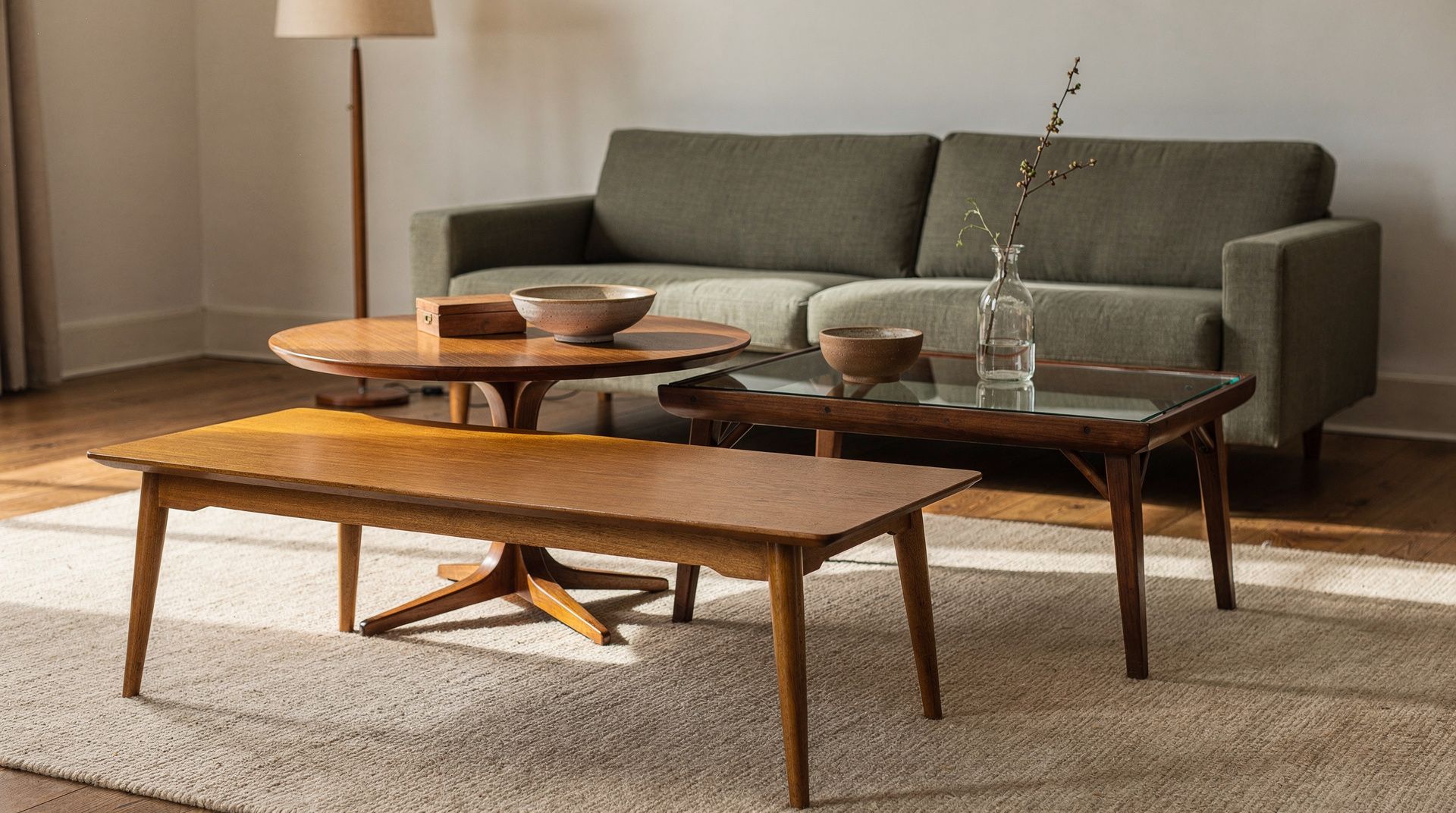
Understanding Mid-Century Coffee Tables: A Curated Approach
The coffee table is a comparatively young category of furniture. Only with the reorganisation of domestic life after 1945, the rise of the open seating group and the low sofa landscape did it gain significance as a piece of furniture in its own right. In the workshops of Scandinavia, northern Italy and the US East Coast, it became, between the late 1940s and the early 1970s, a touchstone for material understanding, constructional logic and formal reduction. Anyone searching for original pieces today moves in a market shaped by reproductions, reworkings and occasionally generous datings. A trained eye for material, base and surface is therefore not an academic luxury but the foundation of any serious purchasing decision.
This guide sorts the characteristics by which the quality and authenticity of a mid-century coffee table can be read. It does not replace a personal inspection, but it sharpens the criteria with which you assess a piece before adding it to your collection.
Characteristic Materials and Their Workmanship
The material palette of the era is manageable but precisely defined. Among the woods, teak and rosewood (predominantly Rio and East Indian rosewood) dominate, alongside walnut, cherry, oak and light maple and birch veneers in Scandinavian and American modernism. The distinction between solid wood and veneer on a substrate is important: high-quality panels from the 1950s and 60s are usually executed as veneer on blockboard or plywood, often with a counter-veneer on the underside and a neatly worked solid-wood edge banding. A consistently solid carcass is not inherently a mark of quality – constructionally it is often even disadvantageous, because it moves.
For non-wood materials, it is worth examining marble (Carrara, Portoro, Verde Alpi), travertine limestones, thick-walled crystal glass, enamelled sheet metal, woven rattan as well as brass, chrome and powder-coated steel. Ceramic tiles, as found in Danish series of the 1960s, are another distinguishing feature. Surface treatment is a central criterion: originals typically show oiled, soap-treated or nitrocellulose-lacquered surfaces. Modern two-component lacquers, glossy polyurethane films or heavily applied waxes indicate later restorations and generally reduce collector value.
Regional Schools, Bases and the Signature of the Designers
The bases reveal the origin. The Danish school (including works by Finn Juhl, Hans J. Wegner, Peter Hvidt and Orla Mølgaard-Nielsen for France & Søn, Grete Jalk or the workshops of Johannes Andersen) works with turned round legs, conically tapered square legs and openly visible mortise-and-tenon joints. Distinctive features are narrow aprons, Shaker-adjacent proportions and frequently a lower shelf in cane or slatted timber. Swedish and Norwegian production (Dux, Bruksbo, Haug Snekkeri) shows a comparable language, often in teak, with quieter edges.
American modernism brings a different formal language: George Nakashima works with live-edge slabs and visible dovetail butterflies; Isamu Noguchi designed in 1947 for Herman Miller the iconic free-form table made of two interlocking wooden supports and a glass top; Paul McCobb, Edward Wormley for Dunbar and Milo Baughman rely on brass, walnut and chrome. Charles and Ray Eames as well as Eero Saarinen (Tulip series for Knoll) establish cast and moulded plywood constructions. In Italy, Gio Ponti, Ico Parisi, Osvaldo Borsani (Tecno) and later Angelo Mangiarotti shaped the language with marble and steel works; in France, Charlotte Perriand, Pierre Jeanneret (Chandigarh project) and Pierre Chapo are relevant with solid elm and oak constructions. German production – Wilhelm Knoll, Walter Knoll or the early Interlübke ranges – moves between the Bauhaus legacy and Scandinavian influence.
Pay attention to the joinery details: dovetailed corners, inset metal fittings, cleanly routed grooves for shelves, turned leg tips with characteristic finishing rings. Screwed angle brackets in galvanised steel are an indicator of repairs or new manufacture.
Authenticity, Condition and Provenance
The examination begins with the markings. Danish manufacturers used the Dansk Møbelkontrol seal (a D-mark in a circle, from 1959 onwards), often in combination with a maker’s brand or paper label from France & Søn, Fredericia, Søborg, Illums Bolighus or the Copenhagen cabinetmakers. Herman Miller and Knoll used printed paper labels and embossed metal plaques whose typography and wording changed over the decades and is today well documented. The absence of a label is not an exclusion criterion, but it calls for additional evidence: constructional features, catalogue illustrations, invoices, previous ownership.
On condition, distinguish between patina and damage. A quietly aged, oiled teak top with fine traces of use ranks higher for collectors than a surface that has been sanded back and re-lacquered. Critical issues include: sanded-through veneers (recognisable by colour shifts and visible substrate at edges), cracked solid panels caused by dryness, loosened mortise-and-tenon joints, subsequently shortened legs, replaced castors or glides, and exchanged glass or stone tops. With marble, a comparison of edge profiles with historical catalogues is worthwhile; with glass, look for original facet cuts and manufacturer etchings. UV light reveals retouching and new lacquer; a look at the underside almost always tells you more than the show face: ageing of the wood, tool marks, old nail holes, remnants of labels, workshop handwriting.
Reproductions and licensed re-editions are not a flaw in themselves, but must be declared as such. A Noguchi Coffee Table from current Vitra or Herman Miller production is a quality piece of furniture, but it is not a vintage object. The price difference compared to an early example with a signature and documented provenance is considerable, and this differential should be reflected in the offer.
At mid-centurydesigns.com we examine every piece according to these criteria, document origin, dating, degree of restoration and existing markings, and disclose what is original, supplemented or reworked. This allows you to make a purchasing decision on the same basis on which we curate: with the conviction that a mid-century coffee table should not only look good, but be able to substantiate its history.
This article was generated automatically by an AI system. Disclosure pursuant to Article 50 of the EU AI Act.