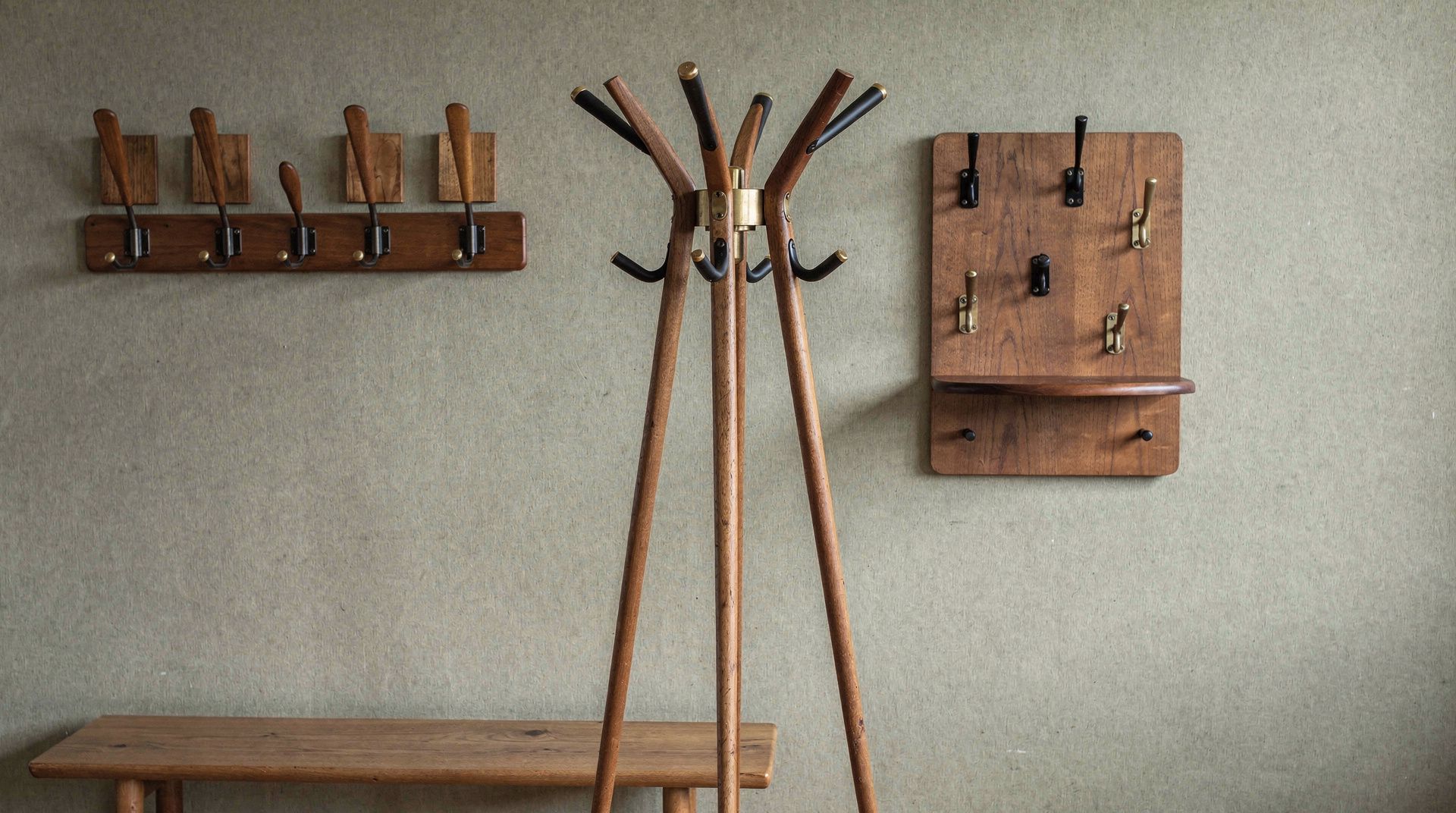
Mid-Century Coat Racks and Hall Stands as Collectibles
Coat racks and hall stands of the Mid-Century era have long been underestimated in the collector’s landscape. As threshold furniture – between the street and the living space – they had to be functional, stable and at the same time presentable. It is precisely in this dual role that the design precision of post-war modernism is most clearly evident: reduced silhouettes, exposed joinery, honest material choices. A wall panel with rhythmically offset brass hooks, a coat tree with cantilevered branches of lacquered steel wire, or a console with an open-pored teak hat shelf are not accessories but independent witnesses of their time.
This buyer’s guide is aimed at you if you regard coat racks not as expendable furniture but as collectibles. It is about construction logic, material pairings, the question of what makes an object authentic and what it can sustain in everyday use. We deliberately stay close to the object: How are the hooks arranged, how is the frame mortised or screwed together, how does the material behave after sixty or seventy years? Anyone who takes these questions seriously will quickly understand why some designs have lost none of their presence to this day.
Characteristic Materials: Wood Species, Metal Fittings, Manufacturing Traces
The material palette of Mid-Century coat racks is manageable but nuanced. Among the woods, teak, rosewood (Rio and East Indian rosewood), walnut, oak and – in Scandinavian series – frequently beech dominate. You can recognise teak by its oily, warm honey-coloured to medium-brown base tone with darker streaks; rosewood has a markedly more contrasting grain and appears deeper in tone. Walnut, frequently found in American designs of the 1950s, shows a calmer, more chocolate-brown figure. When examining wall coat racks, look for solid heartwood rather than veneered particleboard, especially in load-bearing rails. Veneers are not a disqualifying criterion, but the substrate should be solid wood or at least blockboard.
Among the metal fittings, brass, burnished steel, chrome-plated steel and powder-coated round steel are the defining materials. Brass hooks from the 1950s and early 1960s are usually solid-turned or cast, not hollow-pressed. A slightly uneven, aged gold tone with a dark patina in the recesses speaks for authenticity; a flawlessly uniform shine suggests re-plating or replacement parts. Chrome-plated wire frames, typical for compact hall stands, should be cleanly hard-soldered at the joints. Small solder beads and minimal colour differences at the joints are a good sign of period handwork.
Manufacturing traces reward a second look. Hand-cut dovetails, tapered wooden dowels, visibly chamfered edges or lathe marks on uprights point to workshop-based production. Industrial serial production, by contrast, yields precise drill holes, uniform chamfers and typical maker’s stamps on the back of the mounting board.
Regional Schools and Defining Designs
The Danish school shapes the image of the Mid-Century coat rack like almost no other. Aage Kristiansen, Kai Kristiansen and the workshops around Fritz Hansen and Frem Røjle developed wall coat racks with horizontal teak rails and slender brass or aluminium hooks, often in modular lengths. Characteristic is the clear separation between the load-bearing wooden rail and the screwed-on hook, which deliberately allows for repair and replacement. In Sweden, designs by Nils Strinning (String System) worked with the idea of wall integration: delicate, plastic-coated wire ladders into which coat rack panels can be suspended.
From the German-speaking world come the restrained, elegant designs of the 1950s closely related to the kidney-table aesthetic, frequently featuring Formica shelves, conically tapering legs in black lacquered steel and asymmetrically arranged ball hooks in brass. Manufacturers such as WK Möbel or the smaller workshops of the Werkbund milieu stand for careful craftsmanship with a visible constructional principle. From Italy come more sculptural solutions: Carlo Mollino’s playful, often asymmetric wall objects, or the famous “Servomuto” type with its sculptural base disc. The Italian line places greater emphasis on gestural design than on modular systematics.
The American Mid-Century coat rack, in turn, is closely associated with the wall designs of George Nelson. His “Coconut Coat Rack” designed for Herman Miller, and the related wall objects with colour-lacquered wooden balls on steel pins, are iconic and continue to be widely reproduced. For that very reason, the question of authenticity is particularly relevant when it comes to American designs.
Authenticity, Condition and Restoration Decisions
For collectors, the detailed examination determines value. Begin with wall coat racks at the back: originals frequently carry burned-in or stamped maker’s marks, model numbers, and in Danish production the quality control mark of the Møbelfabrikantenes Kontrol (the triple-crown stamp on certified Danish furniture). The absence of any marking is not an automatic exclusion, but it demands more careful assessment of material quality and workmanship.
Check the stability of stands consistently. Place the object on a level surface, load it asymmetrically with the weight of a winter coat and observe any torsion. Coat trees from the 1960s with a star-shaped cast-iron base cross are constructionally robust; lightweight wire constructions, by contrast, may have become loose if solder joints have been repeatedly stressed. On folding or collapsible stands, the hinges are critical. An original brass hinge shows uniform resistance throughout the full range of motion; worn bore holes, visible play or subsequently inserted screws with the wrong head profile (for example, a Phillips head on an object from the early 1950s, where slotted screws were standard) are warning signs.
In restoration, the principle of reversible, minimal intervention applies. Soiled teak can be carefully refreshed with fine steel wool and teak oil without destroying the patina. Surface-sanding should be avoided, as it levels the sharp edges and original tool marks, significantly reducing collector value. Brass should not be polished but merely degreased; the grown patina is part of the object’s history. Chrome parts with surface rust can be treated with aluminium foil and mild oil; deeper pitting is better left visible than erased by re-plating. Replaced hooks should be documented and, where possible, supplemented with period-matching originals from spare parts stocks.
Missing parts are the most common factor reducing value. With modular Danish wall coat racks, individual hooks can often be sourced; with singular designs such as the Nelson wall objects, every replacement ball is an intervention in the substance. Before purchasing, therefore, check whether all elements are present, whether the colour sequence is consistent and whether the metal pins sit straight.
At mid-centurydesigns.com we curate coat racks and hall stands exclusively from verified provenances. Every piece is documented with regard to construction, material substance, completeness and restoration status; visible interventions are disclosed transparently. If you are specifically looking for a particular design, a workshop or a period, our inventory provides reliable information on provenance, condition and what the object carries – in the literal as well as the ideal sense.
This article was generated automatically by an AI system. Disclosure pursuant to Article 50 of the EU AI Act.