CATEGORY · MID-CENTURY CHAIRS

Mid-Century Chairs: A Collector's Buying Guide

Reading seat shells, checking frames, assessing provenance

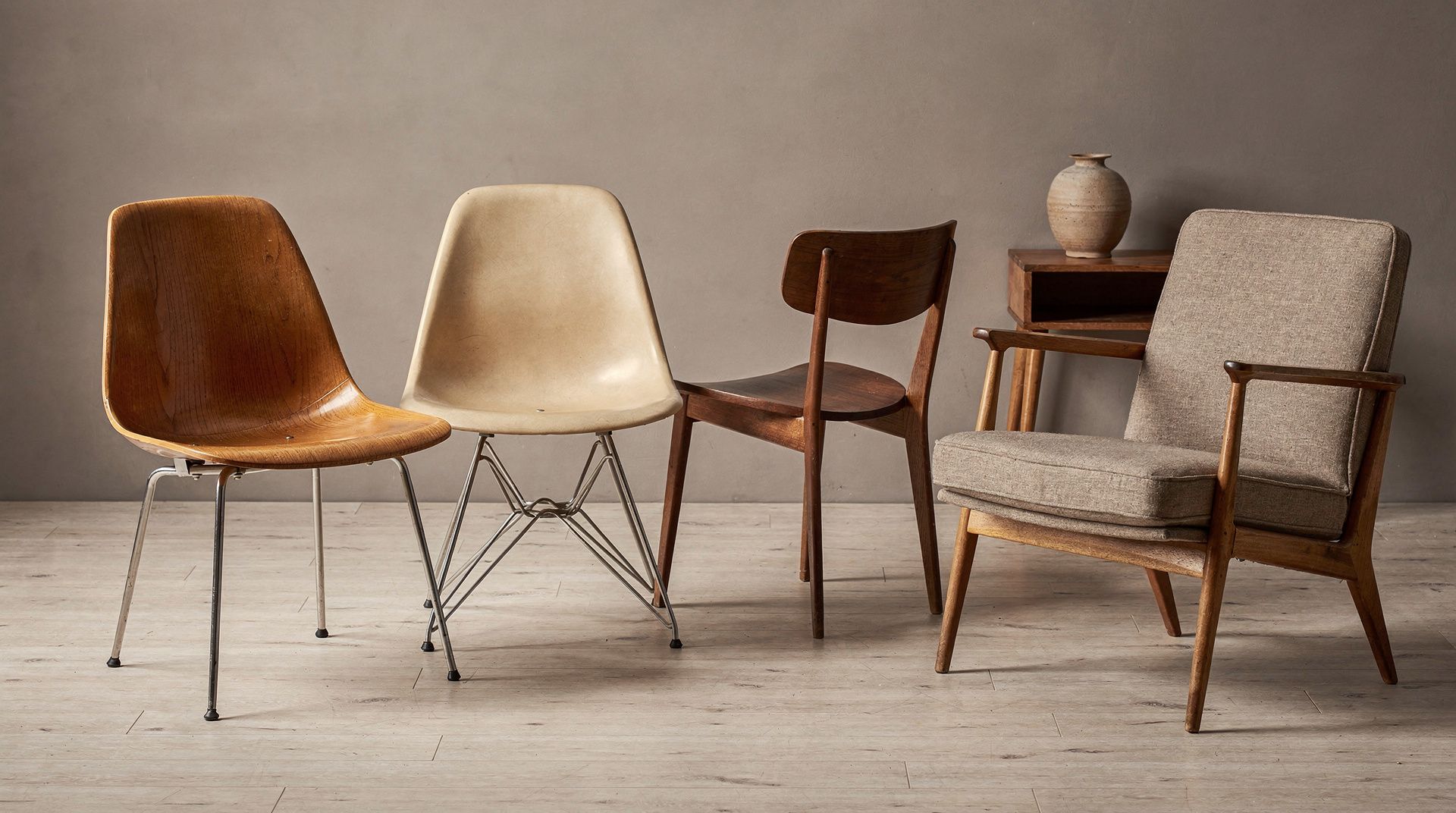
An original Mid-Century chair reveals its origins in the details: in the shaping of the seat shell, in the joinery of the frame, in the patina of teak, rosewood, chrome-plated steel or moulded plywood. This guide helps you recognise characteristic construction features, realistically assess material quality and craftsmanship, and distinguish signs of wear from substantial interventions. This way you make informed purchasing decisions and verify authenticity based on traceable criteria rather than promises.

mid-century·designs

Mid-Century Chairs

ESSAY · 01

Work & Context

mid-century·designs

Understanding Mid-Century Chairs as Collectibles

The chair is perhaps the most honest object of Mid-Century Modernism. It brings together materials research, industrial manufacturing techniques and a new idea of domestic living that took shape in parallel between the late 1940s and early 1970s in Scandinavia, the USA, Italy and Germany. Collectors of vintage chairs today are buying less a piece of furniture than a piece of design history: a seat shell by Charles and Ray Eames, a teak frame by Hans J. Wegner, a chrome-plated cantilever from the legacy of the Bauhaus. The market has grown correspondingly demanding — re-editions and reproductions circulate alongside originals, and condition often determines value more decisively than the model alone.

This buying guide sets out the most important criteria by which collectible chairs can be identified: material and construction, regional signatures, and the verification of authenticity and condition. The goal is not a quick purchasing decision, but a trained eye that can read an object within its historical context.

Recognising Materials and Construction Techniques

The technical signature of a Mid-Century chair almost always lies in the interplay between seat shell and frame. Moulded laminated wood, brought into series production in the USA by Charles and Ray Eames for Herman Miller from 1946, can be identified by the visible veneer layers at the edge of the shell, as well as by the characteristic rubber discs — known as shock mounts — that elastically connect seat and back to the frame. Aged natural rubber hardens, discolours and breaks down over the years; replacement is common in restoration practice but should be documented.

Fibre-reinforced polyester, as used in the Eames Plastic Chairs from 1950 to around 1989, has a slightly fibrous surface that shimmers in raking light. Later re-editions in polypropylene appear smoother and denser. In solid wood chairs of the Scandinavian school, joinery is key: slotted and tenoned corner joints, concealed dovetails, and cleanly executed finger joints at the armrest junction speak to the hand craftsmanship of cabinet-making workshops such as Johannes Hansen, Fritz Hansen and PP Møbler. Teak, rosewood, oak and walnut dominate, with Rio rosewood having been listed under CITES Appendix I since 1992, requiring documentation for cross-border trade.

Steel tube, flat steel and die-cast aluminium point to a different tradition: from the cantilever chairs of the interwar period to Eero Saarinen’s Tulip series for Knoll from 1957, or the Eames Aluminium Group chairs of 1958. Look for casting seams, original chrome plating with a faint bluish tint rather than harsh re-nickel plating, and original upholstery in wool, leather or hopsack.

Regional Schools and Defining Designers

Scandinavia stands for the union of craft and organic form. Hans J. Wegner designed over 500 chairs, including the Round Chair of 1949, the Wishbone Chair CH24 for Carl Hansen & Søn from 1950, and the Shell Chair CH07 of 1963. Finn Juhl collaborated with cabinetmaker Niels Vodder on sculptural solutions in which the seat shell appears to float above the frame. Arne Jacobsen defined a formally reduced, industrially viable aesthetic with the Ant (1952), Series 7 (1955), Egg and Swan (both 1958) for Fritz Hansen. In Finland, Alvar Aalto’s bent-wood technique at Artek provided the constructive foundation; in Sweden, Bruno Mathsson and Yngve Ekström each made distinctive contributions.

In the USA, development was technology-driven: Herman Miller and Knoll produced designs by Charles and Ray Eames, George Nelson, Eero Saarinen and Florence Knoll. Italy developed its own language in the 1950s and 1960s, positioned between rationalism and sculpture — visible in Gio Ponti’s Superleggera for Cassina (1957), Carlo Mollino, and Osvaldo Borsani for Tecno. Germany can be read through the Ulm School, Egon Eiermann, and the early collaboration between Vitra and Herman Miller from 1957. These regional signatures are more than stylistic traits — they help verify attributions: a purportedly Danish armchair with an American plywood construction always requires explanation.

Verifying Authenticity, Condition and Provenance

The first thing to examine is the labelling. Herman Miller used changing labels across the decades, from embossed metal plates in the 1950s to paper and foil labels in later years. Fritz Hansen has long stamped year and model number into the wood; Carl Hansen & Søn uses a branded mark on the underside of the seat. Knoll chairs carry paper labels or embossed markings depending on the era. Missing labels are not disqualifying, but they are a reason to examine construction, material ageing and component proportions all the more carefully. Reproductions often deviate from original dimensions by millimetres, use different screws, different foams or incorrect wood species.

In terms of condition, the market distinguishes between original substance, professional restoration and overpainting. A flattened paper cord on Wegner’s CH24, age-appropriate patina on leather, fine scratches in the clear lacquer — these are marks that authenticate an object, not defects. Problematic by contrast are aggressive re-lacquerings that clog the pores, re-dyeing of rosewood, improper re-gluing of seat shells, or replaced frames. With upholstered pieces it is worth looking under the covering: original webbing, original foams and old nailing confirm that the construction has not been exchanged. Provenance — previous ownership, invoices, catalogue entries or exhibition records — raises the value of comparable pieces considerably, but is rarely complete.


At mid-centurydesigns.com we curate exclusively pieces that meet these standards of scrutiny. Every object is examined for model, manufacturer, production period, material condition and degree of restoration, and documented together with any present markings. Where restoration has taken place, we specify its scope and execution. This allows you as a collector or designer to make a decision based not on images, but on traceable facts about an original Mid-Century chair.


This article was generated automatically by an AI system. Disclosure pursuant to Article 50 of the EU AI Act.

FAQ · 02

Frequently asked about Mid-Century Chairs

5 Answers

01
How do I tell an authentic Mid-Century chair from a modern reproduction?
Genuine Mid-Century chairs show typical manufacturer characteristics: production marks such as pour lines on plastic shells, wood grain patterns that are not repeated identically in serial production, and original assembly techniques. Check the underside of the chair for manufacturer stamps, designer names or numbers. Reproductions often feature perfectly flat plastic surfaces and more precise manufacturing tolerances. Differences in adhesives, fasteners and the patina of the wood are reliable indicators. Reputable sellers can document provenance and production period.
02
How do I assess the quality of the various frame materials in Mid-Century chairs?
Steel tube in chrome-plated or powder-coated finish is considered high quality and durable, especially when joints are welded. Solid wood frames in teak, walnut or birch demonstrate their quality through clean craftsmanship and stable glue joints. Moulded plywood by manufacturers such as Eames was laminated with phenolic resin and is extremely durable. Less valuable are cheap plywood constructions or later steel tube variants with a thinner diameter. The frame should show no cracks, loose glue joints or worn pivot points.
03
Which signs of wear are normal, and when should I walk away from a purchase?
Normal patina on Mid-Century chairs includes light scratches in the lacquer, minor colour variations from UV exposure, slight deformation of seat shells and superficial surface marks on wood. Problematic, however, are deep cracks in plastic or plywood shells, broken or repaired frames, missing or lost surface coatings, and active woodworm (identifiable by bore holes and fine bore dust). Seat indentations should be within acceptable limits and not compressed through. Professional restoration is sometimes worthwhile, but does not necessarily increase the value of an original surface finish.
04
Which construction techniques indicate high Mid-Century quality?
High-quality chairs use welded or steel-screw-fastened frame constructions. Seat shells in polyurethane or plastic should be connected to the frame in a break-resistant manner, not simply glued. Rubber feet underneath indicate quality awareness. Upholstered constructions frequently use coil springs, foam or down on jute underlays. Seams should be precise and even. Particularly valuable pieces show craft refinements such as clean woodworking, fully visible fixings and reversible fastenings. Designers such as Eames, Wegner and Jacobsen invested in robust constructions that continue to function to this day.
05
What distinguishes a vintage chair from a genuine designer piece, and how does that affect value?
Designer chairs were created under the direction of recognised designers and were often produced with their name as a label or stamp (e.g. Eames, Wegner, Møller, Jacobsen). Vintage chairs are mass-produced or regionally manufactured pieces without a documented designer. Designer pieces have collector value, are sought after and well documented, while vintage chairs fetch lower prices. However, unknown vintage chairs can display high craftsmanship and rare material combinations that may appeal to interior designers. Value depends on condition, construction quality and design-historical context — not on the label alone.

GLOSSARY · 03

Related Terms

9 Entries

Seat Shell
A single- or multi-part seating element made of plastic, plywood or laminated veneer, characteristic of Mid-Century chairs. The seat shell is mounted on a separate frame and allows for organic forms and ergonomic adaptations typical of 1950s and 1960s design.
Steel Tube Frame
A structural frame made of seamless or welded steel tubes, often chrome-plated or powder-coated. The steel tube frame was a key innovation of Modernism, enabling lightweight, stackable and mass-produced chairs without a solid wood structure.
Plywood Lamination Technique
A method of producing seat surfaces and backrests by gluing and pressing multiple thin wood layers in a mould. This technique, perfected by designers such as Charles and Ray Eames, achieves both structural stability and sweeping, organic forms simultaneously.
Patina
Surface change caused by age, use and oxidation on wood, metal or plastic. On authentic vintage chairs, patina is a marker of authenticity that attests to age and provenance, but should be distinguished from structural damage.
Urethane Foam
A synthetic foam developed in the 1950s, used for cushioning in Mid-Century armchairs and upholstered chairs. Urethane foam degrades faster than latex, which in older pieces can lead to decomposition and acid breakdown — making inspection for deterioration important.
Frame Number Plate
Original manufacturer or designer numbers, stamped or affixed to the chair frame or the reverse of the seat shell. These number plates are essential for verifying the authenticity, production year and origin of a vintage chair.
Construction Seam
Weld seams or connection points on steel tubes and metal components. The quality, pattern and execution of construction seams reveal the production standard and manufacturing method, and allow distinction between original parts and later replacements or restorations.
Lacquer Layer Ageing
Discolouration, crazing or flaking of original lacquer layers on wooden or metal components. Authentic ageing shows characteristic patterns and irregularities, whereas uniform, perfect lacquer points to reworking or reproduction.
Provenance
The documented origin and ownership history of a piece of furniture. For collectible chairs, traceable provenance — supported by original labelling, invoices or exhibition catalogue entries — is decisive for determining value and establishing authenticity.