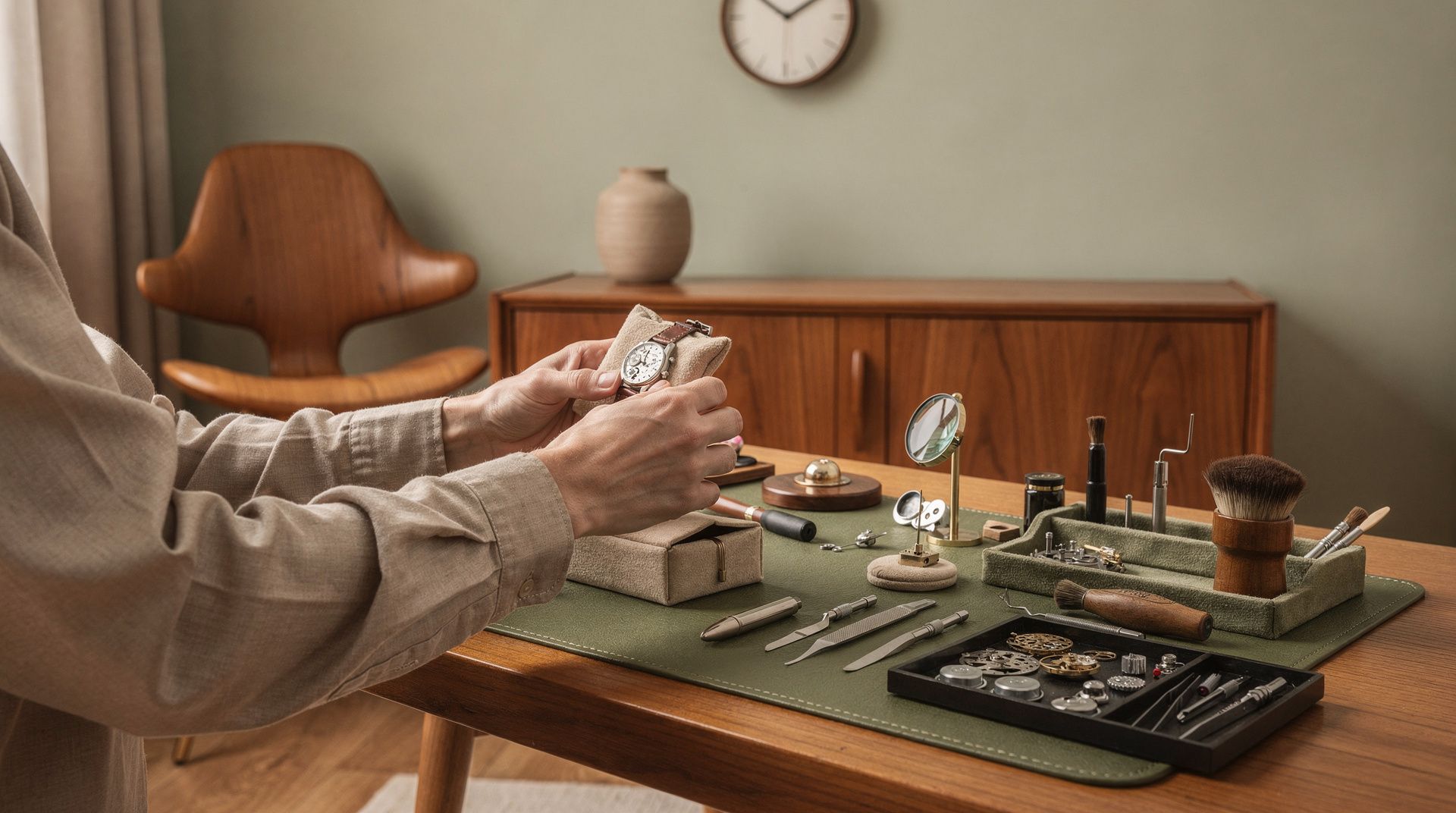
Mechanical Watches from the Mid-Century Era: Care, Maintenance, and an Understanding of a Craft Without Electronics
A mechanical watch from the 1950s or 1960s is not a commodity in today’s sense, but a miniaturised precision instrument made up of a mainspring barrel, gear train, lever escapement, and balance wheel. It requires no battery, as its energy comes from the wound mainspring. Anyone who wears such a watch or keeps one in a collection takes on the responsibility of letting the movement run regularly, having it professionally overhauled, and documenting its condition. Unlike quartz movements, there is no battery replacement here — but there is a clearly defined maintenance cycle: every four to six years, the traditional watchmaker recommends a complete overhaul, during which the movement is disassembled, cleaned in several stages, re-lubricated with specific oils at defined bearing points, and subsequently regulated on a timing machine. This servicing is not a restoration, but the prerequisite for keeping rate accuracy, amplitude, and beat error within the originally intended tolerances.
For collectors and design enthusiasts, it is worth looking at the interplay between movement, case, and dial. The mid-century era is characterised in the watch world by a particularly high density of manufacture calibres, from slim hand-wound movements to the first self-winding automatic rotors. Those who understand the craftsmanship behind these objects make better decisions — both when caring for their own collection and when making new acquisitions.
Characteristic Materials and Movement Architecture
The movement itself typically consists of brass plates and brass bridges, often nickel-plated or finished with Côtes de Genève stripes, perlage, and in some cases bevelling on the edges. Wheels are made of brass, pinions and arbors of hardened steel, and jewel bearings traditionally of synthetic ruby. The balance wheel in this era is usually a ring balance made of a copper-beryllium or Glucydur alloy, paired with a Breguet or flat hairspring made of Nivarox-type alloys, which provide temperature compensation.
The cases follow the material canon of the era: solid gold in 14 or 18 carats, gold-plaqué in varying micron thicknesses, stainless steel, and comparatively rarely platinum. Dials are frequently electrolytically silvered, lacquered, or finished with enamel; indices and hands are made of applied metal. For care purposes, this means: aggressive cleaning agents are off-limits, ultrasonic baths belong exclusively in the hands of the watchmaker, and the choice of lubricating oils follows a precise matrix in which pallet stones, mainspring barrel walls, and jewel bearings each require different viscosities.
Regional Schools and Defining Manufactures
Switzerland hosts the densest network of movements during this period: houses such as Patek Philippe, Vacheron Constantin, Audemars Piguet, and Jaeger-LeCoultre represent the upper tier of manufacture quality, while ébauche suppliers such as A. Schild, ETA, Peseux, Landeron, and Valjoux supplied entire market segments with robust calibres — among them the chronograph calibre Valjoux 72. Rolex established a landmark automatic construction with the Perpetual rotor; Omega shaped a distinctive technical identity with the 5xx-series calibres and the chronograph movement 321.
In Germany, Glashütte’s traditional lines — including Lange, Glashütter Uhrenbetriebe, and Union — as well as western brands such as Junghans, Kienzle, and PUW carried forward an independent movement tradition, often featuring the German lever escapement, swan-neck fine adjustment, and the characteristic three-quarter plate construction. France (Lip), Great Britain (Smiths), and the United States (Hamilton, Elgin, Waltham) contributed further signatures before the quartz crisis from the early 1970s fundamentally altered industrial structures. Those who know the regional context of a movement read hallmarks, calibre stamps, and movement signatures for what they are: indicators of provenance.
Authenticity and Condition for Collectors
With a vintage watch, value is determined not by outward appearance but by the coherence of all components. A collector checks whether the case number, movement number, and reference match one another, whether the dial is original or later restored, whether the hands, crown, and crystal correspond to the year of manufacture, and whether the case has been excessively polished. Excessive polishing destroys edges, bevels, and hallmarks — and is irreversible. An original, aged dial with even patina is value-defining for many references, while a re-lacquered dial significantly reduces collector value.
On the technical side, timing machine records provide information on rate values in multiple positions, amplitude, and beat error. Service records document interventions and replaced parts, ideally specifying the originality of the mainspring, crown wheel, escape wheel, and balance staff. Water resistance in vintage watches should always be treated with caution — old gaskets are brittle, and even after a service, a historic watch cannot be considered a current diver’s watch. For daily care, a dry cloth, regular winding for hand-wound movements, and a watch winder only where it suits the automatic construction are sufficient.
At mid-centurydesigns.com, we curate objects of Mid-Century Modern design with the same standard that collectors apply to a mechanical movement: every piece is examined for the originality of its materials, the consistency of its provenance, and the condition of its original substance. Restorations are named, interventions documented, and anything that does not meet our own standard of authenticity is not included. Those building a collection will find partners here who can precisely assess the origin, construction, and condition of an object.
This article was generated automatically by an AI system. Disclosure pursuant to Article 50 of the EU AI Act.