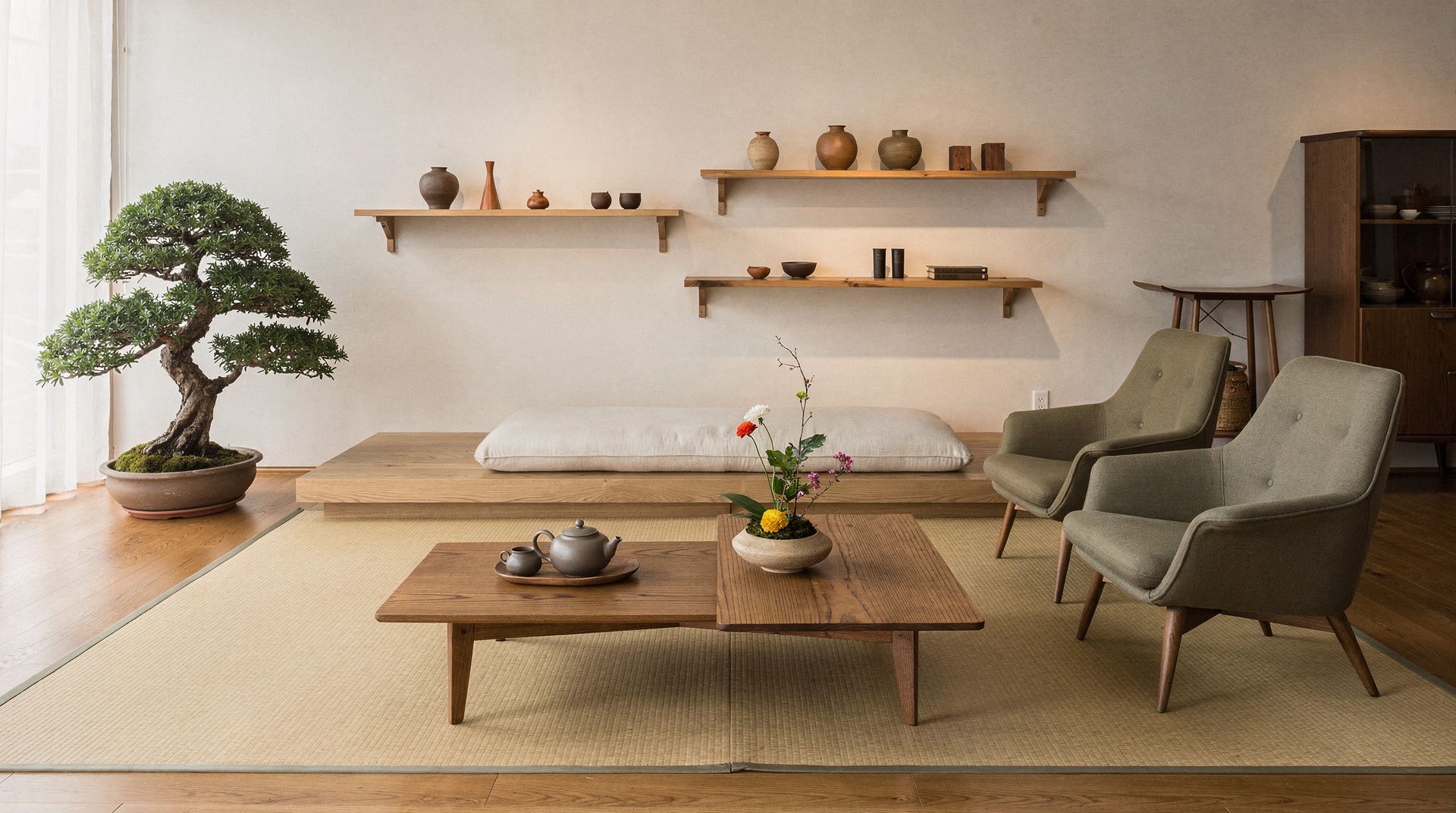
STYLE · JAPANESE MID-CENTURY INFLUENCE

Japanese Influence on Western Mid-Century Modernism

Zen reduction, craftsmanship, and a quiet dialogue between East and West

In the 1950s and 1960s, Western modernism encountered a Japanese design vocabulary that had cultivated reduction, material honesty, and artisanal precision for centuries. Designers such as Isamu Noguchi, Sori Yanagi, and George Nakashima united traditional workshop culture with the ideals of international modernism, shaping a formal language that continues to fascinate collectors and designers alike. At mid-century designs you will find curated pieces in which this dialogue between Zen minimalism and Western modernism becomes tangible.

mid-century·designs

Japanese Mid-Century influence

ESSAY · 01

Work & Context

mid-century·designs

Japanese Mid-Century Influence on Western Design Culture

The dialogue between Japanese formal language and Western modernism is not a postwar fashion, but one of the defining axes of twentieth-century design history. As early as the 1930s, Bruno Taut had pointed in his writings to the Katsura Villa and the principle of the constructively visible; after 1945, this exchange condensed into a grammar of its own. Charlotte Perriand worked in Japan between 1940 and 1946 as an adviser to the Ministry of Commerce and Industry, Isamu Noguchi shuttled between New York and Gifu, and Sori Yanagi translated his father’s Mingei philosophy into industrial mass production. The Zen minimalism that Western authors later invoked was never a stylistic quotation for the Japanese protagonists, but the logical continuation of a craft culture in which joinery, proportion, and material honesty were regarded as cultural constants.

For collectors and curators, the fascination lies precisely in this dual nature: furniture and objects that belong simultaneously to Western modernism and carry forward another, older system of workshop tradition, Ma (the deliberate interval), and Wabi-Sabi. Those who acquire Japanese-inflected Mid-Century pieces today are buying less a look than an attitude toward material.

Characteristic Materials and Joinery

The material palette of the period is compact but precisely deployed. Dominant are native timbers such as Japanese cedar (Sugi), chestnut (Kuri), cherry (Yamazakura), and zelkova (Keyaki), often combined with imported teak or walnut once workshops began producing for export in the late 1950s. The treatment is characteristically restrained: oiled rather than high-gloss lacquered surfaces, brushed grain, visible mortise-and-tenon and dovetail joints. Tenon constructions without metal fasteners are a reliable dating indicator for workshop pieces predating industrial conversion.

Beyond wood, bamboo, woven rattan, hand-formed Washi paper (as in Noguchi’s Akari lamps, manufactured in Gifu by Ozeki since 1951), and ceramic elements from Mashiko or Bizen play a central role. Metal recedes; when it appears, it is usually blackened steel or patinated bronze. Textiles follow the Bingata and Kasuri tradition: plant-dyed cotton, ikat weaves, and occasionally silk. This material discipline clearly distinguishes Japanese designs from their Scandinavian contemporaries, with whom they are often mentioned in the same breath.

Regional Schools and Formative Designers

Three centres can be identified. In Tokyo, an architecturally inflected modernism developed around the art academy and Kenzo Tange, producing Isamu Kenmochi (Rattan Lounge Chair, 1960, for Yamakawa Rattan) and Junzo Sakakura. Sakakura, who worked with Le Corbusier from 1931 to 1936, designed the Japanese Pavilion at the Venice Biennale in 1954 and transposed the Corbusian modular order into Japanese detailing.

A second centre lay in the Kansai and Gifu region, where the workshop tradition of Tendo Mokko industrialised bent-plywood forming from 1940 onwards. Sori Yanagi designed the Butterfly Stool there in 1954, originally from two mould-laminated rosewood shells joined by a single brass rod, produced in series by Tendo from 1956 and awarded the gold medal at the Milan Triennale in 1957. The combination of origami folding and Western bentwood technology is paradigmatic of the transfer.

A third, often overlooked field is the transpacific axis. George Nakashima, a Nisei born in Spokane, combined his experience with Antonin Raymond in Tokyo—after his internment at Camp Minidoka (1942)—with his own workshop in New Hope, Pennsylvania. His Conoid and Minguren series for Knoll and later Widdicomb-Mueller are manifestos of a workshop tradition in which the tree is regarded as co-author. Similarly, Kipp Stewart and George Nelson translated Japanese detail grammar into American production.

Authenticity and Condition for Collectors

With pieces of this provenance, value is determined by precise criteria. The first level of examination is the signature or maker’s label: Tendo Mokko burned a workshop mark into its pieces until the early 1960s; later editions carry paper labels with a model number. Ozeki Akari lamps have carried a red stamp (sun and crescent) since the 1980s; earlier examples bear only Noguchi’s handwritten signature printed on the Washi. Nakashima furniture is documented through the workshop records in New Hope, which the family maintains to this day; written provenance confirmation is indispensable at relevant price levels.

The second level is construction. Hand-cut mortises show minimal tool marks, while industrial reproductions from the 1970s and 1980s display machined, perfectly uniform chamfers and frequently concealed screws. With bamboo and rattan work, the condition of the bindings is critical: rewrapping is acceptable but should be disclosed. Washi coverings on Akari lamps are consumable parts; restoration with original Mino paper does not diminish value, whereas replacement with synthetic fibre does so significantly.

The third level is patina. Oiled Japanese timbers develop a deep, matte surface over decades that is irretrievably lost through aggressive sanding. Collectors prefer honest signs of use over over-restored condition. Water stains on Keyaki or Sugi can be darkened to match, but any large-scale refinishing reduces the documentary quality of the piece.

At mid-centurydesigns.com we curate works from this period with the commitment to making origin, workshop, and condition verifiable for every object. Each piece undergoes examination of construction details, label and signature findings, and restoration history; where possible, we add catalogue raisonné numbers and bibliographic references. This allows you to make your decision on the same basis that institutional collections apply.


This article was generated automatically by an AI system. Disclosure pursuant to Article 50 of the EU AI Act.

FAQ · 02

Frequently asked about Japanese Mid-Century influence

5 Answers

01
Which Japanese designers shaped Western Mid-Century modernism in the 1950s–1960s?
Isamu Noguchi revolutionised furniture design and ceramics through the synthesis of Japanese formal language with American modernism. His Akari lamps and free-form tables became classics. George Nakashima developed organic wooden furniture that united Japanese workshop traditions with Western craftsmanship. Shiro Kuramata founded the Japanese interior design school. These designers opened the West to Japanese aesthetics: reduction, material honesty, and respect for natural surfaces.
02
What is the difference between Japanese Zen minimalism and European functionalism in design?
European functionalism (Bauhaus, Scandinavian modernism) follows the maxim "form follows function" — rational, industrial logic. Zen minimalism in Japanese design pursues philosophical depth: emptiness as an active design element, Wabi-Sabi (the beauty of the imperfect), Ma (negative space). It is not what is present that counts, but what remains unspoken. This leads to different proportions, surface treatments, and philosophies of use — less is not practical, but spiritual.
03
What role did the Japanese workshop tradition play in Mid-Century furniture?
Japanese craft traditions (from the Edo period to the present) emphasise cross-generational knowledge, master–apprentice relationships, and organic material processing rather than mass production. George Nakashima and other Western designers integrated this ethos: visible wood grain, mortise-and-tenon constructions without screws, natural live edges. This created an alternative to steel-tube and plywood modernism and is valued by collectors today for its authenticity and sustainability.
04
How did Japanese influence reach the West after the Second World War?
After 1945, Japan opened up to the West; at the same time, US troops stationed there developed an interest in Japanese aesthetics and brought it home with them. The exhibition "Zen Buddhism and Its Influence on Japanese Culture" (1958–59 in New York) acted as a catalyst. Artists and designers travelled to Japan and absorbed craft techniques. Simultaneously, Japanese designers such as Noguchi and Kuramata established themselves in New York and Europe. This exchange was also fed by a Western longing for a counterpoint to consumer culture.
05
Which Japanese furniture or objects from the 1950s–1960s are collectible today?
Original Akari lamps by Noguchi (hand-crafted Washi paper constructions), Nakashima's free-form furniture in walnut, ceramics by Shoji Hamada and Soetsu Yanagi, Shibui textiles, and lacquerware. Authentic pieces can be identified by signatures, material patina, and the absence of mass-production logic. Caution: imitations of the Akari have been numerous since the 1990s. Provenance and manufacturing techniques are the key distinguishing features.

GLOSSARY · 03

Related Terms

10 Entries

Zen Minimalism
A design philosophy that combines Zen Buddhist principles with Western modernism. Characterised by reduction to essential forms, negative space (Ma), natural materials, and deliberate emptiness as a design element. Formative for international design of the 1950s–1960s.
Ma (間)
Japanese concept of meaningful empty space or pause. Central to Mid-Century design composition: not the object itself but the space around it defines the form. Influenced Western minimalists such as Dieter Rams and Isamu Noguchi.
Tanegashima Influence
Japanese design tradition of craft techniques (the Tanegashima tradition) that inspired Western designers in Mid-Century modernism through precise, functional making. Particularly relevant for Japanese furniture manufacturers such as Tendo and Hida.
Isamu Noguchi
American-Japanese sculptor and designer (1904–1988). Pioneer of the integration of Japanese aesthetics into Western modern design. His work (furniture, lighting, gardens) embodies the synthesis of Zen philosophy and functional modernism.
Mingei Movement
Japanese folk craft movement (founded in 1936 by Soetsu Yanagi) that celebrated the beauty of everyday, handmade objects. Shaped the Mid-Century discourse on authentic materiality and craft value against industrial mass production.
Japanese Modernism
A design current of the 1950s–1960s in which Japanese designers (Kenzo Tange, Sori Yanagi, Shiro Kuramata) synthesised Western functional modernism with Japanese formal principles. Established Japan as an independent modern voice rather than a mere imitator.
Sori Yanagi
Japanese industrial designer (1915–2011). Student of Charlotte Perriand. Developed organic, functional forms that united Japanese craft tradition with Western modernism. His work defined post-war Japanese design on the international stage.
Kintsugi Aesthetics in Design
Japanese philosophy of repair and imperfection, applied to design principles: appreciation of signs of use, authenticity, and ageing as part of beauty. Mid-Century designers drew on this approach as a counterpoint to flawless industrial aesthetics.
Charlotte Perriand in Japan
French designer (1903–1999) who worked in Japan in 1940–1942 and 1951–1960. A catalyst for the exchange between Western functional modernism and Japanese tradition. Her mentee Sori Yanagi shaped the international synthesis.
Washi and Natural Materials
The use of Japanese natural materials (Washi paper, timbers such as Hinoki/cypress, bamboo, linen) in Mid-Century furniture and interiors. A symbol of conscious material choice, sustainability, and sensory quality as a counterpoint to Western plastic modernism.