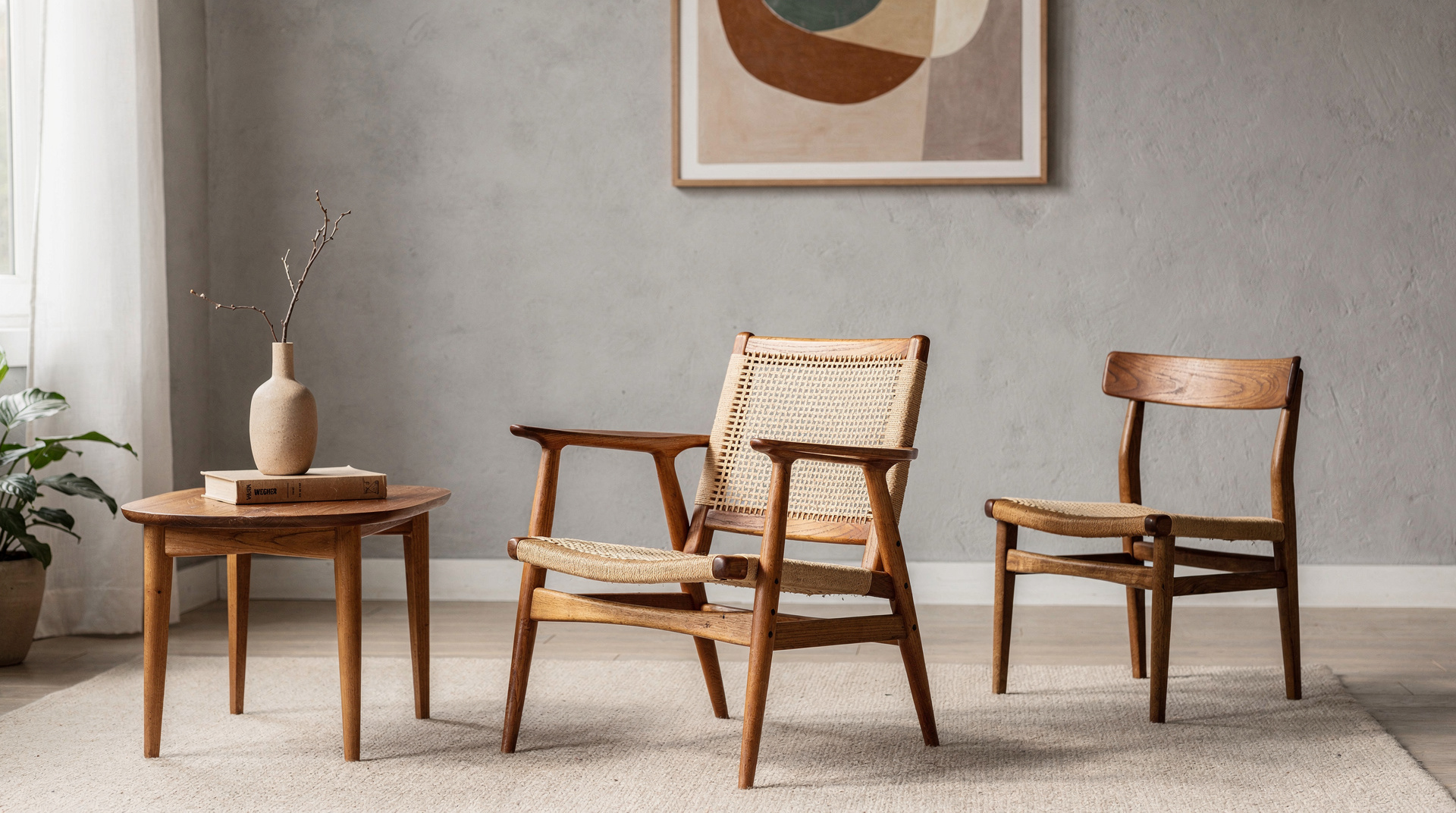
Hans Wegner – The Chair Master of Danish Modern
Hans J. Wegner (1914–2007) shaped the image of Danish furniture design in the 20th century like virtually no other designer. Trained first as a cabinetmaker in Tønder, later at the Kunsthåndværkerskolen in Copenhagen, he combined artisanal precision with an intuitive understanding of seating comfort and construction. Over 500 chair designs are attributed to him, including icons such as the Wishbone Chair (CH24, 1949 for Carl Hansen & Søn), the Round Chair (JH503/PP503, 1949) and the Peacock Chair (JH550, 1947 for Johannes Hansen). Wegner’s approach was that of a cabinetmaker who draws, not an architect who prescribes furniture. It is precisely this closeness to the material and the workshop that makes his works so sought after today by collectors, curators and architects in search of substantial, honest furniture design.
To engage with Wegner is to enter the very heart of Danish Modern: that brief, productive phase between the late 1940s and the 1960s, when Danish Snedkerlaug exhibitions presented new prototypes each year and a close-knit network of master cabinetmakers, architects and designers emerged. The rediscovery of this period since the 2000s has consolidated the market, but has also encouraged reproductions, modifications and optimistic attributions. A discerning eye for material, provenance and condition is therefore more important than ever.
Characteristic Materials and Construction
Wegner’s material canon is concise and consistent. At its core are solid hardwoods, above all oak and teak, more rarely walnut, mahogany or cherry. For structurally stressed components such as the curved top rail of the CH24 or the characteristic bow of the Round Chair, ash was used, as it lends itself superbly to bending and laminating. Beech is found primarily in earlier serial furniture produced for FDB Møbler.
The visibly expressed construction is characteristic: dovetail joints on seat frames, cleanly executed mortise-and-tenon connections, conically fitted round tenons, sometimes secured with contrasting wooden wedges. Seat surfaces were, depending on the model, woven with paper cord (papercord), strung with natural cord, upholstered in leather or fashioned from solid wood. Papercord of approximately 3 mm thickness is standard for the CH24; a hand-woven seat surface requires around 120 metres of cord and several hours of work. For upholstered pieces, wool fabrics from classic Danish weavers (Kvadrat, historically also fabrics from Boligmagasinet) and vegetable-tanned aniline and saddle leather predominate, developing a rich patina over time.
Surfaces were traditionally soaped or treated with linseed oil, more rarely lacquered. These open-pored finishes allow the wood to breathe, but are sensitive to water rings and aggressive cleaning agents. A deep, even colour tone in teak, or a pale, softly gleaming soap-finished oak, are indicators of careful maintenance over decades.
Regional Schools, Manufacturers and Contemporaries
Wegner never worked in isolation. His body of work emerged within the orbit of the Copenhagen Cabinetmakers’ Guild and is inseparable from the workshops that realised his designs. Johannes Hansen in Søborg produced the technically demanding individual pieces and small series from 1940 onwards, including the Round Chair, which became known worldwide in 1960 through the Nixon–Kennedy television debate. Carl Hansen & Søn in Odense took over serial production of the CH programme from 1949; PP Møbler in Allerød has continued the most cabinetmaking-intensive models since the 1970s, such as the PP503 and the PP19 (Papa Bear Chair). For Fritz Hansen, Wegner designed, among other pieces, the China Chair (FH4283, 1944); for Getama in Gedsted, numerous sofas and daybeds; for AP Stolen, the AP19 (Papa Bear Chair, 1954); and for FDB Møbler, more affordable everyday furniture.
Wegner stands alongside colleagues who used the same workshops and shared similar ideals: Finn Juhl, whose sculptural design language contrasts with Wegner’s constructive clarity; Børge Mogensen, his close friend and collaborator at FDB; Arne Jacobsen, who simultaneously pursued the industrial path via Fritz Hansen; Kaare Klint as the academic pioneer of the Møbelskolen; as well as Ole Wanscher and Poul Kjærholm, who extended the canon in their own directions. Those who collect Wegner understand these neighbourhoods and can situate pieces more reliably within the Danish canon.
Authenticity and Condition for Collectors
With Wegner chairs, the combination of maker’s mark, construction details and provenance determines authenticity and value. Original brand stamps or metal plaques from Johannes Hansen, Carl Hansen & Søn, PP Møbler, Getama or AP Stolen are usually found on the underside of the rail or on the seat frame. Supplementary paper labels were common practice at Johannes Hansen but are frequently lost. The model number, the manufacturer’s abbreviation and, for more recent pieces, a serial number provide information about the period and workshop. Early CH24 examples from the 1950s differ in details such as leg cross-section, backrest profile and seat height from current production runs.
Differentiated standards apply to condition. Papercord seat surfaces are a wear component and may be professionally re-woven without diminishing collector value, provided the pattern is correctly executed. Re-lacquering, sanding marks that cause the original crispness of edges to be lost, and replaced legs or back sections significantly reduce value. With leather upholstery, a genuine, even patina is often more desirable than a re-upholster. Loose tenon joints, cracks in load-bearing components and moisture damage at the foot are critical concerns. Provenance documentation such as receipts, photographs from first ownership or auction records considerably increases confidence and is virtually indispensable for rare models from the Johannes Hansen production.
At mid-centurydesigns.com, we curate Wegner works with the ambition of placing each piece in its constructive, material and historical context. We verify manufacturer markings, document restorations transparently, distinguish between original substance and professionally executed renewal, and record provenances where they are verifiable. This allows you to make a purchasing decision on the same basis that museums and institutional collections use: traceable facts rather than attribution based on intuition.