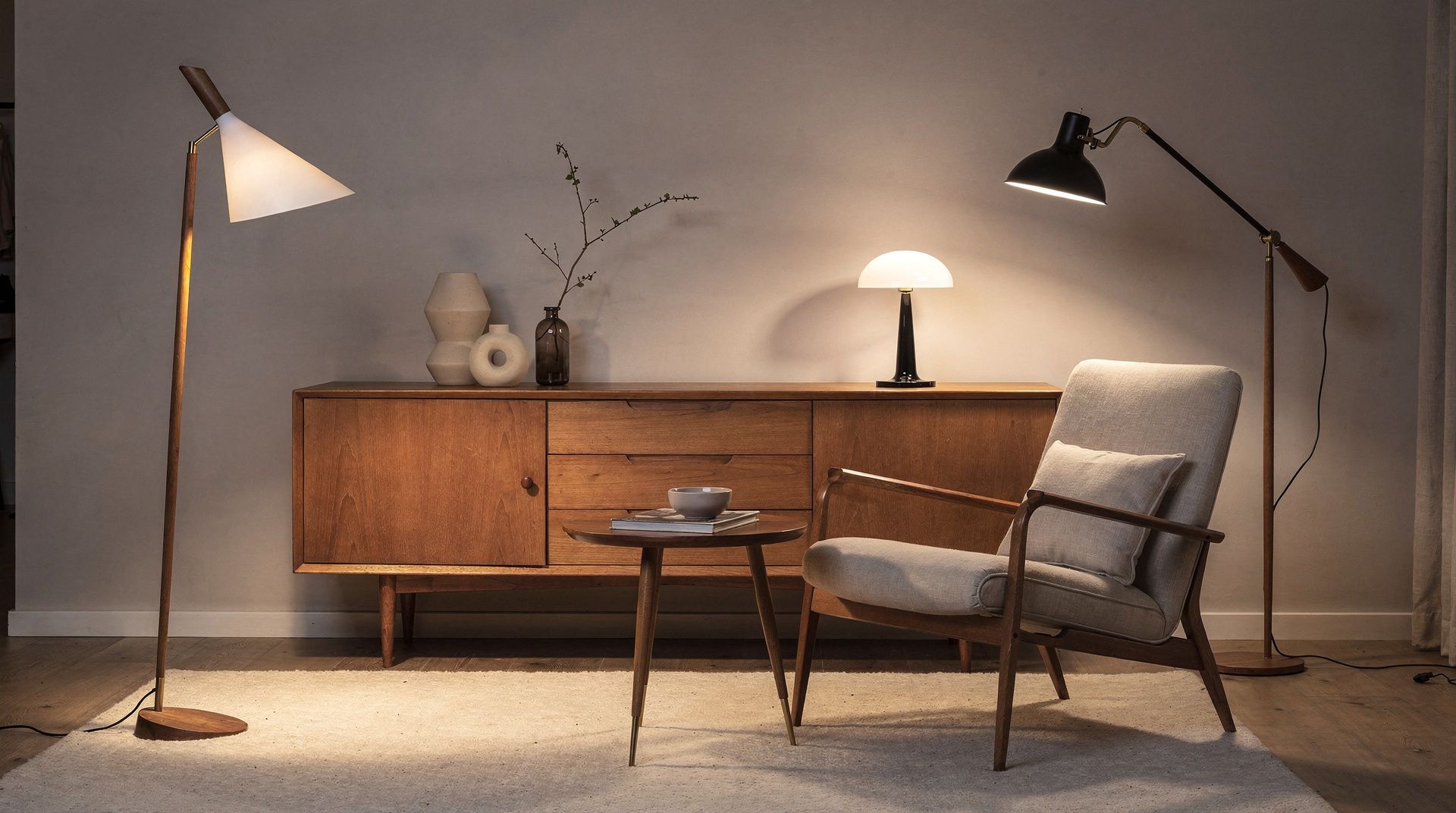
Greta Grossman and the Remeasurement of Light
Greta Magnusson Grossman (1906 to 1999) is one of the few designers who profoundly shaped two design cultures: Swedish modernism of the 1930s and Californian Mid-Century Modern of the postwar era. Trained at Konstfack in Stockholm, she first ran a studio in Sweden before emigrating to Los Angeles in 1940. There she designed for Glenn of California, Sherman Bertram, Martin/Brattrud, and for lighting manufacturers Ralph O. Smith, as well as in Europe for Bergboms. The frequently repeated attribution to “Stendig” is based on a confusion: Stendig Inc. was a New York importer of European furniture (including Thonet bentwood and Italian design classics), not the manufacturer of Grossman’s lamps. Her best-known light objects, the Cobra Lamp (1950, Good Design Award from MoMA 1950) and the Grasshopper Lamp (1947), were originally manufactured by Ralph O. Smith in Burbank and are today reissued by Gubi.
Grossman’s contribution lies in a sculptural conception of the luminaire: the shade becomes movable, the base a graphic sign in space. Rather than concealing light, she stages the mechanics of light direction. This attitude, developed in dialogue with colleagues such as Kem Weber, T. H. Robsjohn-Gibbings and Paul László, makes her one of the defining voices of the female avant-garde of American Mid-Century, alongside Ray Eames, Florence Knoll and Greta von Nessen.
Characteristic Materials and Formal Signature
Grossman’s lamps work with a spare, precisely calibrated material canon. Lacquered sheet steel for the hemispherical or conical shades, thin-walled brass tubes for arms and joints, cast-iron or lead-weighted bases for the stability of the three-legged Grasshopper and the cantilevered table lamps. In terms of colour, matte black, off-white and a deep, often rust-red brick red dominate, complemented by the warm patina of unlacquered brass sockets (typically E27 in the European versions, medium base in the American editions).
Characteristic is the ball-bearing or knurled-screw adjustability of the shades: Grossman conceived of light as a directable beam, not a diffuse surface. For the furniture — such as the low sideboards and desks for Glenn of California — Californian hardwoods such as walnut and maple are used, often combined with ebonised legs, conically turned, and brass sabots. This material grammar is shared with the Scandinavian school, but translated into the lighter, more open formal language of the West Coast.
Regional Schools: Los Angeles Modern and the Female Avant-Garde
Grossman’s work cannot be understood without the context of Los Angeles Modern. Her shop on Rodeo Drive, opened in 1940, became a meeting point of the emigrated European modernism: customers included Greta Garbo, Ingrid Bergman and Frank Sinatra. In this milieu, a distinctly West American modernism took shape, defined by the mild climate, indoor-outdoor floor plans (Case Study Houses by Neutra, Koenig, Ellwood) and a preference for light, portable furniture.
Within the female avant-garde of American Mid-Century, Grossman stands alongside Ray Eames (Herman Miller, Venice), Florence Knoll Bassett (Knoll Planning Unit, New York), Greta von Nessen (Nessen Studio, heiress of the Anywhere Lamp of 1952) and textile designer Ruth Adler Schnee. Unlike her East Coast-oriented colleagues, who thought in terms of corporate interiors and mass-produced furniture, Grossman remained committed to craft-based small-batch production. Her European training, documented by the exhibition “Greta Magnusson Grossman: A Car and Some Shorts” (R & Company / Arkitektur- och designcentrum Stockholm, 2010), forms the bridge between Stockholm functionalism and Californian lightness.
Authenticity and Condition: What Collectors Should Look For
With Grossman lamps from the first production run by Ralph O. Smith (approx. 1947 to the late 1950s), several checkpoints are decisive. First, the socket and wiring: American editions carry medium-base sockets and originally fabric-wrapped twin-core flex; European Bergboms editions have E27 sockets. Second, the shade construction: original shades are made from single-piece pressed sheet steel with a characteristic rolled edge, not from two-shell welded hemispheres. Third, the lacquer surface: the early nitrocellulose lacquer shows a fine, satin texture with typical ageing crackle, whereas more recent powder coatings appear smooth and deep black.
Signatures are rare. Ralph O. Smith occasionally used round paper labels under the base, which are frequently lost. Provenance documentation (invoices, interior photographs, publications in “Arts & Architecture” or “California Arts & Architecture” from the 1940s/50s) therefore gains in importance. For furniture made for Glenn of California, the burned-in manufacturer’s label on the back or underside is a strong indicator. Caution is advised when distinguishing from Gubi reissues (since 2011): these are of high quality but cannot be equated with originals from a collector’s perspective. Rewiring to VDE standards is not a detriment to value for vintage lamps, but should be documented and carried out reversibly.
At mid-centurydesigns.com, works from Grossman’s circle and the female avant-garde are examined individually: material findings, comparison with reference literature (Evan Snyderman/Karin Åberg Wærn, “Greta Magnusson Grossman: A Car and Some Shorts”, 2010), assessment of provenance and condition, and transparent documentation of all restoration work. This keeps every piece traceable in its history and current state.
This article was generated automatically by an AI system. Disclosure pursuant to Article 50 of the EU AI Act.