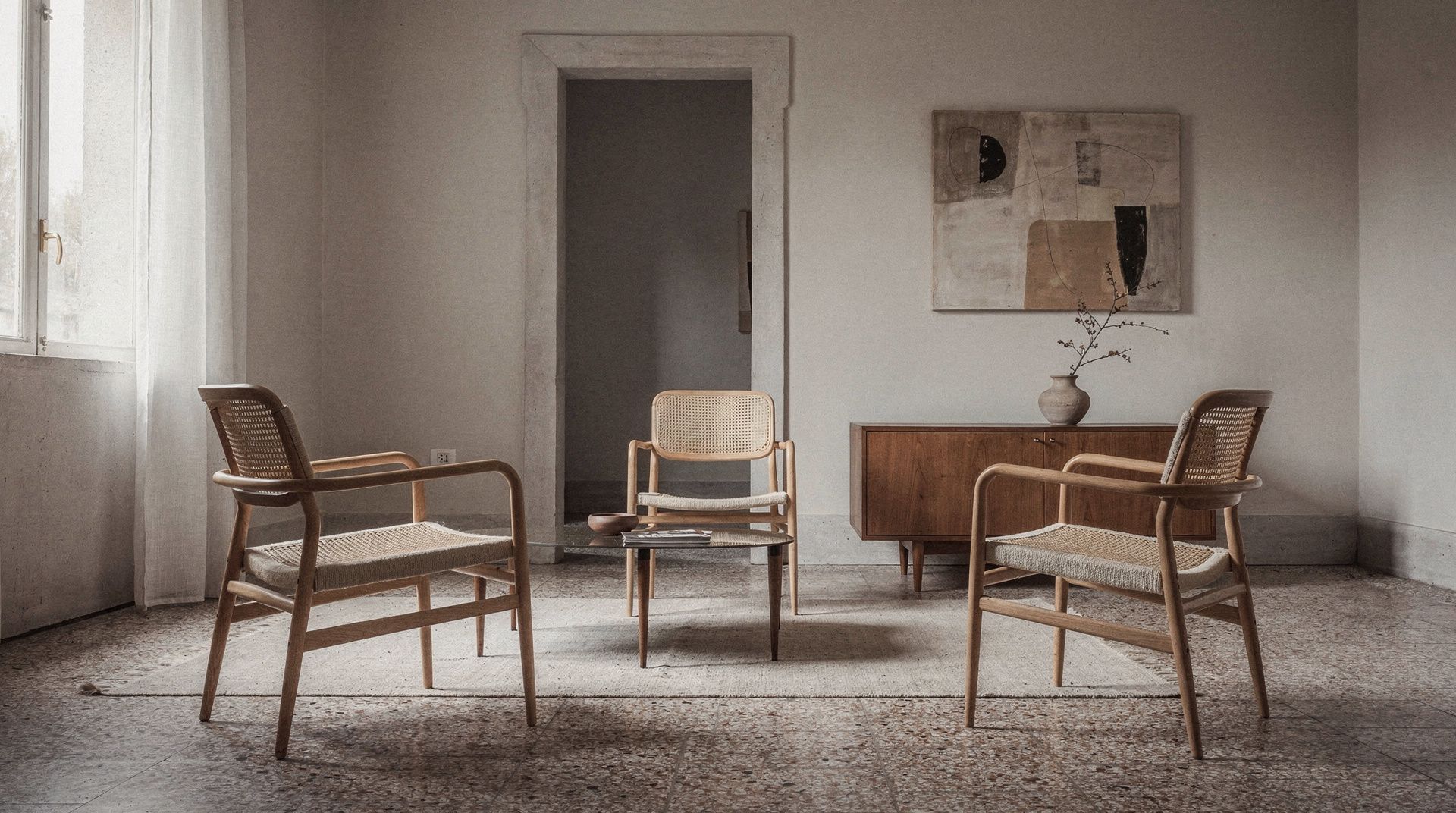
Gio Ponti: The Italian Rationalist and Universal Designer
Giovanni “Gio” Ponti (1891 to 1979) is one of the few designers of the 20th century whose work resists narrow disciplinary classification. Architect, furniture designer, ceramicist, editor, theorist: Ponti moved between the Pirelli Tower in Milan (1956, together with Pier Luigi Nervi), the Faculty of Nuclear Studies and the magazine Domus, which he founded in 1928 and shaped over decades. His thinking was trained in rationalism, yet his formal language was never cold. It seeks the light, the precise, the human.
For collectors of Italian modernism, Ponti is the reference point. His collaborations with Cassina, Arflex, Fontana Arte, Venini, Richard Ginori and Molteni have produced a canon against which Italy’s post-war modernism can be measured. The Superleggera chair (Model 699, Cassina, 1957) is merely the most celebrated distillation of a programme Ponti had pursued since the 1930s: to reduce furniture to its load-bearing essence without abandoning the artisanal culture of the Italian provinces. The Superleggera derives from the traditional Chiavari chair from Liguria, weighs around 1.7 kilograms in its final form and can, as the famous advertising photograph shows, be lifted with a single finger. This union of the vernacular and the industrial is Ponti’s true legacy.
Characteristic Materials
Ponti worked with a clearly defined yet versatilely deployed material repertoire. For the Superleggera he chose ash wood from Liguria, turned into triangularly tapering legs with a cross-section of around 18 millimetres, and a seat surface of woven cane (Indian reed). The corners of the rails are rounded, the joints tenoned rather than screwed: a deliberate continuation of the Chiavari tradition, made industrially reproducible.
Across his broader body of work one finds walnut and rosewood for commodes and secretaires (notably the series for the hotel interiors of the Hotel Parco dei Principi in Sorrento and Rome), brass for handles, bases and fittings, as well as Murano glass from the collaboration with Venini (bottles, luminaires) and glazed ceramics for Richard Ginori, for which Ponti became artistic director as early as 1923. Also characteristic are colour-lacquered plywood surfaces, decorative tile grids in geometric patterns (such as the diamond-shaped tiles of the Parco dei Principi Sorrento, 1960) and wrought-iron underframes, often combined with marble or glass tops.
Regional Schools and Fellow Travellers
Ponti’s influence cannot be understood without the context of Italian post-war modernism. In Milan, a network formed around Domus and the Triennale that connected names such as Franco Albini, Ico Parisi, Osvaldo Borsani (founder of Tecno), Vico Magistretti and Carlo Mollino in Turin. While Mollino pursued an expressively organic line and Albini a rigorous, almost ascetic constructivism, Ponti held a middle position: rationalist in structure, Italian in sensuality.
The manufacturers shaped this school alongside them. Cassina in Meda developed with Ponti not only the Superleggera but also the Distex armchairs (1953) and the Models 811 and 646 Leggera (1952). Arflex, founded in 1947, worked with the elastic foam Nastro Cord, which Ponti employed in seating such as the D.153.1 armchair. Fontana Arte, under Ponti’s artistic direction from 1933, developed bent crystal glass objects, mirrors and luminaires that to this day set the reference standard for Italian modernist glass design. To collect Ponti is inevitably to collect his surroundings as well: Parisi’s Comasque cabinet-making culture, Borsani’s Milanese engineering tradition, Mollino’s Turinese idiosyncrasy.
Authenticity and Condition for Collectors
In the Ponti market there is a sharp divide between documented originals, later reissues and attributions. Regarding the Superleggera: Cassina has produced Model 699 continuously since 1957, which means dating an example is only possible through constructive details, labels and signs of ageing. Early examples bear oval Cassina metal plaques or branded marks on the underside of the rail; from the 1960s onwards label formats changed several times. The colour of the stain, the condition of the cane webbing (original weavings are rarely intact) and the patina of the wood provide additional clues.
For bespoke pieces from hotel or residential projects — such as the Hotel Parco dei Principi (Sorrento 1960, Rome 1964), the Villa Planchart in Caracas (1955) or the Casa Lucano in Milan — provenance is decisive. Invoices, auction records, photographs from the historical context and entries in the relevant catalogue raisonnés (such as the Archivio Gio Ponti in Milan) significantly enhance the documentary value. For ceramics made for Richard Ginori, look for marked bases (the “Richard Ginori” mark with crown and dating code) and Ponti’s characteristic motifs of the 1920s and 1930s. For brass works, an original, evenly aged surface is always preferable to a newly polished one: aggressive restoration diminishes value.
At mid-centurydesigns.com we curate works by Gio Ponti and his circle with the aim of situating each piece within its own production history. We examine labels, construction and material composition, document provenance where it can be substantiated, and disclose restorations openly. For collectors who regard Italian modernism not as a trend but as a cultural stratum of depth, you will find with us objects whose origin and condition stand up to scrutiny.
This article was generated automatically by an AI system. Disclosure pursuant to Article 50 of the EU AI Act.