George Nelson and the Idea of Democratic Living
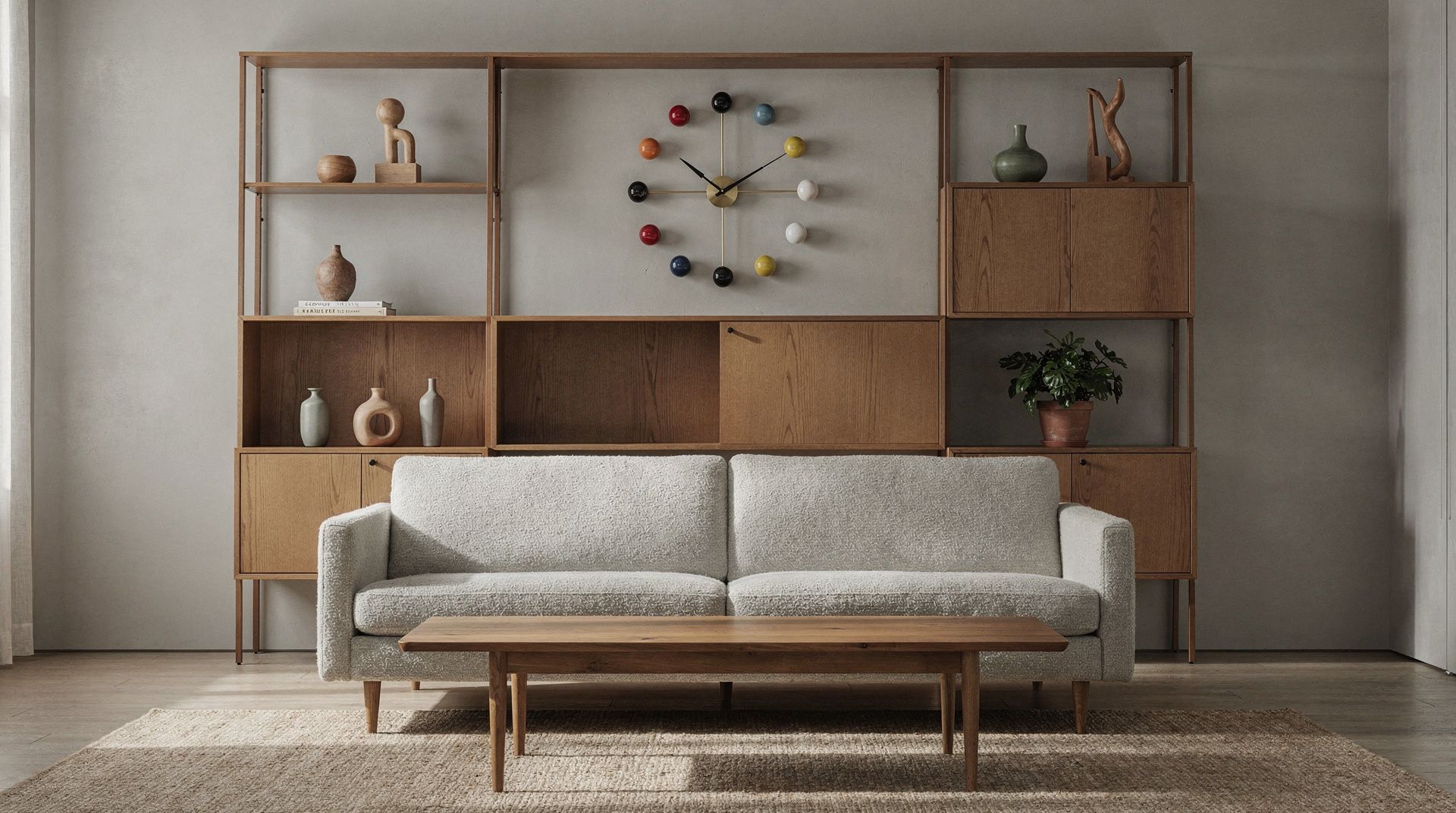
George Nelson (1908 to 1986) is one of the most intellectually influential figures of American Mid-Century Modern. As Design Director of Herman Miller from 1945, he shaped not only a product range but an attitude: furniture should adapt to life, not the other way around. From this premise emerged the Comprehensive Storage System (CSS, 1959), one of the first consistently modular wall systems for the private home, complemented by icons such as the Ball Clock (1949/1950, developed within the Nelson Office with contributions from Irving Harper and Isamu Noguchi), the Coconut Chair (1955), and the Marshmallow Sofa (1956).
Nelson’s thinking was that of a publicist and architect. He curated, brought Charles and Ray Eames as well as Alexander Girard to Herman Miller, and articulated an ethics of function in essays such as “Problems of Design.” Whoever acquires an original piece from his circle today acquires less an object than a position: the conviction that good design can be accessible, adaptable, and enduring. It is precisely this combination of conceptual clarity and industrial serial readiness that makes Nelson so compelling for collectors to this day.
Characteristic Materials and Construction Principles
Nelson’s formal language thrives on the contrast between industrial and craft materials. The CSS works with aluminium tension poles between floor and ceiling, onto which cabinets, shelves, writing surfaces, and drawers in walnut or rosewood veneer can be freely arranged. This separation between load-bearing structure and flexible fittings is the true conceptual core: a system that grows with its inhabitant.
For seating furniture, the Nelson Office relied on chrome-plated steel tube, bent steel wire constructions (Coconut Chair), latex and foam upholstery over taut textile covers, and wool fabrics from the Girard programme. The Ball Clock combines lacquered wooden balls with delicate metal spokes, optionally in brass or burnished finishes. The Bubble Lamps (from 1947) use a patented spray resin on wire frames, producing an evenly diffused light scatter. Those examining originals should pay attention to the quality of veneer selection, clean mitre joints, original hardware, and the characteristic material pairing of warm wood with cool metal.
Regional Schools and the Network around Nelson
Nelson operated at the intersection of the East Coast and the Midwest. His office was based in New York, production was at Herman Miller in Zeeland, Michigan. This triangle of New York’s discursive space, Michigan’s manufacturing expertise, and the California workshop of the Eames in the Case Study Program decisively shaped American Mid-Century.
In his inner circle worked Irving Harper (Marshmallow Sofa, Ball Clock, Herman Miller logo), Ernest Farmer, John Pile, Don Ervin, and later Michael Graves at the Nelson Office. In parallel, Florence Knoll developed a stricter, European-influenced line at Knoll Associates in New York, uniting Mies van der Rohe and Eero Saarinen. In California, Charles and Ray Eames stood for organic plywood and aluminium casting; in Michigan, Cranbrook graduates around Saarinen and Harry Bertoia formulated a sculptural modernism. Nelson distinguished himself from these neighbouring schools through his systemic approach: not the individual piece of furniture, but the infrastructure of living was at the centre. The fact that he combined European impulses — from the Bauhaus and Le Corbusier — with American production logic makes his position in design history singular.
Authenticity, Provenance, and Condition
With Nelson pieces, the marking is decisive. Herman Miller furniture from the 1950s and 1960s typically bears stamped or embossed labels with the company logo, sometimes additionally date stamps or model numbers. For the CSS, original aluminium tension poles with floor plates and ceiling fittings as well as the matching veneer cabinets are crucial; later retrofits can be identified by differing profiles and more modern screw connections. With the Ball Clock, provenance is more complex: early versions were manufactured by the Howard Miller Clock Company (not Herman Miller) and bear corresponding markings on the reverse. Vitra has been reproducing licensed reissues since the 1990s, which are clearly distinguishable from originals.
In terms of condition, honesty counts above perfection. Veneer may age; what matters are undamaged edges, original hardware, and a traceable restoration history. The upholstery of Coconut and Marshmallow models has almost always been renewed over the decades; here the question is whether the re-upholstery was carried out professionally, with appropriate materials, and reversibly. Bubble Lamps should retain their original spray resin skin; visible yellowing is period-typical, while extensive cracking significantly reduces value. Provenance records, auction documentation, receipts from first ownership, or publication references in contemporary Herman Miller catalogues substantially increase certainty.
At mid-centurydesigns.com, we examine every object from George Nelson’s circle for markings, construction, and condition, document provenance transparently, and disclose restorations openly. Whoever acquires a CSS element, a Ball Clock, or a Coconut Chair from us receives not only a piece of furniture, but a piece of American design history with a solid foundation for their own collection.
This article was generated automatically by an AI system. Disclosure pursuant to Article 50 of the EU AI Act.