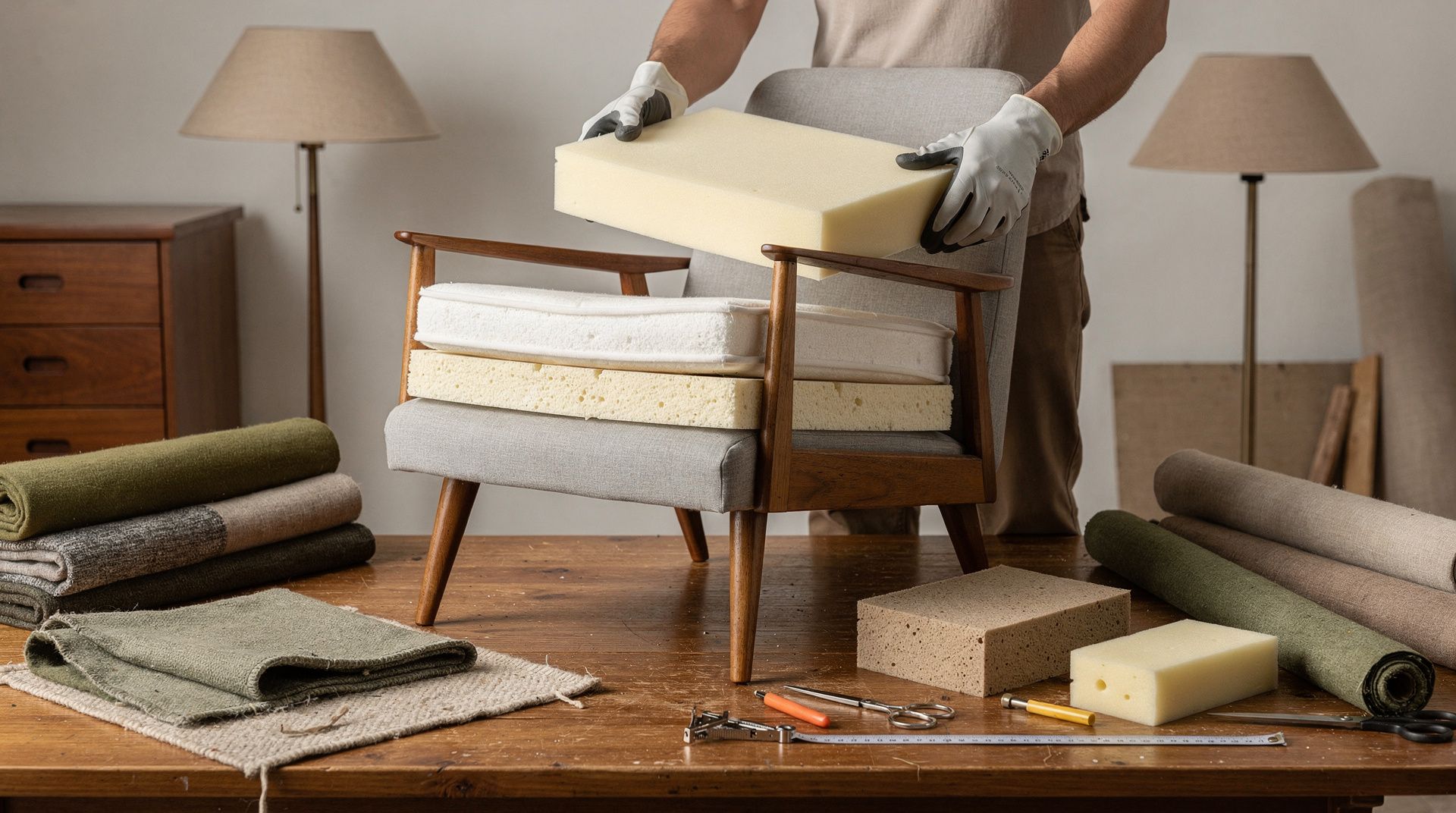
MATERIAL · FOAM UPHOLSTERY CORES REUPHOLSTERING VINTAGE UPHOLSTERED FURNITURE

Replacing foam and upholstery cores in vintage upholstered furniture

When reupholstering makes sense and how to properly assess material quality

A worn-out armchair or a deformed sofa cushion does not mean the end of a mid-century design – it marks the due moment for professional restoration. You will learn how to identify exhausted upholstery cores, which foam densities (weight per unit volume in kg/m³) are appropriate for seats, backs and armrests, and when classic materials such as horsehair, coconut fibre or latex are the better choice over modern PU foam. We also demonstrate calm, material-preserving techniques for disassembly that keep webbing, spring cores and original upholstery fabrics intact.

mid-century·designs

foam upholstery cores reupholstering vintage upholstered furniture

ESSAY · 01

Work & Context

mid-century·designs

Replacing upholstery cores: when reupholstering vintage furniture is truly worthwhile

An original mid-century upholstered piece is more than a place to sit. It is a historically significant construction of wooden frame, webbing, springs, foam or latex cores and upholstery fabric, in which every layer serves a function. Replacing the core of a sofa from the 1950s or 1960s deeply affects the interplay of seating comfort, silhouette and the character that comes with age. It is therefore worth assessing soberly whether a complete reupholstering is actually necessary or whether partial restoration will suffice. Primary indicators are seat surfaces that have compressed by more than two centimetres permanently, crumbling polyurethane foam that releases dust when squeezed, a musty odour that persists even after airing, and tears in the upholstery along the seams of the main stress zones. An intact, only lightly patinated original cover with a functional core generally stays in one piece. The principle is: preserve as much original material as possible, renew only as much as necessary.

When selecting materials, density is the decisive factor – not firmness alone. For seat cores, European PU foams are characterised by a density figure expressed in kilograms per cubic metre as the key indicator. Values below 35 kg/m³ are unsuitable for load-bearing seat surfaces in collectible pieces and will result in renewed sagging within just a few years. For sofas and armchairs in daily use, densities between 40 and 50 kg/m³ are standard, combined with a compression hardness value that comes close to the original seating firmness of the design. Anyone wishing to come as close as possible to the original feel should consider high-density cold foam or, for pieces of Scandinavian manufacture, a construction of latex over webbing. During disassembly, calm hands are essential: photograph the upholstery fabric before removal, mark nail and staple patterns, store original piping, buttons and cord in sorted order, and number the webbing strips before releasing them. This allows the construction to be reconstructed precisely after the core has been replaced.

Characteristic materials in mid-century upholstery construction

Between 1945 and 1970, upholstery construction shifted from the traditional horsehair-kapok-coil spring system towards new foam materials. Dunlopillo latex, patented in 1929 and widespread in serial furniture production from the 1950s onwards, defined Scandinavian and British designs. Latex ages slowly, but becomes brittle once the surface turns powdery yellow and the characteristic perforations begin to tear. Polyurethane flexible foam, available from the late 1950s, prevailed due to its weight and cost, but has a typical lifespan of 25 to 40 years depending on density and UV exposure. Many pieces feature composite constructions: webbing or sinuous springs within the frame, topped by a load-bearing foam slab and covered with a thin layer of wadding or fleece as a fabric protector. Upholstery fabrics range from pure new wool boucle textiles from Denmark to Italian mohair velvet and aniline leather. For reupholstering, it is crucial that the new core exactly replicates the volume of the original, as the silhouette of the design will otherwise be compromised.

Regional schools and their structural characteristics

Danish workshops associated with Fredericia, Getama or France & Søn frequently worked with exposed Pirelli rubber webbing, loosely placed latex cushions and removable covers. Here, replacing the core is comparatively straightforward, provided the webbing still holds its tension. Models by Hans J. Wegner, Finn Juhl or Børge Mogensen, however, require precise cushion dimensions, as the proportion relative to the frame is part of the design concept. Italian designs of the 1960s, from the circles of Cassina, Arflex or Zanotta, adopted fully volumetric foam bodies over wooden or metal frames at an early stage, sometimes with integrated tension straps. Replacing such foam volume forms entirely is demanding work and should be done using shaped cuts. German serial furniture by Walter Knoll, COR or Wilkhahn relied on robust sinuous springs with medium-density foam slabs on top. American designs by Herman Miller or Knoll – notably the shell seats by Eames or Saarinen – combine fibreglass or plastic shells with vulcanised rubber buffers and thin latex seat pads, the replacement of which requires custom-made forms.

Authenticity and condition from a collector’s perspective

For collectors, the value assessment shifts with every intervention. An untouched original cover with a functional core generally commands the highest regard, even when it shows signs of use. A professionally executed reupholstering in a period-correct fabric – such as a wool fabric by Kvadrat, De Ploeg, or in original mohair qualities – preserves collectible value, provided the core geometry and construction are documented. Problematic are compromise solutions involving overly soft foam from DIY stores, concealed reinforcements made from chipboard, or removed labels. Before any intervention, check for stamps, embossings or sewn-in manufacturer labels, usually found on the underside of the frame or inside the upholstery. Retain removed original parts, even if they will not be reused. For models with verifiable provenance, a reversible restoration is preferable to complete renewal. Document every step photographically, as a clean restoration history is part of the basis for negotiation in any future sale.

At mid-centurydesigns.com, upholstered furniture is assessed for frame, webbing, core condition and upholstery history before being added to our inventory. Each piece is described with details of manufacturer, attribution, condition and restoration steps carried out, so that you as a collector or designer can make an informed decision about whether an object should remain untouched or be carefully restored.


This article was generated automatically by an AI system. Disclosure pursuant to Article 50 of the EU AI Act.

FAQ · 02

Frequently asked about foam upholstery cores reupholstering vintage upholstered furniture

5 Answers

01
How do I tell whether the foam in a mid-century armchair needs to be replaced?
The original foam in furniture from the 1950s to 1970s often deteriorates into dust or crumbles, especially if it has been exposed to moisture for a long time. A first sign: press into the fabric and a permanent indentation forms that does not spring back. Tapping the piece raises clouds of dust, or the surface appears uneven because material has broken away. In that case, a specialist should inspect the layer. If the original padding is still firm and the springing responds elastically, reupholstering without replacing the core may be sufficient.
02
What foam density is right for restoring genuine vintage upholstered furniture?
Mid-century furniture was typically manufactured with foams of a density between 30 and 40 kg/m³. Today, restorers recommend a density of 35 to 40 kg/m³ for authentic reconstruction: this restores the original seating firmness and the historic feel of sitting in the piece. Higher densities (50+ kg/m³) make the furniture stiffer, while lower ones (below 30) lead to faster sagging. Make sure the foam is certified to DIN standards. Good foam at this density will last at least 10 to 15 years before any significant wear occurs.
03
How do I assess the material quality of the original padding before removing it?
Start by examining the upholstery material: is the fabric or leather still supple, or has it become brittle? Yellowed, stiff seams indicate age and deterioration. Then feel the upholstery cores from the outside. Are they still compact and even, or can you sense areas of compression and hollow spots? When disassembling, carefully remove the first upholstery layer to document the sequence of layers: in originally preserved pieces, horsehair, jute or coconut fibre are often found above the steel springs, with foam underneath. These layers give you information about the factory of origin and the decade of production. Damaged metal springs indicate a full rebuild, not just foam replacement.
04
How do I safely remove the upholstery without damaging the frame?
Begin by documenting all nails and staples on the underside of the furniture (photographs). Then work from the inside out: remove the decorative trim or upholstery fabric at the sides first, not from the top. Use a flat spatula or pry bar to release staples – never a hammer directly on the wood. The frame of many mid-century pieces is made from slender oak strips or teak that splinter easily. Work calmly, layer by layer. Pause if the wood creaks and reposition yourself. After disassembly, clean the frame parts with a wire brush and remove sawdust and old staple remnants before applying the new upholstery.
05
Do I always need to replace the upholstery cores when reupholstering?
Not necessarily. If the springing of the armchair or sofa is still intact and the steel springs are undamaged, you can replace the cover and keep the foam if it still provides adequate resilience. However, foam from the 1950s was often treated with chemicals that are considered problematic today. For allergy sufferers and as a long-term precaution, restorers recommend replacing the foam whenever reupholstering. This costs approximately 30 to 40 percent more, but gives you twenty years of reliable performance. If springs are already broken or the padding has sagged through, replacement is unavoidable.

GLOSSARY · 03

Related Terms

9 Entries

Foam density
The weight of foam per cubic metre, measured in kg/m³. Higher density (from 40 kg/m³ upwards) indicates better durability and dimensional stability. In vintage furniture, density is a central quality criterion: original upholstery cores from the 1950s–60s often measure 30–50 kg/m³, and modern replacement foams should achieve at least 35–45 kg/m³.
Upholstery core
The basic structure of an upholstered piece of furniture, consisting of the springing (sinuous springs, pocket spring units or webbing) and a foam layer on top. The upholstery core determines seating comfort and longevity. In mid-century furniture, the quality of the original core is an indicator of retained value and the effort required for restoration.
Reupholstering
The process of renewing the outer covering (fabric or leather) of an upholstered piece of furniture while retaining or replacing the frame and padding. Necessary when the original cover is worn, faded or damaged. Professional reupholstering preserves the silhouette and original proportions of the piece.
Sinuous springs
Wave-shaped bent steel springs attached directly to the wooden frame. Typical of mid-century upholstered furniture as a cost-effective alternative to pocket spring units. Sinuous springs offer less differentiated support but, when well made, do not fatigue as quickly as cheap foam.
Pocket spring unit
A springing system in which individual steel springs are sewn into fabric pockets so that each spring works independently. Offers greater comfort and better pressure distribution than sinuous springs. Frequently found in high-quality mid-century designs, particularly in beds and sofas by renowned manufacturers.
Synthetic foam
Polyurethane or polyether foam, the standard material in furniture production from the 1960s onwards. Inexpensive, mouldable and synthetically manufactured throughout. Quality varies considerably: high-quality foam remains elastic for 20–30 years, while cheaper foam quickly compresses or disintegrates (deterioration possible from 10–15 years).
Natural latex
An elastomer derived from rubber tree sap, used in some premium mid-century furniture (1950s–70s). Offers superior durability (50+ years without significant deterioration) and breathability. Expensive today, but preferable for the restoration of high-quality pieces. A rare component in standard vintage furniture.
Material sample
Small swatches of upholstery fabric or foam used to assess colour, texture and durability. When purchasing vintage furniture, material samples should be taken to evaluate the condition of the inner padding beneath the visible cover and to realistically gauge the extent of restoration required.
Disassembly
The professional dismantling of covers, padding and, where applicable, springing systems of an upholstered piece of furniture down to the bare wooden frame. Careful disassembly without damaging the frame is a prerequisite for professional restoration. Documenting the construction (photographs) before disassembly assists with reassembly afterwards.