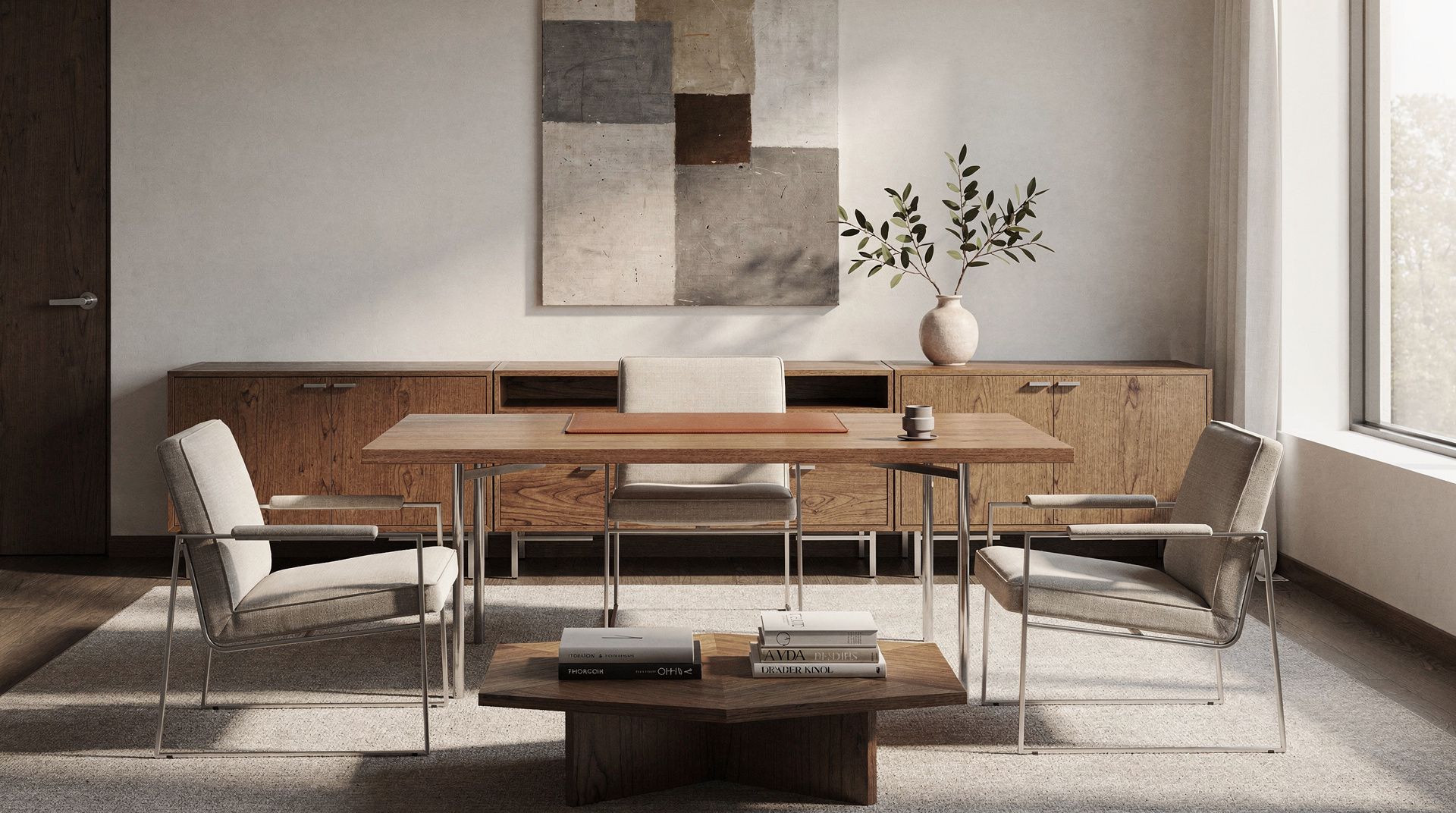
DESIGNER · FLORENCE KNOLL

Florence Knoll: Architect of Corporate Modernism

How the Planning Unit reimagined the office

Trained under Eliel Saarinen at Cranbrook and under Mies van der Rohe at IIT, Florence Knoll transferred the principles of modern architecture to the interior of the postwar corporation. With the Knoll Planning Unit, founded in 1943, she developed a holistic approach that united floor plan, modular furniture, textiles, and color palettes. Her sofas, benches, and desks from the 1950s are today regarded as the grammar of a quiet, precise modernism whose authorship long stood in the shadow of her male colleagues.

mid-century·designs

Florence Knoll

ESSAY · 01

Work & Context

mid-century·designs

Florence Knoll: The Architect Behind Corporate Modernism

Florence Knoll Bassett, born in 1917 in Saginaw, Michigan, shaped the image of the modern office in the 20th century like virtually no other designer. Her education took her through the Cranbrook Academy of Art, where she studied under Eliel Saarinen and was in close contact with Eero Saarinen, Charles Eames, and Harry Bertoia, and on to the Illinois Institute of Technology under Ludwig Mies van der Rohe. This dual influence—the organic Cranbrook tradition on one hand, the rigorous Miesian rationality on the other—became the foundation of her work.

In 1943 she joined Knoll Associates, the firm led by Hans Knoll, which she co-directed after their marriage in 1946 and ran alone following Hans Knoll’s death in 1955 until 1965. With the Knoll Planning Unit she built up from 1946 onward, she developed an integrated approach encompassing interior architecture, furniture design, and corporate identity. Clients such as CBS, IBM, H. J. Heinz, Cowles Publications, and Connecticut General Life Insurance received not mere furnishings but a complete spatial concept in which floor plans, colors, textiles, and furniture were conceived as a single system. Florence Knoll herself modestly described her own designs as “fill-in pieces”—complements to the icons of Mies, Saarinen, and Bertoia. In fact, her sofas, armchairs, tables, and credenzas from the 1200 series and the Lounge Collection are today classics in their own right, defining the restrained, rigorous canon of corporate modernity.

Characteristic Materials and Construction Principles

Florence Knoll’s furniture designs follow a clear logic of visible structure. Frames of chromed or burnished steel support precisely upholstered cubes whose cushions emphasize geometry with taut, parallel seams. Typical is the contrast between cold, polished metal and warm natural materials: wool fabrics from Knoll Textiles, frequently in designs by Eszter Haraszty or Suzanne Huguenin, or carefully selected leather qualities.

For the case goods—particularly the credenza series and the desks—she favored veneered solid-wood work in Rio rosewood, walnut, teak, or white oak, combined with bases in black-lacquered steel. Tabletops in Carrara or Verde Alpi marble, travertine, and glass tops on T-base or H-base frames are part of her vocabulary. The craftsmanship follows an almost architectural precision: aligned veneer patterns, recessed pull rails, minimal joint lines. Anyone who picks up an original immediately recognizes its solidity in the weight of the frames, the cleanliness of the welds, and the consistency of the edge details.

Regional Schools and the Planning Unit’s Environment

Florence Knoll’s work cannot be understood without the transatlantic dialogue between the Bauhaus, Cranbrook, and the American East Coast. Mies van der Rohe provided the rigorous foundation with the Barcelona program and the Brno chairs, which Knoll produced under license from 1948. Eero Saarinen added a sculptural counterpoint with the Pedestal and Womb series, and Harry Bertoia a third position with his wire chairs of 1952. Within this ensemble, Florence Knoll deliberately positioned her own designs as quiet, tectonic elements.

Parallel to the Knoll Planning Unit in New York, George Nelson at Herman Miller in Zeeland, Michigan, together with Charles and Ray Eames and Alexander Girard, established a related but formally more open lineage. While Herman Miller leaned more heavily toward expressive individual pieces, Knoll under Florence Knoll’s leadership defined the restrained, systemic language of the American corporate interior. Parallels existed in Europe with designers such as Dieter Rams or in the Italian rationalist tradition around Franco Albini, yet the specifically American format—in which interior architecture, graphics, textiles, and furniture were conceived as a total system for corporate headquarters—remains Florence Knoll’s original contribution.

Authenticity and Condition for Collectors

Several features are central to evaluating original Knoll pieces from the Florence Knoll era. Early productions from New York bear paper labels reading “Knoll Associates, Inc.” with addresses such as 320 Park Avenue or 745 Fifth Avenue through the late 1960s. After 1969, labels reading “Knoll International” appear. On case goods, these markers are frequently found on backs, drawer bottoms, or undersides of tabletops. Metal frames may carry stamped impressions or adhesive foil labels.

Points to examine include veneer thickness and veneer pattern, which on originals from the 1950s and 1960s are noticeably more substantial than on later reissues. Marble tops on originals frequently feature a thicker edge and a hand-polished bevel. On upholstered pieces, the frame construction of nickel-plated or chromed steel tube with its characteristic weld points is an important indicator, as are the original webbing and the foam quality. Complete reupholstery diminishes value less severely than structural alterations, provided period-accurate fabrics—ideally from the historical Knoll Textiles program—have been used. On chrome, widespread delamination and repolishing are to be viewed critically; an even patina, by contrast, is considered a sign of untouched substance. Provenance documentation from original installations—such as from documented Planning Unit projects—considerably increases a piece’s significance to collectors.

At mid-centurydesigns.com, pieces from the orbit of Florence Knoll and the Knoll Planning Unit are examined for labeling, construction, material quality, and restoration history before being accepted into inventory. Each item is described photographically and in text with details on provenance, condition, and documented interventions, so that you as a collector have a reliable basis for your decision.

FAQ · 02

Frequently asked about Florence Knoll

5 Answers

01
Who was Florence Knoll and why is she significant to mid-century design?
Florence Knoll (1917–2019) was an American designer and entrepreneur who shaped 20th-century furniture design. After her training under Eliel Saarinen and her time at the Cranbrook Academy of Art, she joined Knoll International in 1946 and made it the leading force in modern office furniture design. She developed the concept of the "Planning Unit"—a holistic approach to furnishing office spaces that united functionality, aesthetics, and human ergonomics. Her legacy lies in her understanding of furniture design as part of corporate culture and spatial planning, not merely as individual objects.
02
What is Knoll's "Planning Unit" and how does it differ from other office furniture systems?
The Planning Unit was a revolutionary modular system that Florence Knoll developed from the 1950s onward. Rather than treating furniture as isolated pieces, she regarded the entire office space as an integrated system of elements such as room dividers, desks, shelving, and lighting that could be combined flexibly. The system also took into account acoustics, ventilation, and the movement patterns of users. The Planning Unit thereby established the principle of the open-plan office and made modular office furniture the norm in postwar corporate architecture.
03
Which original Florence Knoll designs are collectible today and what makes them valuable?
Particularly sought after are her early lounge chair and sofa designs such as the Knoll Lounge Chair (1943–1945), her tables with characteristic metal frames, and the modular spatial elements from the 1950s. Their value lies in the combination of iconic, timeless aesthetics, constructive elegance, and the fact that Florence Knoll asserted her own vision as a designer in a male-dominated industry. Originals with documented provenance—especially pieces from early Knoll productions or bearing the Florence Knoll label—command higher valuations. The historical significance of being one of the few women to lead a design company lends her works additional collector relevance.
04
How do I recognize an authentic Florence Knoll piece and what should I look for when buying?
Authentic Florence Knoll designs typically bear the Knoll label with the manufacturer's name and often the designer's name as well. Pay attention to material quality: high-grade wood frames (often walnut or oak), precisely finished metal constructions, and quality upholstery fabrics or leather. The documented production history is important—early pieces (1940s–1950s) are more sought after and more expensive. Check for signs of wear that are appropriate to the age: a slight patina often enhances authenticity, while major damage diminishes value. Reputable sellers can provide provenance documentation. For modular systems, all components should be documented and fully functional.
05
How does Florence Knoll's design philosophy differ from that of her male contemporaries such as Charles and Ray Eames?
While the Eameses focused on experimental materials and a playful formal language, Florence Knoll concentrated on rationality, systemic thinking, and the holistic space. Her approach was less experimental but more systematic and user-oriented. She saw herself not primarily as an artist but as a problem-solver for corporate environments. Moreover—unusually for her era—she was not only a designer but also an entrepreneur who brought her own designs to market with a sharp business sense. While the Eameses created iconic individual pieces, Knoll created an ecosystem of mutually functioning furniture and spatial elements.

GLOSSARY · 03

Related Terms

8 Entries

Planning Unit
A modular office furniture system developed by Florence Knoll in the 1950s. A partition system of standardized elements that enabled flexible floor plans and led to a reduction in operating costs for companies. It established the concept of the open, organizable office space.
Modular Design
A design principle in which furniture is assembled from interchangeable, standardized components. Enables flexibility, cost efficiency, and individual adaptation to different spatial formats. A core strategy of the Knoll Planning Unit.
Corporate Design
The comprehensive visual and spatial identity of a company. Florence Knoll developed a pioneering methodology for shaping office environments as an expression of corporate culture—not merely functional, but as a means of communication.
Knoll International
An American furniture company founded in 1938, led by Florence Knoll and her husband Hans Knoll. It developed into an icon of modern furniture design with a focus on ergonomic and modularly organized office furniture for large corporations.
Ergonomics
The science of adapting workplaces and furniture to human body dimensions and movement patterns. Florence Knoll systematically integrated ergonomic principles into her furniture constructions to maximize comfort and productivity.
Mid-Century Modern
A design movement of the 20th century (approximately 1933–1965) emphasizing a functionalist formal language, constructive clarity, and industrial production. Florence Knoll is counted among the defining designers of this era in furniture design.
Space Planning
The holistic analysis and conception of interior spaces taking into account functionality, user behavior, and aesthetic criteria. Florence Knoll combined architectural space planning with furniture design and was a pioneer of this integrated approach.
Constructive Aesthetics
A design principle in which the visible construction of an object determines its aesthetic form. Characteristic of Florence Knoll's work, which understood form and structure as a unity, without decorative superfluity.