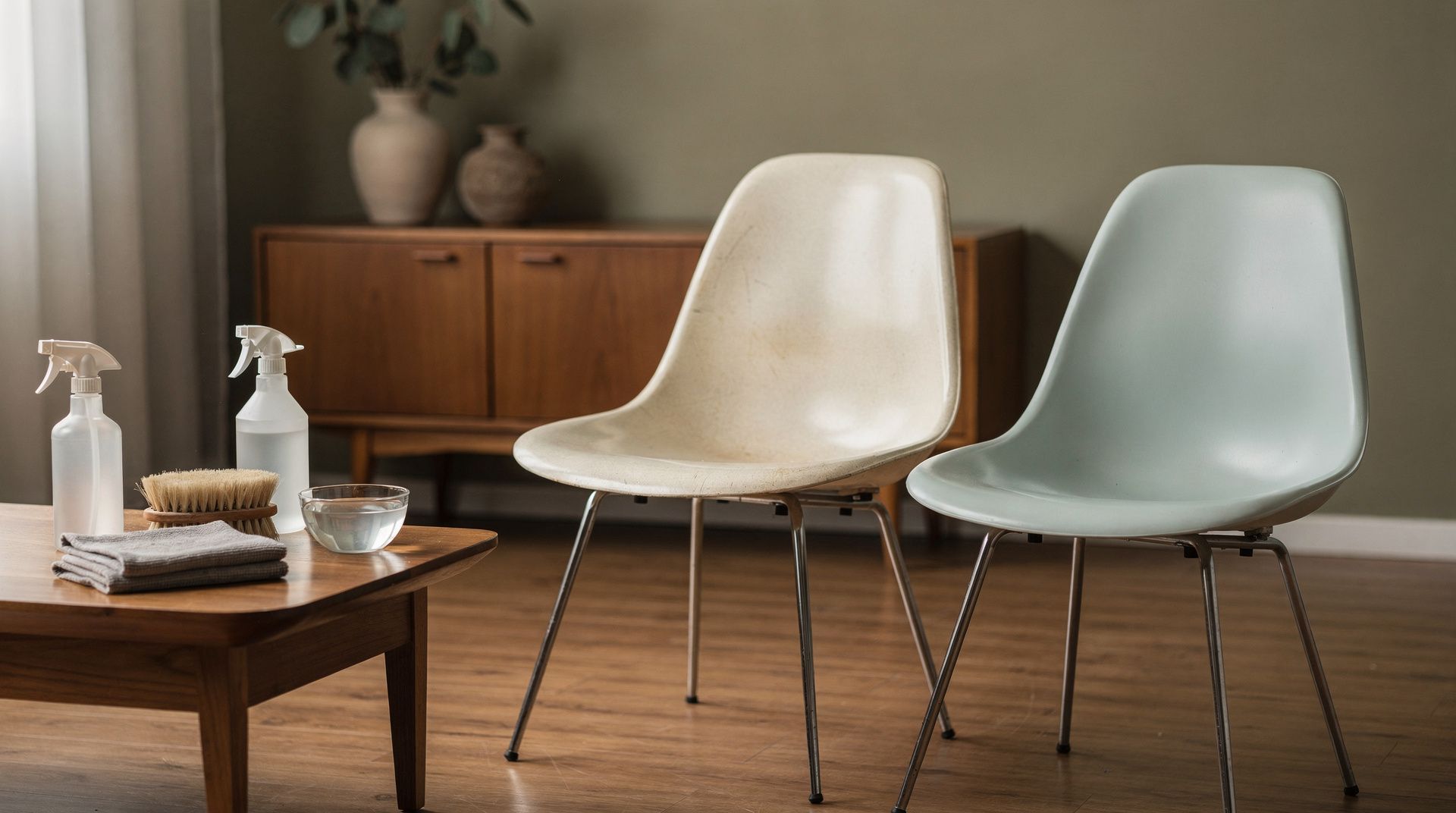
Fiberglass Shells and Plastic Furniture: Care, Preservation, and Value Retention of the Space Age Era
The plastic furniture of the 1950s to 1970s ranks among the most culturally charged objects of postwar modernism. It represents the leap into industrial mass production, in which materials such as glass-fiber-reinforced polyester, ABS, polypropylene, and polyurethane became design staples for the first time. Anyone collecting a fiberglass shell by Charles and Ray Eames, a Panton Chair from the early Baxter production, or an Eero Saarinen Tulip series today inevitably also deals with topics that barely matter for wooden or metal furniture: yellowing, chalking of the surface, fine hairline cracks, static charge, and the long-term effects of UV radiation.
The good news: many of these materials are remarkably robust when treated correctly. The less good news: wrong cleaners, aggressive polishes, or ill-considered restoration attempts can destroy the patina—and thus the provenance—of a piece within minutes. A Herman Miller shell from the first Zenith production with visible fiber structure and dark inclusions is fundamentally different from a reissue from the 2000s. Recognizing, preserving, and carefully tending to these differences is the task of every serious collector.
1. Characteristic Materials and Their Care
Glass-fiber-reinforced polyester (GRP/fiberglass) is the defining material of the early Eames Plastic Chairs, produced by Zenith Plastics for Herman Miller from 1950. It is recognizable by the slightly wavy, fibrous back with visible glass fiber bundles shimmering through the translucent resin matrix. Lukewarm water with a pH-neutral cleaner—such as a mild soap concentrate—applied with soft cotton or microfiber is suitable for cleaning. Solvents such as acetone, turpentine, or harsh all-purpose cleaners must be avoided, as they dissolve the resin surface and expose the fiber structure. Light scratches can be carefully worked out with high-quality plastic polish as used in boat building. It is important to work in the direction of the fibers and with very light pressure, so as not to polish the characteristic visible surface to a shine—original shells have a matte, silky finish.
ABS and polystyrene, as found in the early Panton Chair (from 1968 at Vitra/Herman Miller in Baxter production) or in the Componibili by Anna Castelli Ferrieri for Kartell, are more susceptible to yellowing caused by UV exposure and thermal stress. Discoloration here is often not superficial but penetrates the entire material. Complete de-yellowing is only possible with hydrogen peroxide treatments, which are controversial in the collector context because they alter the original structure and the results often regress.
Polypropylene, as in Robin Day’s Polyprop Chair (Hille, from 1963), behaves more stably but loses plasticizers with age and becomes brittle. Here, antistatic cleaning with distilled water is the safest option.
Polyurethane foam in seating by Gaetano Pesce or Olivier Mourgue ages practically without exception and crumbles irreversibly after 30 to 50 years. Preservation here means: store in darkness, dry, and at a constant temperature.
For all plastics: prolonged UV exposure is the greatest enemy. A position out of direct south-facing window light, UV-protective window films, and ideally a relative humidity of around 45 to 55 percent will significantly extend the lifespan.
2. Regional Schools and Influential Designers
The USA defined the technical foundation of industrial plastic seating furniture with the Eames couple and their fiberglass shells, as well as with Eero Saarinen (Tulip series for Knoll, 1957, fiberglass seat shell on an aluminum base). Herman Miller and Knoll were the publishers who brought this language into everyday life.
In Italy, a distinct and often more color-intensive interpretation developed from the 1960s onward. Kartell, founded in 1949 by Giulio Castelli, became the center of Italian plastic modernism with designs by Joe Colombo (Universale Chair 4867, from 1967, initially in ABS, later in polypropylene), Anna Castelli Ferrieri, and Vico Magistretti (Selene, 1969, for Artemide). Gaetano Pesce worked for B&B Italia (then C&B Italia) with polyurethane, including the Up series (1969).
In Denmark, Verner Panton created the eponymous stacking chair (Panton Chair, designed 1959–1960, first serial production from 1968 at Vitra/Herman Miller)—the first single-piece plastic chair in furniture history. Early versions in cold-formed rigid polyurethane foam differ significantly from the later Baydur and polypropylene editions.
In France, Pierre Paulin (fabric-covered foam constructions for Artifort) and Olivier Mourgue (Djinn series, 1965, famously featured in Kubrick’s 2001: A Space Odyssey) shaped the softer, sculptural vocabulary of the Space Age era.
3. Authenticity and Condition: What Collectors Should Look For
On an original Eames Fiberglass Side Shell from the Zenith production (1950 to 1954), you will find an embossed Zenith signature on the underside, often accompanied by the large Herman Miller label. From 1954, Summit Plastics took over production; from 1957, the small Miller label appeared. The fiber structure of the early shells is coarse, with visible dark inclusions and a slightly irregular back. Reissues from 1999 (Vitra in Europe) and the resumption of fiberglass production from 2013 are finer and lighter in both material and structure.
For the Panton Chair, the market distinguishes four production phases: the Herman Miller/Vitra editions from 1968 in cold-formed rigid polyurethane foam, the Baydur version from 1971, the temporary discontinuation in 1979, and the current polypropylene version from 1999. Early examples carry corresponding embossings and differ markedly in weight, surface gloss, and edge formation.
For all plastic furniture, the following applies to condition assessment: even, age-appropriate patina is desirable; localized repairs with two-component resin are acceptable when carried out professionally and disclosed. Repainting significantly reduces value. Hairline cracks at stress points (seat surface edges, connections to the base frame) must be examined critically, as they propagate under load. Original bases, glides, and connecting elements are value-determining and should be documented.
At mid-centurydesigns.com, every plastic and fiberglass piece of furniture is examined prior to inclusion in the inventory for production phase, material structure, labels, repair history, and base originality. Dating is carried out on the basis of embossings, labels, and craft-historical characteristics; condition reports transparently identify discoloration, hairline cracks, and any conservation work carried out. This is how you find Space Age classics whose provenance and material integrity are reliably documented and which hold their own as collection objects in the long term.
This article was generated automatically by an AI system. Disclosure pursuant to Article 50 of the EU AI Act.