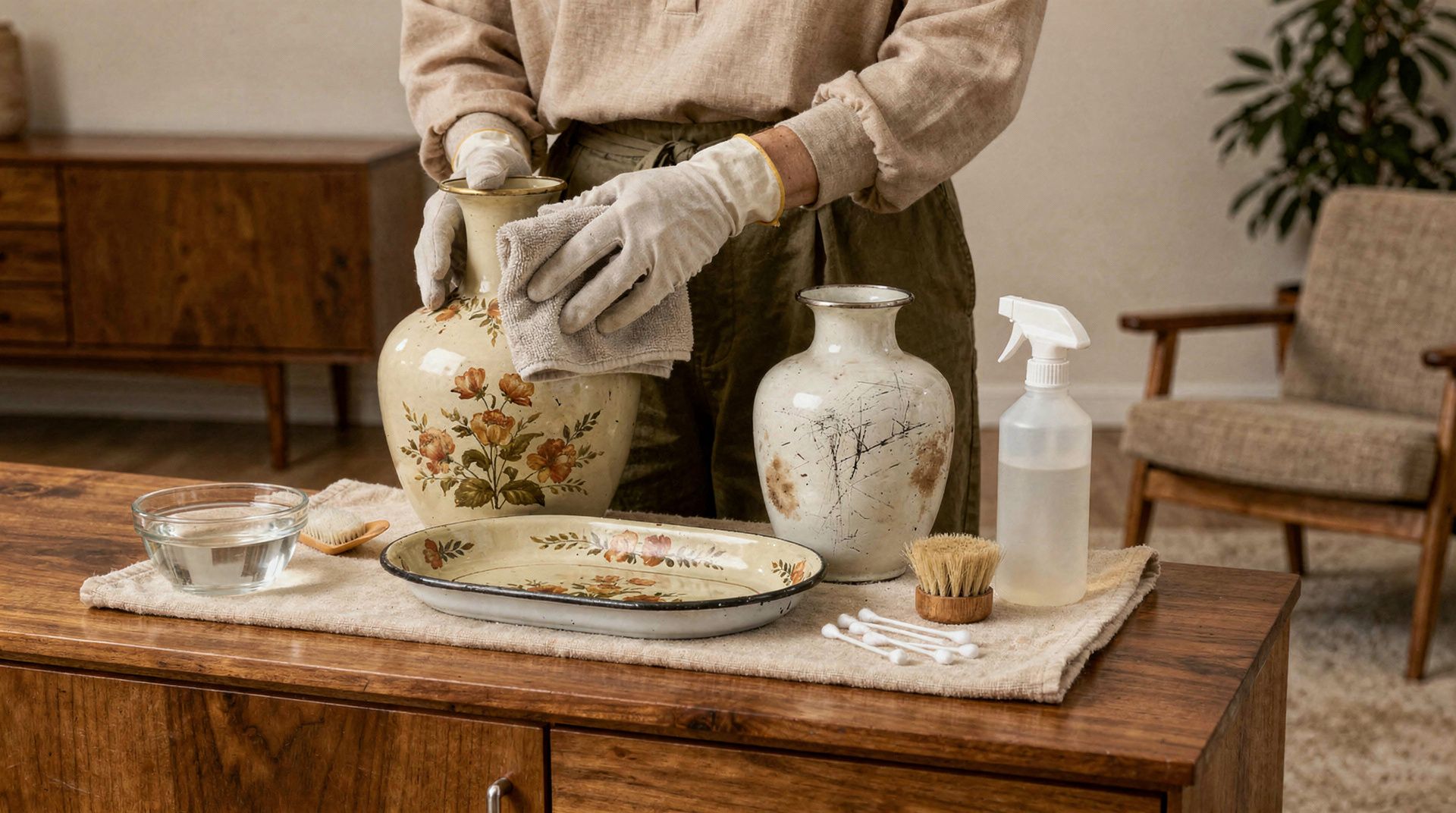
Cleaning and preserving enamel: what collectors need to know
Enamel — glass powder fused onto metal at high temperatures — is one of the most durable surfaces in design history and at the same time one of the most delicate to handle. The glass-like layer is hard, scratch-resistant against many everyday materials and colour-stable over decades. However, it is brittle, responds to impact and point loads with chipping, and does not tolerate aggressive chemicals when overglaze colours or screen prints are involved. Collectors of mid-century objects made from enamelled steel, copper or cast iron therefore work with a dual perspective: preserve substance, respect patina, never over-clean.
The guiding principle is: mild aqueous cleaning with pH-neutral soap, soft cotton or microfibre cloths, no abrasives, no steel wool, no chlorine-based cleaners and no strong acids or alkalis. Discolouration on white interior enamel can often be loosened with a diluted bicarbonate paste, applied gently and removed without pressure. True scratches in the glass flux are rare; what appears as a scratch is usually metal abrasion from cookware or cutlery and can be reduced with bicarbonate over time. Genuine hairline cracks, known as craquelure, and chips down to the metal core are irreversible and should be documented rather than disguised. Painted or printed overglaze decorations require particular restraint: cold water, no soaking times, no dishwasher and no solvents such as acetone, which can attack binding agents.
For storage, stable climatic conditions have proven effective: room temperature, moderate humidity, no direct metal-on-metal contact, no stacking without an intermediate layer of acid-free tissue paper or felt. Thermal shocks — such as hot dishes placed on cold stone — are the most common cause of new cracks in otherwise intact pieces.
Characteristic materials
In mid-century modern design, three base materials predominate. Enamelled steel with a cobalt or nickel undercoat forms the foundation of many Scandinavian and Central European kitchen and household objects, often with a high-gloss top enamel in off-white, mustard yellow, sage green or midnight blue. Copper as a base is found in studio art enamel, where translucent enamels are fused over chased or guillochéd surfaces and glow with inner depth. Cast iron with a thick, multiply fired enamel layer defines the heavy cooking pots of the post-war era, whose interiors are usually lighter and whose exteriors are executed in bold solid colours or colour gradients.
For all three materials, the surface is not lacquer but glass. This explains the great colour depth, the UV resistance and, at the same time, the susceptibility to chipping at edges, handles and rims, where the layer is structurally thinner.
Regional schools and designers
In France, Le Creuset from 1925 and Cousances shaped the colourful cast enamel tradition, which Raymond Loewy advanced in design terms in the late 1950s with the colour gradient of the “Volcanique”. Denmark, through Michael Bang and Jens Quistgaard at Dansk International Designs, produced enamelled series that combined Scandinavian restraint with robust everyday functionality. Finland is inseparably linked with Kaj Franck and the Finel enamel line at Wärtsilä-Arabia, for which Esteri Tomula, Raija Uosikkinen and Anja Juurikkala, among others, designed graphic decorations. In Germany and Austria, names such as WMF, Riess and the enamel sign and tableware tradition of the Bauhaus milieu stand for a sober, functional formal language. In the United States, art enamellers such as Paolo Soleri, Kenneth Bates and the workshops of Bovano of Cheshire worked with translucent enamels on copper, which belong more to the studio craft movement than to serial production.
Knowledge of these origins is relevant for care: French cast enamel tolerates hot washing-up water and natural-bristle brushes; Finnish overglaze decorations on sheet steel do not.
Authenticity and condition for collectors
Before any cleaning comes examination. Original marks appear on Finel as a fired base stamp, on Le Creuset as an embossed or printed lettering with size number, and on Dansk with the well-known four-ducks logo and country designation. Post-war productions differ from later re-editions frequently in weight, interior colour and handle construction. An authentic piece typically shows an even glass flux, clean edge runs and a characteristic patina that has not been artificially rejuvenated.
Four categories have proven useful for condition assessment: chips down to the metal core with visible rust formation; surface craquelure without loss of substance; metal abrasion from use; and production-related pinhole pores, which are a material characteristic rather than a defect. Restorations using cold enamel, lacquer or epoxy are usually clearly identifiable under raking light and a UV lamp and significantly diminish collector value. Anyone acquiring a piece should insist on an honest condition description, photographs of the base, edges and interior, and a traceable provenance.
At mid-centurydesigns.com, enamel objects are individually examined, documented under daylight and raking light, their marks identified and their condition described in transparent categories. Restorations are named, patina is preserved, and the curation follows the conviction that an honestly described original piece is always preferable to a reworked object.
This article was generated automatically by an AI system. Disclosure pursuant to Article 50 of the EU AI Act.