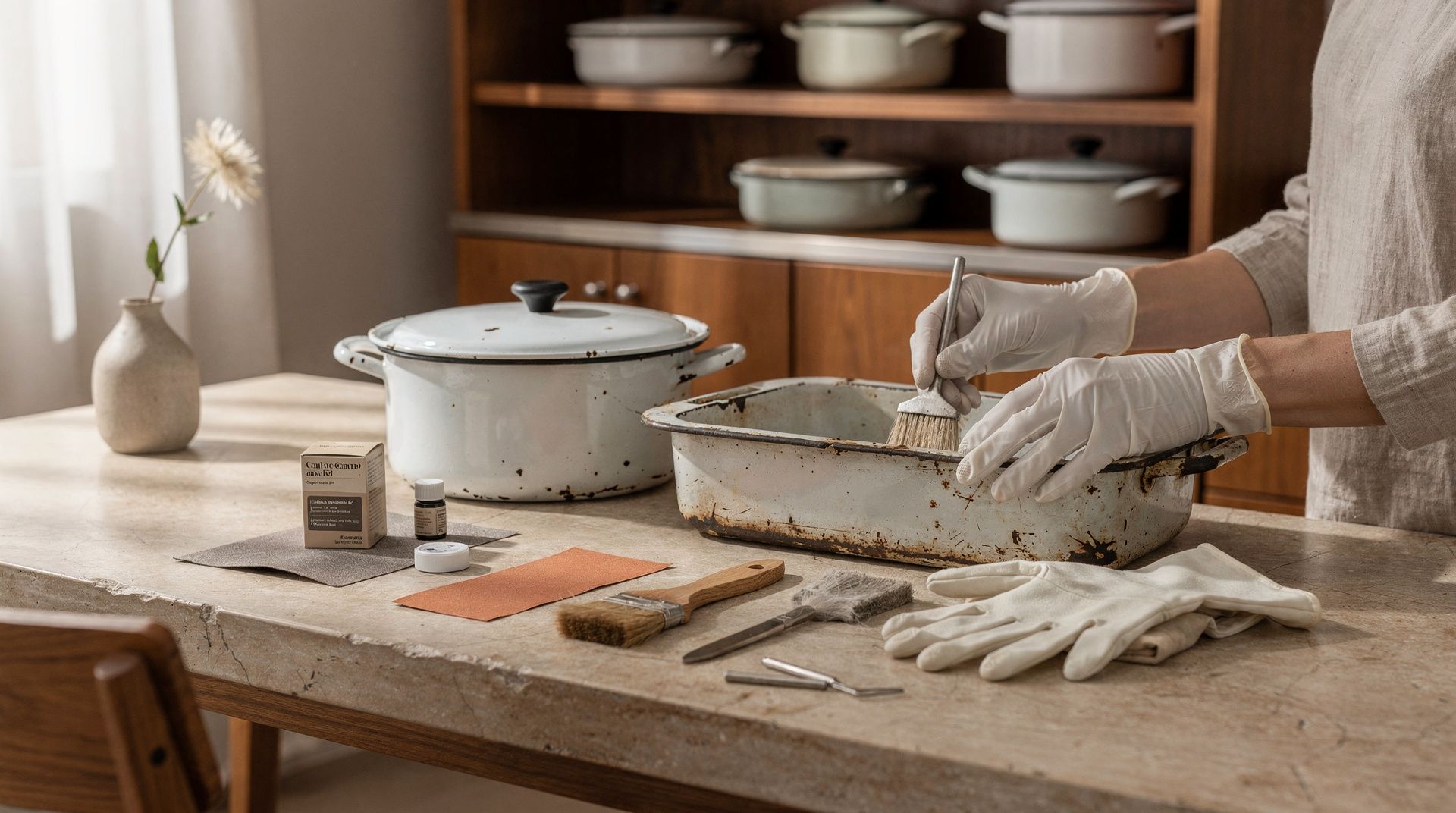
Repairing enamel scratches and rust stains on enamelled vintage cookware
Enamel is essentially glass, fused onto steel or cast iron at temperatures between 780 and 850 degrees Celsius. This technical foundation explains both: the remarkable resilience of enamelled Mid-Century cookware against acids, fats and temperature fluctuations, and at the same time its peculiar vulnerability. A hard knock to the edge, a dropped lid, a too-rough pot scrape, and the glass-like layer chips away at a point. Beneath it lies bare steel that begins reacting with humidity immediately. Rust pockets migrate beneath the intact enamel and, over time, lift it away from the base material.
Anyone who collects or uses Dansk Købenstyle by Jens Quistgaard, early Le Creuset in Volcanique, Cathrineholm with lotus décor or the enamelled ranges by Michael Lax for Copco will sooner or later face the question: stabilise yourself or have it professionally re-enamelled? The answer is rarely clear-cut, but it follows clear material-technical principles. This text classifies repair techniques, the limits of home treatment and the consequences for collector value.
1. Characteristic materials and what they mean for repair
Mid-Century enamel differs considerably depending on the base material. Cast iron with enamel (Le Creuset from 1925, Descoware from Belgium, Copco from 1960) typically carries two to three enamel layers: a dark base coat and a colour-bearing top coat. Chips on the interior expose porous cast iron that absorbs water. A food-safe repair is virtually impossible here, as any mass applied afterwards cannot reach the original firing temperature. Small chips on the outer rim can be stabilised with heat-resistant enamel repair lacquer (such as a two-component type), as long as the affected area does not come into contact with food.
Pressed steel with enamel (Cathrineholm from Norway, Finel by Arabia, Dansk Købenstyle from thin carbon steel) is lighter, thinner and more sensitive to impact. Rust typically appears at rivet points, handle penetrations and base edges. Surface rust on the enamel itself mostly results from external contamination (steel wool, dishwasher baskets) and can be removed without material loss using a paste of bicarbonate of soda and water or a diluted citric acid solution (around five percent). True substrate rust, identifiable by brownish discolouration showing through from beneath the enamel, is by contrast irreversible without complete re-enamelling.
For treating rust on exposed steel, phosphoric acid-based rust converters have proved effective, transforming iron oxide into stable iron phosphate. These products are not approved for food contact, however. Anyone wishing to continue using a piece of cookware must keep the treated area spatially separate from the interior — meaning work exclusively on exterior surfaces.
2. Regional schools, designers and their repair logic
The Scandinavian school favoured thin-walled pressed steel with precise screen-printed décors. Grete Prytz Kittelsen designed the Lotus series for Cathrineholm from 1954, whose value today depends significantly on the condition of the décor. Any polishing treatment on the exterior risks décor loss; the characteristic turquoise and mustard yellow in particular are UV-sensitive. Repair here means first and foremost: do nothing that jeopardises the print.
Kaj Franck and Ulla Procopé worked at Arabia on enamelled household ranges that were not structurally designed for repairability. The Danish Købenstyle line by Jens Quistgaard for Dansk (from 1956) was originally produced in France, later in Thailand. Country of production noticeably influences wall thickness and enamel quality and should be checked before any repair decision.
The French-Belgian tradition around Le Creuset and Descoware relied on heavy cast-iron bodies with multi-layer enamel that tolerates edge repairs, but effectively disqualifies interior damage from continued kitchen use. In the United States, Michael Lax developed for Copco a formal language mediating between both schools, combining Scandinavian linearity with cast-iron mass. Professional re-enamellers still exist in Europe in small numbers, for instance in the context of industrial sign-making and bathtub restoration. Costs regularly exceed the market value of the object, with the exception of museum-relevant individual pieces.
3. Authenticity and condition for collectors
For collector assessment a clear hierarchy applies: original condition with visible signs of use beats a professionally executed partial repair, and a professionally executed partial repair beats any re-enamelling. Completely re-enamelled pieces lose their value as material testimony and are, strictly speaking, replicas on original bodies. With signal colours such as the Flame Orange of early Le Creuset or the specific blue of Dansk Købenstyle, tonal shifts from re-firing are unavoidable, since the original pigment recipes (some containing cadmium and uranium, now regulated) cannot be reproduced.
Checkpoints before purchase: hold rim and lid edges against the light (hairline cracks become visible as thin dark lines), check the interior base for matt patches (indicating dishwasher damage), inspect handle fixings for rust seepage, view décor surfaces dry rather than wiping them wet. A practised thumbnail drawn across the surface detects the finest chips that are missed visually. Stampings and maker’s marks on the base should be cross-referenced against documented production periods, as forged marks circulate on sought-after lines.
The following preventive measures extend service life: hand-washing with a soft sponge, no dishwasher, no metal utensils in pots, storage with felt interlayers between stacked pieces, avoidance of thermal shock (no cold water into a hot pan). These routines prevent precisely those damages that later raise the question of re-enamelling.
At mid-centurydesigns.com, enamelled cookware and objects are individually inspected for hairline cracks, substrate rust and décor condition before being added to the inventory. Condition descriptions identify chips to the millimetre with photographic documentation; production origin and dating are established by reference to stampings and catalogue comparison. Re-enamelled or touch-up-lacquered pieces are fundamentally not listed. This leaves the decision of whether an object remains in use or merits a place in a collection as a witness to its time with you, on a reliable basis.
This article was generated automatically by an AI system. Disclosure pursuant to Article 50 of the EU AI Act.