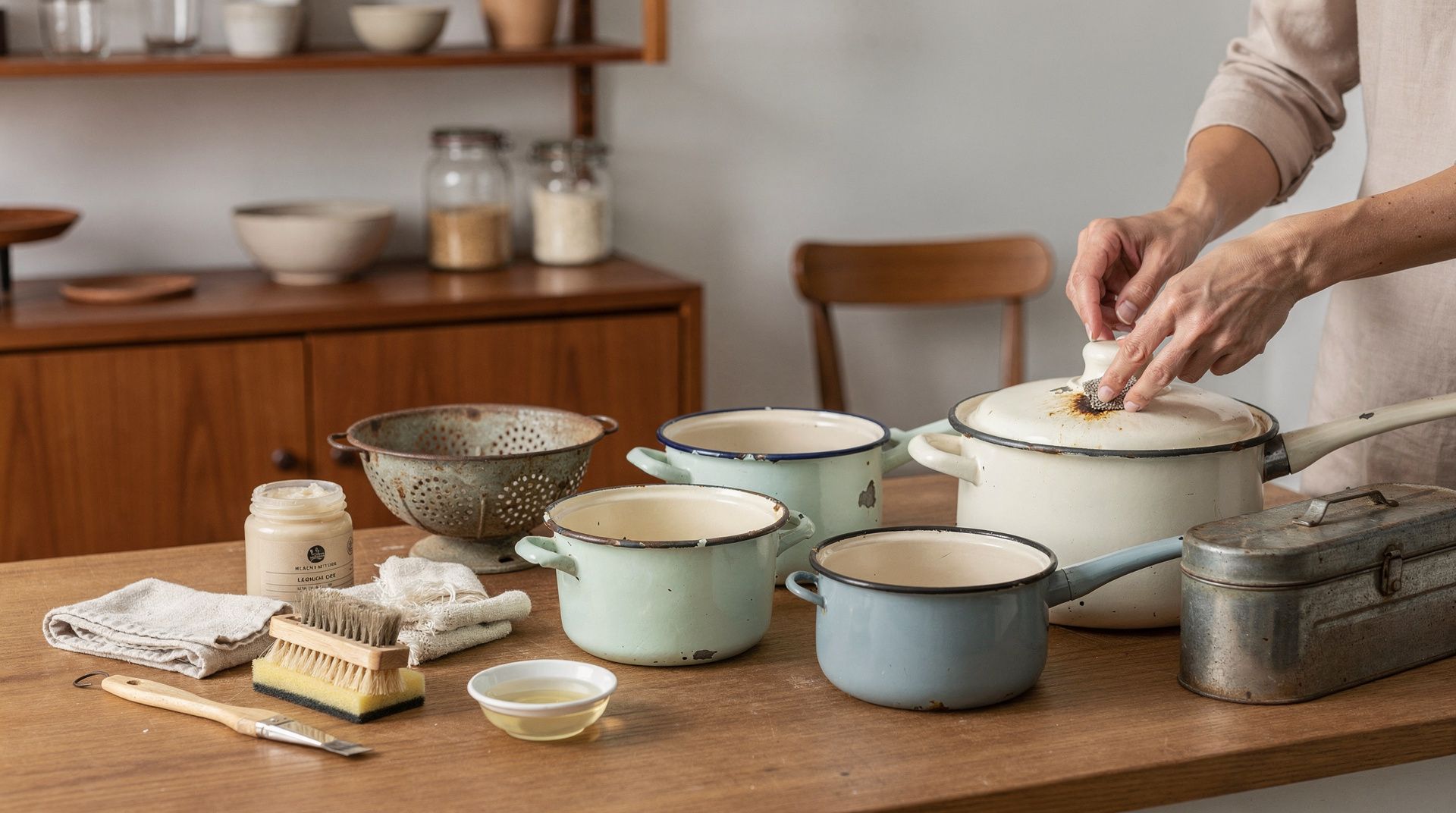
Safely Restoring Enamel Cookware and Vintage Household Items
Enamel is one of the most honest surfaces of the 20th century: a glass melt fired onto steel or cast iron at around 800 °C, combining colour, hygiene and durability in a single layer. This very materiality is what makes vintage enamel so sought after — and at the same time so delicate to care for. Anyone picking up a piece from the 1950s to 1970s is holding industrial glass in a thin, brittle layer. Scratches, chips and rust blooms are not catastrophes, but part of an ageing process that can be stabilised with restraint and expertise. Restoration here does not mean renewal, but the halting of processes: stopping the rust, conserving the enamel, respecting the patina. Anything beyond that shifts an object from original towards replica and diminishes its collector value.
The following sections classify material knowledge, provenance and condition assessment in the way we apply them in our daily dealings with Mid-Century household items. We write from the perspective of a curated trade that prefers to show an honestly aged piece with clear provenance over a sanded-down, freshly lacquered object with no history.
Characteristic Materials and What They Reveal About Restoration
Enamel from the mid-20th century typically sits on one of two substrates: deep-drawn sheet steel for lightweight pots, bowls, jugs and kitchen utensils, or cast iron for heavy roasters and cocottes. Both materials respond entirely differently to damage. With sheet steel, the enamel layer is thin — usually two-ply, consisting of a dark base enamel and a coloured top enamel. When it chips off, the steel is exposed and begins to rust immediately upon contact with moisture. With cast iron, the layer is thicker, more elastic and less likely to be damaged down to the substrate; instead, chips at edges and lid rims are typical, because the casting underneath yields locally at the slightest impact.
For treatment, this means: rust spots on exposed steel are best treated mechanically with a brass-bristle brush or fine bronze wool — never steel wool, as its particles embed themselves and accelerate rust formation. Chemically, diluted citric acid or oxalic acid solutions have proven effective as cold rust converters, transforming rust into a water-soluble salt without attacking the surrounding glaze. After neutralising with clean water and thorough drying, the damaged area is sealed with a food-safe micro-wax or, for purely decorative objects, with an acid-free conservation oil. For cookware intended for continued use, a cosmetic enamel repair using cold enamel from oven repair supplies is possible — however, it cannot withstand direct flame and should be understood as a touch-up, not a restoration. Fine hairline cracks in intact enamel, known as crazing, are not damage but a natural indicator of ageing and should be left untreated.
Regional Schools and Defining Designs
Mid-Century modern enamel household goods cannot be understood without their regional traditions. In France, Le Creuset, founded in 1925 in Fresnoy-le-Grand, defined the heavy, orange-lacquered cast iron cocotte, which became the epitome of bourgeois kitchen culture in the 1950s and 1960s. Staub, also French and produced in Alsace since 1974, works with a matte, multi-layered glaze on cast iron. In the Netherlands, ceramicist and designer Cor Unger created functional storage tins and bread bins with lithographed enamel decorations for Brabantia.
Scandinavia provided perhaps the most important design impulses: Kaj Franck for Finel, the enamel division of Arabia in Finland, designed pots, jugs and bowls from the late 1950s onwards whose forms were deliberately reduced and whose decorations came from artists such as Esteri Tomula, Anja Juurikkala and Raija Uosikkinen. Germany and the GDR produced robust everyday ware — for example at Riess in Austria, which still manufactures to historical forms today, or at the enamel processing plants in Lauchhammer and Olbernhau. In Great Britain, the firm Judge of Birmingham relied on pastel-coloured sets that helped define the colour code of the British post-war kitchen. These origins are crucial in condition assessment, because enamel thickness, colour construction and base marks vary considerably — and a Finnish Finel piece demands different restoration decisions than a French cast iron roaster.
Authenticity and Condition for Collectors
Assessing a vintage enamel piece involves four levels: marking, formal integrity, surface condition and provenance traces. The base mark is the first checkpoint. With Finel, for example, the combined signature with manufacturer details — and sometimes the name of the decorator — appears from 1962 onwards; Le Creuset has datable embossings and colour codes that allow a rough classification by decade. Formal integrity refers to correspondence with the original design: handles, pouring spouts, lid knobs and rivets were altered over the years, and a later-added Bakelite or plastic handle can fundamentally change the character of a piece.
Surface condition is read with nuance by collectors. Signs of use on the inside of a cooking pot, slight discolouration, fine crazing or minimal edge chips are considered authentic and value-preserving, as long as the colour surface on the outside remains intact. What is critical are large-scale repaints, sanded-down base marks and flaws covered with oven paint, as these irreversibly conceal the original substance. Rust that has already formed bubbles beneath the enamel is structural damage and can only be stabilised, not reversed. Provenance traces such as initials scratched in by former owners, old inventory labels or records of kitchen origin increase documentary value and should under no circumstances be removed. As a rule of thumb: any restoration that could not be reversed within ten minutes is going too far.
At mid-centurydesigns.com, we assess every enamel and household object against precisely these criteria before adding it to our inventory: mark, formal integrity, substance of the glaze, degree and reversibility of any prior treatments. We document edge chips, crazing and base marks photographically, openly disclose restoration interventions and strictly distinguish between conserved originals and decoratively reworked pieces. This gives you, as a collector or designer, a reliable basis for deciding whether an object belongs in your collection, in an interior project or in everyday kitchen use.
This article was generated automatically by an AI system. Disclosure pursuant to Article 50 of the EU AI Act.