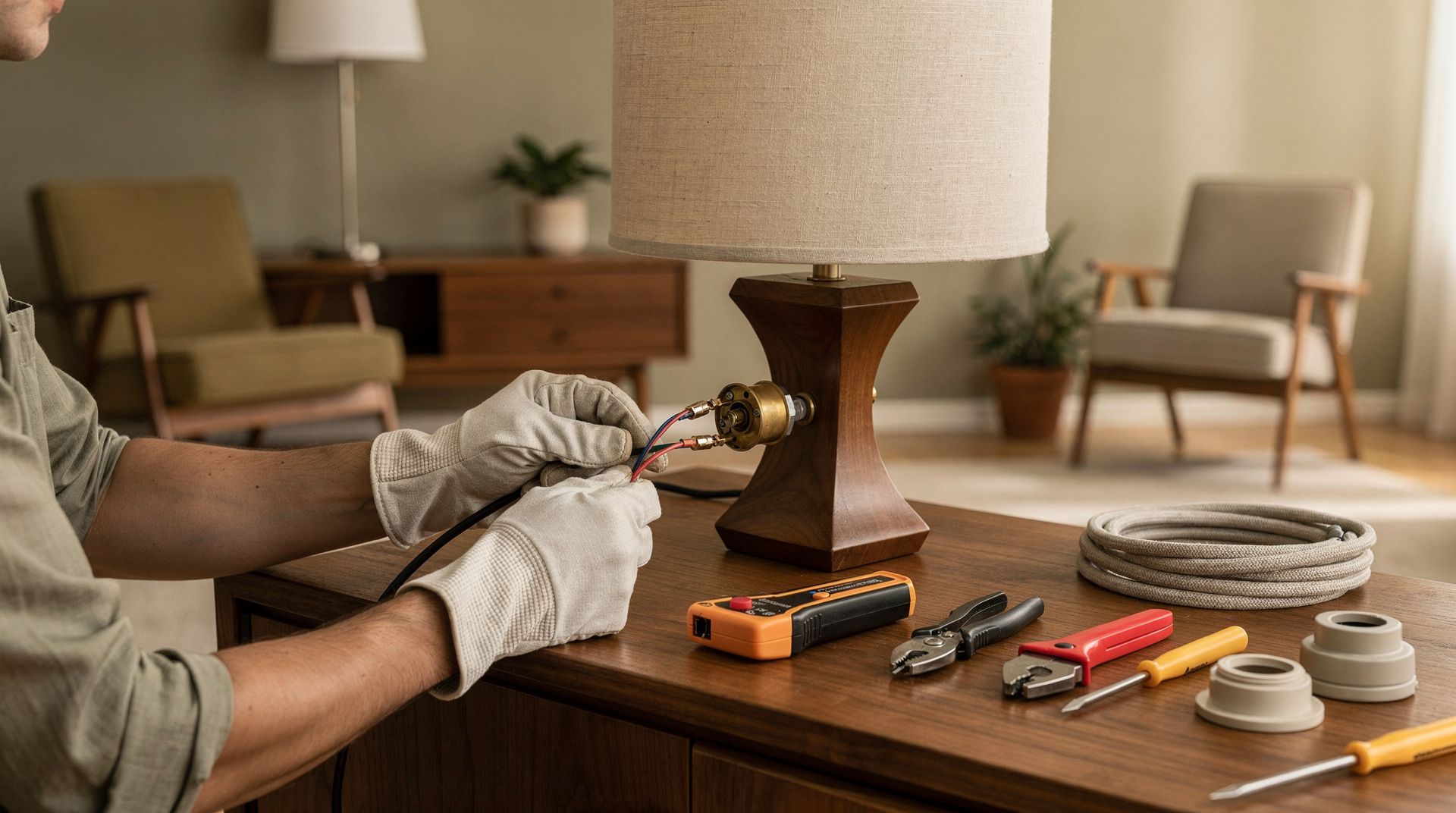
Professionally rewiring vintage luminaires: why re-cabling is part of preserving the piece
A floor lamp by Arredoluce, a pendant from the Stilnovo circle or a wall arm by Jacques Biny has often half a century or more behind it. What rarely survives that time is the electrics. Textile-sleeved cables become brittle, rubber insulation crumbles at the touch, Bakelite lamp holders show hairline cracks, and earthing is simply absent on many European luminaires from the 1950s and 1960s because it was never specified by the manufacturer. Anyone who buys a vintage luminaire and puts it into service without checking the current-carrying components risks not just a short circuit, but in metal housings also a fault-to-chassis contact.
Professional re-cabling means, for us: preserving the original fabric to the maximum, but replacing all safety-relevant components and checking them against the applicable standards (in Germany we follow DIN VDE 0100 and DIN EN 60598 for luminaires). This is not restoration in the museum sense, but the prerequisite for a piece to do again what it was built to do: make light, every day, without side effects. The following guide summarises what you should look out for in terms of materials, provenance and condition, and what a clean electrification looks like step by step.
1. Characteristic materials and what they mean for the electrics
Mid-century luminaires are studies in materials. Brass, burnished brass, nickel-plated steel, lacquered aluminium, Murano glass, opal glass, Perspex, teak and rosewood appear in various combinations. For electrification purposes, it is relevant that almost all metal housings are conductive and can therefore be live in the event of a fault. This applies particularly to Italian luminaires in lacquered sheet metal and French brass work, which were often supplied from the factory with only a two-pole connection.
When dismantling, you will encounter typical signs of age: rubber cables that crumble when bent, solder joints with oxidised copper strands, Bakelite or early thermoset lamp holders with cracks in the thread, and strain reliefs that were never more than a knot in the cable. The following should always be replaced: the complete mains cable (for a textile look, use a modern, tested textile cable H03VV-F or H05VV-F), all E14 and E27 lamp holders (now with ceramic body and defined temperature class), switches, strain reliefs and, where present, the intermediate terminal blocks. Original canopies, reflectors, joints and decorative sleeves are retained. With Murano glass and opal glass shades, it is worth checking the lamp holder itself: LED lamps are a sensible choice because they drastically reduce the heat load on delicate glass and historical lacquers.
Tools and materials for working to a professional standard: multimeter with continuity and insulation testing, wire strippers, ferrules with crimping tool, temperature-resistant silicone sleeves for internal wiring, tested ceramic lamp holders, metal strain reliefs and, if the housing is metallic, an earthing point with toothed washer directly on the chassis.
2. Regional schools and designers: why provenance determines the approach
Electrification follows the construction, and the construction is regionally shaped. Italian luminaires of the post-war period – from Stilnovo, Arredoluce, Arteluce (Gino Sarfatti), Oluce (Giuseppe Ostuni, later Vico Magistretti) or O-Luce – are often multi-arm in design, with joints through which cables are routed. Patience is required here: every cable route must be planned before assembly, because the wiring cannot be corrected later without opening the piece again. Sarfatti’s models for Arteluce illustrate perfectly how seriously the Italians took proportion and articulation – and how little thought they gave to subsequent serviceability.
In France, the formal language was shaped by Serge Mouille, Pierre Guariche, Jacques Biny (Luminalite) and Robert Mathieu. Mouille’s iconic black wall and ceiling lights use thin steel tubes through which single-core cables were routed. Re-cabling to today’s standard requires pulling a double-insulated cable through those tubes – millimetre-precision work. Scandinavian luminaires, such as those by Poul Henningsen (Louis Poulsen, PH series), Jo Hammerborg (Fog & Mørup) or Vilhelm Lauritzen, are often constructionally more accessible because the Danes paid early attention to serviceability and material separation. The German and Swiss contributions – Kaiser Idell (Christian Dell), BAG Turgi or the circle around Sigfried Giedion – follow a Bauhaus-influenced logic: reduced forms, robust lamp holders, often with better strain reliefs as standard from the factory.
Knowing which school a piece comes from also means knowing where the typical weak points lie and how much reversibility is possible. That is not nostalgia – it is craftsmanship.
3. Authenticity and condition: what collectors should check
A safely electrified luminaire is only a collectable piece if the electrification has not compromised its authenticity. Four criteria are central for us. First: preservation of original fabric. What is original is the chassis, reflectors, shades, joints, surfaces, labels and manufacturer’s plates. Anyone who paints over a Stilnovo plate or re-powder-coats a Mouille arm destroys value. Patina on brass is desirable, not a flaw.
Second: reversibility. Every electrical modification should be undoable without damaging the piece. New holes drilled for additional strain reliefs are a warning sign, as are glued rather than screwed canopies. Third: documentation. We document which parts were replaced, what cable cross-section was used, whether and where earthing was applied, and what maximum lamp wattage is permitted. This information is part of the provenance of a vintage object in current use. Fourth: testing. After electrification, visual inspection, continuity testing of the protective conductor (for Class I protection), insulation resistance measurement and a functional test under load follow. Only then does a piece leave the workshop.
The handling of replicas and later reissues remains a critical point. Serge Mouille has been officially re-edited for years, as have many Sarfatti designs through Astep. These pieces are legitimate, but they are reissues, not vintage. For collectors, the difference between an Arteluce production from the early 1960s and a current licensed manufacturing matters considerably – in price as much as in significance.
At mid-centurydesigns.com we curate original luminaires from the Mid-Century Modern context and hand them over in a condition that does justice to their provenance and meets today’s electrical requirements. Every luminaire in our inventory is disassembled, cleaned, fitted with new cables, ceramic lamp holders and tested strain reliefs before sale, earthed professionally where required, and then electrically tested. What you find with us is not a museum showcase, but functional design with provenance that you can switch on in the evening without giving the wiring a second thought.
This article was generated automatically by an AI system. Disclosure pursuant to Article 50 of the EU AI Act.