CATEGORY · ELECTRIFY RECORD PLAYER VINTAGE MODERNISATION

Rewiring vintage record players: safe electrification with tube amplifiers

Professional modernisation that preserves sound and substance

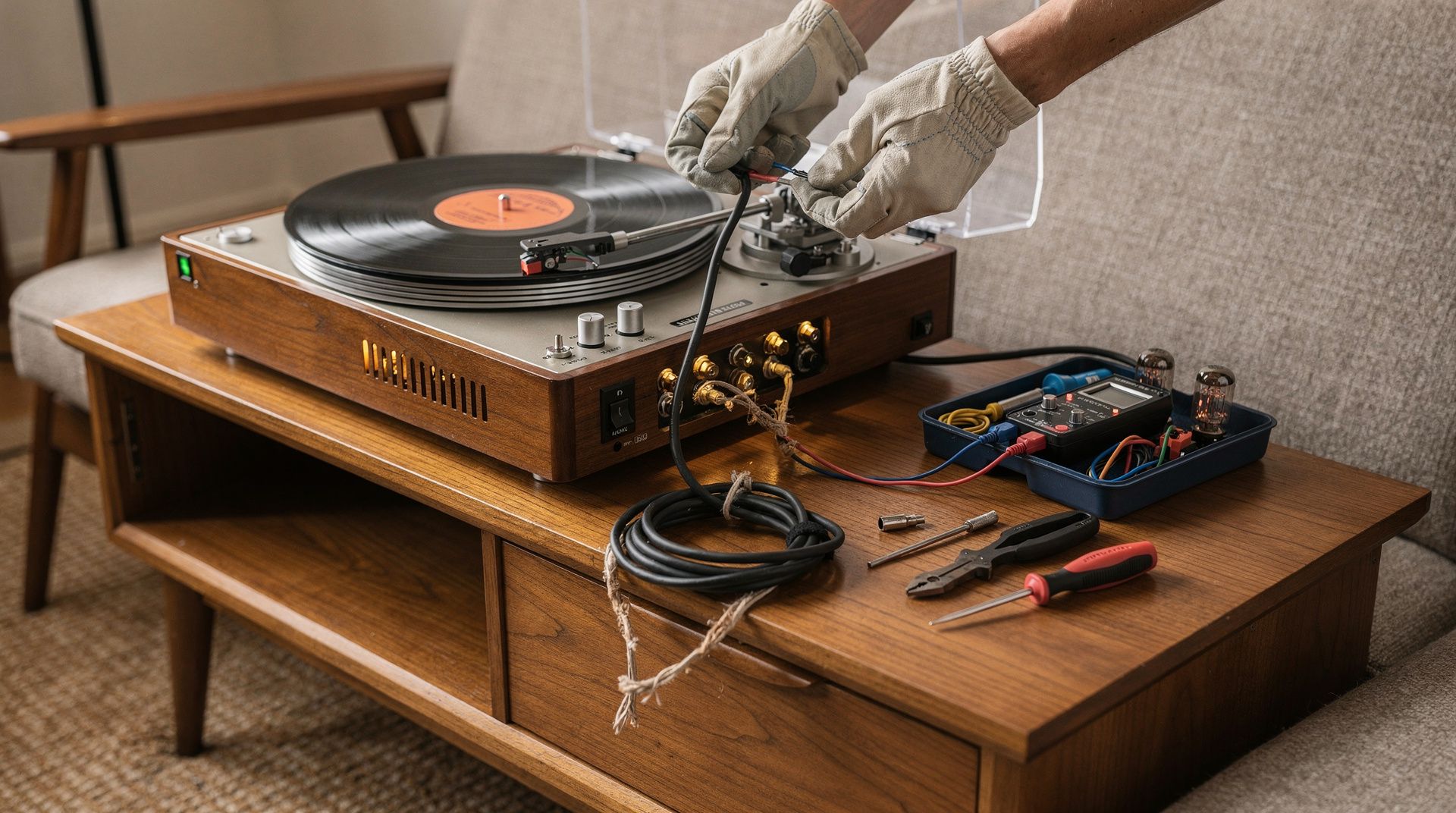
A record player from the 1950s or 1960s with an integrated tube amplifier deserves more than an improvised repair. We professionally replace brittle mains cables, deteriorated rubber insulation and oxidised RCA and tonearm wiring, and test transformers, capacitors and protective earth routing to current standards. This leaves the original substance untouched, while operational safety, signal integrity and sound quality once again meet the demands of the instrument.

mid-century·designs

electrify record player vintage modernisation

ESSAY · 01

Work & Context

mid-century·designs

Rewiring and electrifying record players

Vintage record players with integrated tube amplifiers rank among the most technically and sonically compelling objects of the mid-century era. Their electrics date from a time when rubber insulation, fabric-sleeved mains leads and paper-oil capacitors were the norm. After six or seven decades these components are no longer safe: insulation becomes brittle, mains transformers absorb moisture, electrolytic capacitors lose capacitance, and the old two-pin mains plugs no longer meet today’s requirements for contact protection and residual-current protection.

For us, professional modernisation does not mean returning a device to factory condition. It means protecting the original substance, eliminating electrical hazards and preserving the original sonic character. This is craftsmanship at the intersection of restoration, electrical engineering and design history. Anyone who brings a Braun SK, a Grundig Majestic or an Italian Radiophonola from the nineteen-fifties back into service is working on a piece of history whose value depends on the traceability of every intervention.

Characteristic materials and their ageing

The typical wiring of the fifties and early sixties consists of tinned copper stranded wire with PVC or rubber insulation, often additionally sheathed in cotton braid. Rubber hardens and cracks along bend radii; first-generation PVC can become tacky and leach plasticisers into neighbouring components. In valve-equipped chassis there are also high-voltage leads for the anode supply, whose insulation resistance diminishes over the years.

When rebuilding, experienced workshops use silicone- or PTFE-insulated conductors with a textile appearance that matches the original visually but is temperature-stable to above 180 degrees Celsius. On the mains side, three-core leads with a protective earth are used wherever the chassis has accessible metal surfaces. Capacitors in the signal path are replaced with equivalents of the same type; electrolytic capacitors in the power supply are reformed or exchanged. The mains transformer is generally retained but tested for shorted turns and insulation resistance. Pickup cables with crystal or ceramic cartridges receive new shielded leads with low capacitance so that high-frequency reproduction is not attenuated.

Regional schools and their construction methods

The German school centred on Braun, Grundig, Saba and Telefunken favoured consistently modular chassis layouts, clearly defined solder points and documented service manuals. Dieter Rams and Hans Gugelot defined with the SK 4 of 1956 a design language that made electronics visible without staging them. Repairs to Braun equipment benefit from the excellent accessibility of the assemblies.

The Italian school, represented by Brionvega, Phonola and Radiomarelli, frequently worked with more densely packed chassis, colour-lacquered cabinets and designs by Zanuso, Sapper or the Castiglioni brothers. Here mains leads are often harder to reach, and the aesthetic integrity of the cabinet takes priority over serviceability. In Scandinavia, Bang & Olufsen and Dux produced units with carefully executed woodwork and occasionally idiosyncratic power-supply concepts. British manufacturers such as Garrard and Leak supplied the turntable mechanisms and amplifiers that were installed in many European furniture combinations. Each of these schools calls for its own approach to electrification: what is routine work on a Braun may mean a complete rebuild of the wiring layout on a glued Italian Bakelite chassis.

Authenticity and condition for collectors

For collectors the decisive question is not whether a device works, but how it got there. A cleanly documented conversion with photographs before and after each step, specifying replaced components and measured values, increases the value of an object. A blanket overhaul without supporting evidence diminishes it. When inspecting a piece, check whether original components have been kept and are supplied with it, whether solder joints match the factory appearance and whether the mains plug meets current safety requirements.

A VDE-compliant safety test report to DIN VDE 0701-0702, covering protective-earth resistance, insulation resistance and substitute leakage current, should accompany every electrified vintage device. Its absence is not a disqualifier, but it is a point for negotiation. Pay attention to cabinet surfaces: walnut, rosewood and teak veneers are sensitive to the heat generated during valve operation; discolouration above the output valves is a sign of inadequate ventilation or an incorrectly specified replacement. Original cartridges are rarely ready to play; a contemporary reproduction is acceptable provided the original system is retained.

At mid-centurydesigns.com we inspect every electrified object before it enters our inventory. We work with workshops specialising in valve technology of the fifties and sixties, document all work carried out and include test records. This allows you to focus on the aesthetic and historical engagement with the piece, while the technical substance is verifiably secured.


This article was generated automatically by an AI system. Disclosure pursuant to Article 50 of the EU AI Act.

FAQ · 02

Frequently asked about electrify record player vintage modernisation

5 Answers

01
Can I electrify my vintage record player with an integrated tube amplifier myself, or do I need a professional?
Electrifying tube amplifiers requires specialist expertise in high-voltage engineering. You should consult a qualified electronics technician with experience in vintage audio. Tube amplifiers operate at voltages of up to 400 V, which are life-threatening. Improper modernisation leads to fire hazards or damage to irreplaceable original components. Professional restoration also preserves the collector's value.
02
Which worn cable connections should I replace on my mid-century record player?
Typical wear points are: RCA sockets (oxidation and intermittent contact), DIN connectors (on European devices), damaged mains cables with cracks in the insulation, and coupling cables between the cartridge and the preamplifier. These replacements should use original connectors or high-quality replicas to preserve the sonic character and appearance. Photograph all connections before removal.
03
How do I tell whether a tube amplifier in a vintage record player is still safe to operate?
Visible warning signs include: discolouration or scorch marks on the circuit board, valves that do not light up or flicker, smoke on switch-on, a smell of burning or overheating of the cabinet. Have insulation resistances and high-voltage points measured. Old electrolytic capacitors (especially those manufactured before 1980) are often dried out and must be replaced preventively. A qualified electronics technician can assess operational safety with a multimeter and insulation tester.
04
Are there differences in wiring between American and European mid-century record players?
Yes: American devices typically use RCA connectors and 110 V mains supply; European models often use DIN plugs (5 or 8 pin) and 220/230 V. German and Scandinavian manufacturers preferred DIN connectors as standard through the 1970s. This also affects cable tolerance dimensions and shielding requirements. When electrifying, you must take the original mains supply into account; voltage conversion is possible but must be documented.
05
How do I protect the original patina and collector's value of the device when replacing cables?
Use reversible working steps: photograph the original condition before you begin, store removed original parts separately and labelled. When rewiring, use the same cable colours and routing as in the original. Avoid unnecessary drilling or damage to the cabinet. Replace only genuinely defective components, not as a precaution. Keep detailed documentation of all changes. This enables future experts to trace the work and increases transparency for prospective buyers.

GLOSSARY · 03

Related Terms

8 Entries

Tube amplifier
Analogue audio amplifier using vacuum tubes instead of semiconductors. Frequently integrated into mid-century record-player furniture. Produces a characteristic harmonic overtone structure; modernisation requires safe high-voltage wiring and capacitor replacement.
Cartridge interface
Electrical connection between the record-player tonearm and the amplifier. Vintage outputs often use RCA connectors or proprietary plugs. Replacement with high-frequency-shielded cables reduces hum and improves signal quality with legacy hardware.
Capacitor replacement
Exchange of spent electrolytic capacitors in tube amplifiers. Capacitors lose capacitance after 50+ years, causing hum and bass loss. Necessary for safe, stable power supply in electronic vintage furniture.
High-voltage protection
Protective device against faults in the tube-amplifier circuit. Vintage record-player furniture often contains 300–400 V DC. A modern circuit breaker and earthing prevents electric shocks and meets current electrical-safety standards.
Ground relocation
Rerouting of the earth loop in record-player circuits to reduce hum-loop noise. Routing the cartridge earth via a separate conductor to the amplifier chassis improves signal integrity in modernised wiring.
Mains transformer test
Functional testing of the power-supply transformer in a tube amplifier. Insulation deficiencies, shorted turns or core damage require replacement by a qualified technician. Prior testing prevents fire risk when vintage devices are put back into service.
Loudspeaker impedance matching
Matching the output impedance of the tube amplifier to the rated loudspeaker impedance (usually 4, 8 or 16 ohms). Mismatching in modernised wiring leads to distortion. A correctly specified transformer output stage is required.
Wear-free mains connector
Replacement of old mains plugs with modern IEC connectors or Schuko plugs meeting current safety standards. Reduces contact oxidation and faults during repeated switching of vintage furniture amplifiers.