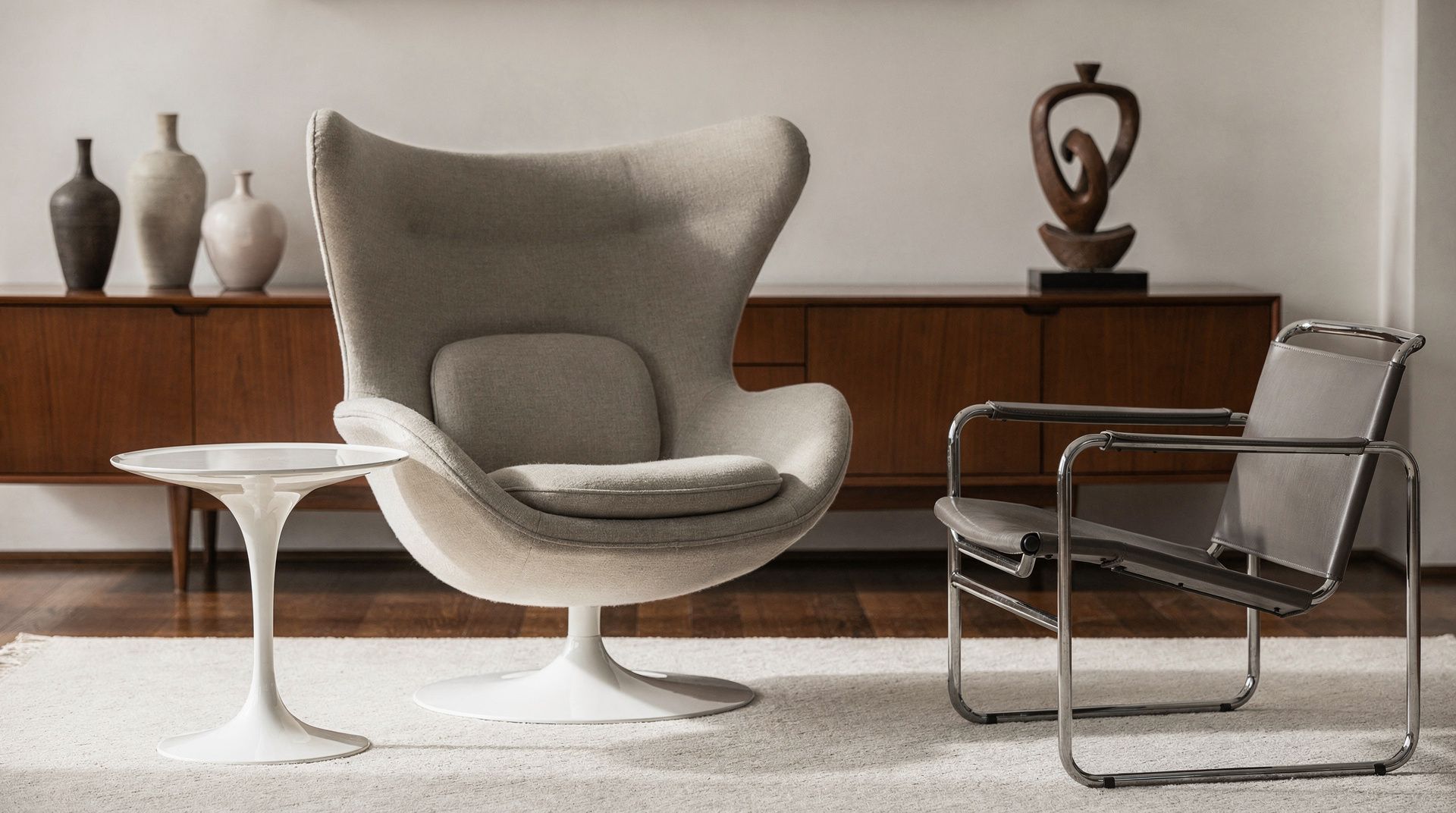
Eero Saarinen and the Language of Organic Structure
When you engage with Eero Saarinen (1910–1961), you enter a body of work in which architecture and furniture design follow the same formal idea: the dissolution of the rigid right angle in favor of flowing, load-bearing curves. Born in Kirkkonummi and living in the United States from 1923, the son of architect Eliel Saarinen studied sculpture in Paris and architecture at Yale before working at his father’s office at the Cranbrook Academy of Art. It was precisely there, in the company of Charles Eames, Florence Knoll (née Schust), Harry Bertoia, and Ray Kaiser, that the attitude later described as “organic structuralism” took shape: the search for a single, plastically conceived form that brings together function, statics, and expression.
The breakthrough began in 1940 with the entry submitted jointly with Charles Eames for the MoMA competition “Organic Design in Home Furnishings,” which honored both designers for their shell-shaped seating in molded plywood. From there, the arc spans the Womb Chair (Model 70, 1948 for Knoll) and the Pedestal Group, better known as the Tulip Series (1955/56), through to the late architectural manifestos: the TWA Flight Center at New York’s JFK Airport (1956–1962, opened posthumously) and the Dulles International Airport Terminal (completed 1962). Saarinen himself described the design goal of the Pedestal Series as cleansing the “slum of legs” beneath tables and chairs. This conviction — conceiving a piece of furniture as a sculpture with a single point of support — directly connects his furniture to the shell roofs and vaults of his buildings. Those who collect originals today are not collecting stylistic quotations, but built ideas.
Characteristic Materials and Construction Methods
Saarinen’s formal language is inconceivable without the material developments of the postwar era. The Womb Chair combines a compression-molded shell of fiberglass-reinforced polyester with a chromed steel tube frame and a separate upholstery of latex or foam padding with a textile cover. This makes it one of the first mass-produced domestic pieces of furniture to transfer plastic technologies from aircraft manufacturing into the private interior.
The Pedestal Group, produced by Knoll Associates from 1957, involves a structural compromise that Saarinen openly acknowledged: he envisioned the seat shell and base as a single material, but the plastics available at the time could not achieve the necessary strength in the base area. The solution is a cast, internally reinforced aluminum base with a white Rilsan — or, today, polyurethane — coating, combined with a shell of fiberglass-reinforced polyester. It is the uniform white lacquer finish that creates the illusion of a monolithic object. The tabletops of the series are made, depending on the version, from marble (classically Arabescato or Calacatta), laminated plastic, or veneered wood.
The Grasshopper Chair (1946) and the Model 70 Womb program, by contrast, are dominated by molded plywood, while Models 71 and 72 (1950 for Knoll) rely on a delicate steel tube frame with an upholstered seat shell. This range is often traded as the “steel armchair” or “Executive Chair” and demonstrates Saarinen’s interest in disciplined, industrial production beyond the sculptural gesture.
Cranbrook, Knoll, and the Transatlantic Network
Saarinen’s work cannot be understood without the Cranbrook Academy of Art in Bloomfield Hills, Michigan. Under the direction of his father Eliel Saarinen, a milieu emerged there during the 1930s and 1940s that gave rise to an entire generation of defining designers: Charles and Ray Eames, Florence Knoll, Harry Bertoia, Jack Lenor Larsen, and Ruth Adler Schnee. The Cranbrook imprint explains the affinity between Saarinen’s shell furniture, Eames’ plywood work, and Bertoia’s wire mesh pieces: shared material experiments, shared manufacturing partners, a shared understanding of craft as thinking in prototypes.
The second axis is the connection to Knoll. Florence Knoll, a friend of Saarinen’s since Cranbrook, integrated his designs into the Hans and Florence Knoll program from 1943, thereby creating one of the most important distribution channels for American Mid-Century design. Knoll International took over European manufacturing and licensing from 1957, which is crucial for provenance research today: European editions bear different stamps and labels than the US production from East Greenville and Grand Rapids.
Within the American Mid-Century landscape, Saarinen represents the East Coast line of a sculptural modernism, complementary to the California workshop culture of the Eames Office in Venice and the Scandinavian-influenced, wood-oriented school that emerged in parallel in Denmark under Wegner, Juhl, and Mogensen. The dialogue with Europe remained constant: Saarinen’s early training in Paris, the Finnish heritage, and the later collaboration with Kevin Roche and Cesar Pelli in his Bloomfield Hills office made him a pivotal figure between the continental architectural tradition and American industrial modernism.
Authenticity, Condition, and Provenance in Collecting
Buyers of Saarinen originals must examine several layers. First, the labeling: Knoll furniture from different production periods carries different labels. Early pieces from the 1950s and 1960s often display paper or metal labels with the addresses “320 Park Avenue” or later locations; from the 1970s onward, embossed metal plaques and adhesive batch labels predominate. For the Pedestal Series, the adhesive manufacturer’s label beneath the seat shell or tabletop is a key authentication feature, as is the material quality of the base, which in originals is made of lacquered cast aluminum, not plastic.
Second, the condition of the coating. The white Rilsan coating of early Tulip bases shows characteristic yellowing over the years, hairline cracks at the edges, and sometimes chips at the foot ring. Professional recoating is possible but, if undisclosed, reduces collector value. For marble tops, repairs to edge chips and repolishing are common; completely replaced tops must be identified as such. With the Womb Chair, inspect the shell for hairline cracks in the fiberglass, the frame for original chrome plating, and the upholstery for replacement covers, which are frequent and only reduce value when they do not follow the original textile program.
Third, provenance. Auction records, purchase receipts from first ownership, interior design invoices, or object-specific photographs from the acquisition period are a significant value factor for important pieces. Reproductions and licensed replicas differ from original production in their detailed dimensions, material thicknesses, screw and joint solutions, and in the absence of period-typical signs of use.
At mid-centurydesigns.com, we examine every piece for manufacturer labels, construction details, and material consistency, document restorations transparently, and place objects in their production-historical context. You will find there exclusively works whose attribution, manufacturing period, and condition are verifiably documented, so that your collection rests on a foundation that does justice to Saarinen’s demand for constructive clarity.
This article was generated automatically by an AI system. Disclosure pursuant to Article 50 of the EU AI Act.