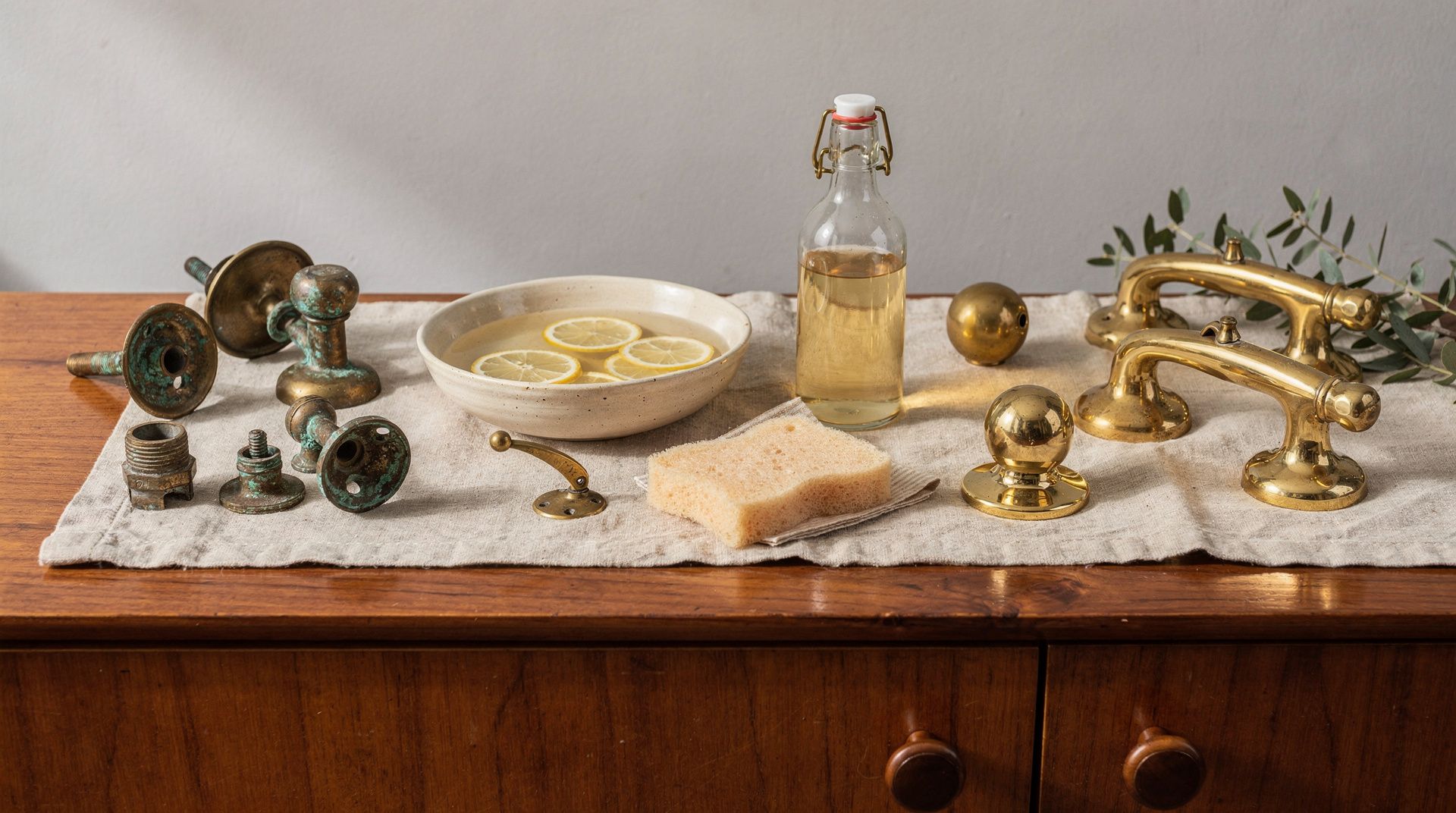
MATERIAL · DE-OXIDIZING AND PATINATING BRASS

De-oxidizing and patinating brass: verdigris, high gloss, patina

Between chemical cleaning and preserving naturally grown surfaces

Brass fittings, mounts, and decorative elements on mid-century furniture tell their story through their surface: from the factory-polished shine to the naturally grown, sometimes greenish oxidized patina. Whoever removes verdigris, works with vinegar or citric acid, or treats scorched fittings is simultaneously making a decision about the character and value of the object. This guide categorizes the common methods, defines their limits, and shows how vintage brass can be preserved long-term without losing the authenticity of collectible pieces.

mid-century·designs

De-oxidizing and patinating brass

ESSAY · 01

Work & Context

mid-century·designs

De-oxidizing and patinating brass: a question of approach

Brass is a copper-zinc alloy that reacts to air, moisture, and hand perspiration. The resulting surfaces tell the story of an object’s use: the warm golden tone of freshly polished fittings, the matte brown patina of handles touched over decades, the greenish deposit on spots where moisture has rested. Anyone treating vintage brass is therefore deciding not just about aesthetics, but about substance and provenance. Verdigris, chemically composed predominantly of basic copper acetates or copper chlorides, is active corrosion and should be removed because it continues to attack the metal. A naturally grown, uniform patina, on the other hand, is a protective layer and in many cases adds to the object’s value. Every serious restoration moves between these two poles.

The common household remedies vinegar and citric acid work because their weak organic acids dissolve copper oxides without significantly attacking the alloy itself. Control is key: concentration, exposure time, mechanical post-treatment, and — above all — the question of whether the component is solid brass or merely brass-plated. This is precisely where the collector’s sensibility diverges from craftsman’s activism.

1. Characteristic materials and their reactions

In mid-century furniture making, brass appears in several forms that must be treated differently. Solid yellow brass is found on fittings, base feet, decorative trim, and lamp mounts from high-quality Danish, Italian, and French production. These components can tolerate a bath in diluted citric acid solution (approximately 30 to 50 grams per liter of warm water) for a few minutes, followed by thorough neutralization with clean water and immediate drying. Pure household vinegar at five to six percent acidity acts more gently and is the safer choice for sensitive engraved or chased surfaces.

Gold-plated or electroplated brass-coated metal — common in more affordable Italian series lighting or American fittings from the late 1950s — cannot withstand acid baths. The thin coating is worn through by acid and mechanical polishing within seconds. A magnet test provides initial clues: if the core is ferromagnetic, it is coated sheet steel. In the case of scorched brass mounts — such as those found on Stilnovo, Arredoluce, or Sciolari luminaires — a dark brown to black oxide layer is often present around the socket, caused by the heat of aging textile cables and overpowered light sources. These discolorations are part of the object’s history and can, if at all, only be removed with a partial loss of the original surface structure.

2. Regional schools and their approach to surface

The attitude toward brass surfaces is historically shaped by region. In the Danish school around Kaare Klint, Ole Wanscher, and Finn Juhl, brass was used sparingly and precisely — frequently on runners, feet, and hinges. The Scandinavian collecting tradition preserves a quiet, mid-brown patina here; a high-gloss polish is considered an intrusion upon the material calm of the designs. In Poul Henningsen’s PH luminaires for Louis Poulsen, the brass-colored interior reflection is instead a technical component of the light distribution and may be adjusted without altering the character.

Italian postwar production — exemplified by Gio Ponti, Max Ingrand for Fontana Arte, Angelo Lelii for Arredoluce, or Gaetano Sciolari — calculated the golden-gleaming surface as part of the luxurious effect. Freshly produced, these objects were high-gloss. Collectors continue to debate whether a careful re-polish followed by conservation corresponds to the design intent, or whether six decades of naturally grown patina have become the actual object. The French school around Maison Jansen, Jacques Adnet, or Maison Charles often features a deliberately darker, burnished bronze-brass mixture whose surface lacquer was applied at the factory; here, any aggressive cleaning constitutes a loss of substance. In the American sphere, Paul McCobb, Edward Wormley for Dunbar, and early Knoll production worked with visible brass details whose condition today significantly influences valuation.

3. Authenticity and condition for collectors

For collector evaluation, the rule holds: a uniform, naturally grown patina is a marker of authenticity. Auction houses and specialist dealers now document surfaces with the same care as wood veneers. Anyone bringing an object to full high gloss removes sixty years of use history in a matter of hours and thereby reduces market value in many cases. Selective treatment makes sense: neutralize active verdigris spots locally with cotton swabs and citric acid solution, preserve the surrounding patina, then rinse with distilled water and dry with a soft cotton cloth.

For long-term preservation, microcrystalline wax — as used in museum restoration — has proven its worth. Applied thinly and worked in with a soft brush, it forms a reversible protective layer that reduces further oxygen contact without sealing the surface. Clear lacquers from hardware stores are unsuitable for collectable pieces: they yellow, crack, and can only be removed with solvents that further damage the object. Storage in a stable indoor climate between 40 and 55 percent relative humidity, and avoiding contact with wool, unwashed cotton, or chloride-containing cleaning agents, extends the state of preservation over decades. Scorched sockets should in principle be professionally rewired before any decision is made about surface treatment; electrical safety takes precedence over aesthetics.

At mid-centurydesigns.com, every piece is assessed for materiality, surface condition, and history of intervention before being listed. Where patina carries the character of an object, it is preserved; where active corrosion threatens the substance, conservation measures are taken. Condition descriptions transparently state whether a piece has been polished, re-patinated, or retains its original surface, so that collectors and designers can make decisions on a reliable basis.


This article was generated automatically by an AI system. Disclosure pursuant to Article 50 of the EU AI Act.

FAQ · 02

Frequently asked about De-oxidizing and patinating brass

5 Answers

01
How do I properly remove verdigris and oxidation from brass without damaging the material?
Verdigris forms from copper carbonate and adheres to the surface. For gentle cleaning, submerge the object in a solution of vinegar or diluted citric acid (approximately 1 part acid to 3 parts water). After a soaking time of 15–30 minutes, work it gently with a soft brush. For stubborn deposits, soaking for several hours may be necessary. Important: after treatment, rinse immediately and thoroughly with distilled water and dry completely to prevent flash rust. For sensitive objects with a patina you wish to preserve, use mechanical methods instead, such as microfibre cloths or very fine steel wool.
02
When is it worth preserving the natural patina rather than polishing to a high gloss?
On high-quality vintage brass fittings and original mounts, the patina is often a witness to the passage of time and affects the value. The older the piece, the more collectors appreciate the authentic surface. Especially with signed designer brass or elements from the 1950s and 1960s, you should evaluate before cleaning: is the surface evenly colored and textured, or are these more like soiling marks? A uniform, dark brown or green patina is usually original and worth preserving. Deposits and spots can be gently removed with distilled water and a cloth without polishing.
03
What are scorched brass fittings and how should I treat them?
Scorched or tarnished areas arise from heat or old storage conditions and present as brown-black, matte-colored patches. These differ from normal patina by their blotchy, uneven distribution. To treat them, vinegar or citric acid baths also work here, though the scorched areas have frequently penetrated more deeply. Longer soaking (30–60 minutes) with occasional brushing is required. Afterwards, the brass should be immediately lacquered or sealed with wax to prevent re-oxidation. Important: a new, artificial high-gloss polish looks out of place on such pieces. A matte, preserving sheen is more authentic.
04
How do I preserve vintage brass objects long-term after cleaning?
After chemical or mechanical cleaning, sealing is crucial. You have two proven options: (1) Apply a coat of high-quality wax (carnauba wax or beeswax) with a soft cloth and buff — this protects for approximately 6–12 months. (2) Apply a thin, transparent synthetic resin lacquer (e.g. acrylic or polyurethane) — this lasts 1–2 years. Store the brass afterwards in a dry environment (humidity below 50 percent) and avoid direct sunlight. Silica gel packs nearby help in more humid rooms. Regular checks (monthly) allow early detection of oxidation and easier follow-up treatment.
05
Can I use vinegar and citric acid together, and which method is more effective?
Both act similarly: vinegar (acetic acid at approximately 5 percent) is weaker and gentler, while citric acid is more concentrated and acts faster. Vinegar is better suited for sensitive or heavily patinated pieces, as it works more slowly and in a more controlled manner. Citric acid is more effective against stubborn oxidation and scorched areas. Mixing the two is not recommended, as they do not act synergistically and control becomes more difficult. Rule of thumb: start with vinegar when in doubt; only move to citric acid if necessary. After treatment, always rinse immediately with distilled water (leave no mixed acid residue) and buff dry. Testing on an inconspicuous area is mandatory for valuable pieces.

GLOSSARY · 03

Related Terms

10 Entries

Verdigris
Green or blue-green oxidation product on brass surfaces, chemically a basic copper carbonate or copper hydroxide. Forms through long-term exposure to moisture and air; protects the material beneath from further oxidation, but can be removed for cleaning and conservation purposes.
Patina
Surface layer of controlled oxidation and weathering marks on brass and other metals. Often prized in mid-century design as testimony to aging and traces of use; the deliberate preservation of an authentic patina is part of the conservation ethics of vintage objects.
Vinegar cleaning
Chemical cleaning process using diluted acetic acid to remove oxidation layers from brass. A milder method than aggressive acids; particularly suitable for fittings and mounts where selective cleaning without deep alteration of the substance is desired.
Citric acid treatment
Use of citric acid (C6H8O7) or citric acid-containing pastes for the gentle de-oxidation of brass. More effective against light to moderate oxidation layers; allows finer control of the removal process than stronger cleaning agents and is gentler on the material.
High-gloss polish
Mechanical or chemical process for producing a reflective, gleaming brass surface through the complete removal of oxides and patina. Recreates the original condition, but requires regular re-polishing and results in minimal material loss with repeated application.
Patina preservation
Conservation principle whereby the naturally grown surface layer of a vintage object is deliberately retained. For brass, this means removing superficial soiling without stripping the oxide layers, in order to preserve authenticity, the character of aging, and collector value.
Scorch marks
Dark to black discolorations on brass surfaces caused by heat exposure during soldering, welding, or storage near heat sources. These scorched areas are chemically stable oxide layers; their removal requires stronger agents and must be weighed against the need to preserve the substance.
Long-term conservation
Systematic measures to slow oxidation and deterioration of brass surfaces over years to decades. A combination of controlled storage (dry, not airtight), passivating surface protectants, and regular light cleaning.
Passivation
Chemical treatment with protective layers (e.g. waxes, lacquers, or specialist conservation agents) to protect the brass surface from renewed tarnishing and oxidation. Preferred in the vintage field: breathable, reversible methods that conserve patina without sealing the surface.
Copper carbonate
Green oxidation product (CuCO3) that forms on brass under the influence of carbon dioxide and moisture. Main component of stable verdigris; chemically relatively inert and aesthetically valuable in patina preservation, but visually disruptive when a high-gloss restoration is the goal.