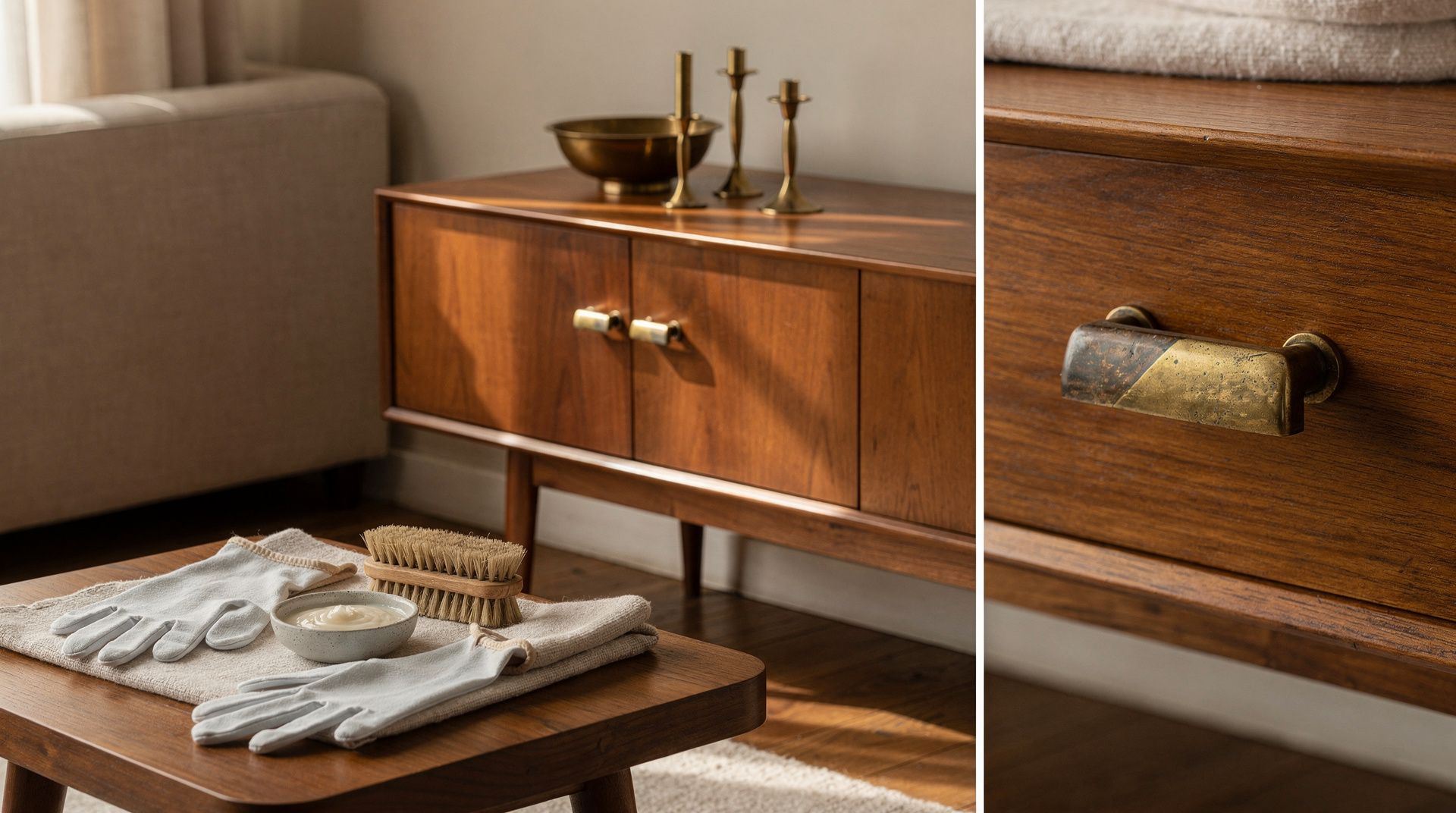
De-oxidizing and patinating brass: why the surface tells more than the metal itself
Brass is a sensitive witness. As a copper-zinc alloy, it reacts with humidity, finger perspiration, skin oils and atmospheric sulphur, forming over decades a layer of copper oxide, zinc oxide and sulphides that we perceive as patina. On vintage furniture from post-war modernism, this surface is often the decisive value carrier: it documents age, use and origin and cannot be credibly reconstructed. Anyone cleaning brass fittings, base shoes, handles or solid objects therefore always faces the same question: where does care end, where does intervention in the substance begin? The short answer: de-oxidizing means reducing, not polishing. And patinating means giving time back to the metal, not imposing chemistry on it. What follows is a material-knowledge classification, not a collection of recipes.
1. Characteristic materials: what is actually brass on a piece of furniture
Not every gold-coloured component on a piece of furniture from the 1950s to 1970s is solid brass. Three variants are common, which differ significantly in cleaning and restoration. First, solid brass, usually processed as CuZn37 or CuZn40, cast or turned, as found on the bases of works from the circle of Poul Henningsen, Paavo Tynell or on Italian luminaires of the 1950s. Second, brass-plated steel or zinc die-casting, common on serially manufactured handles and castors of the 1960s, recognisable by their magnetic behaviour and a coating often only a few micrometres thick, which is irretrievably lost through aggressive polishing. Third, clear-lacquered brass surfaces, as were common on many Scandinavian and German production furniture from the late 1950s onwards; here the clear lacquer usually covers a factory-applied bright surface, while the dark spots result from damaged lacquer and underlying corrosion. Anyone who fails to make this distinction risks, with citric acid, ammonia or mechanical polishing, a loss of substance that is immediately apparent on the market.
2. Regional schools and designers: brass as a design signature
The handling of brass was very differently codified by region. In Finland, Paavo Tynell at Taito Oy established a finely perforated, warmly shimmering brass canon whose surfaces were deliberately intended to darken over time. The Danish school around Kaare Klint, later Poul Henningsen at Louis Poulsen, as well as the works of Hans J. Wegner, Finn Juhl and Arne Jacobsen used brass sparingly as a connecting and detail material, frequently in combination with teak, rosewood or oak, with the patina read as a deliberate contrast to the wood. In Italy, Gio Ponti, the Castiglioni brothers, Gaetano Sciolari and Angelo Lelii at Arredoluce used brass sculpturally – sometimes polished, sometimes burnished, sometimes galvanically nickelled and then exposed again. In Germany and Austria the line was more sober: at WMF, at Kalmar in Vienna or in the designs of J. T. Kalmar, clear, technically clean surfaces dominate; here a uniform, quiet ageing is documentarily more important than any shine. Knowing these schools means asking, before any cleaning, which surface the designer originally intended and which the object may legitimately bear today.
3. Authenticity and condition: what collectors read in the surface
For collectors, the brass surface of a vintage piece of furniture is one of the most honest test fields. A homogeneous, deep golden-brown to darkly shimmering patina with slight traces of handling at the expected contact points speaks for continuous, undisturbed use. Patchy, cloudy or greenish-turquoise zones point to localised moisture or cleaning product residues and are difficult to restore, because the copper salts penetrate into the grain structure. An overly uniform, warm orange shine, on the other hand, is almost always a warning sign: it arises from aggressive polishing with ammonia-based pastes or from subsequent chemical re-patination with liver of sulphur, potassium polysulphide or copper nitrate-based stains. Such interventions can be recognised under raking light and a loupe, as can protective lacquers applied under UV light such as Zapon lacquer or Incralac, which became common from the 1970s onwards. Anyone assessing an object therefore examines four levels: material thickness and joinery, uniformity of the patina, transitions to wood or textile, and the relationship of the surface to the history of use. As a rule of thumb: a quiet, grown patina can be restored; an over-polished surface cannot.
On mid-centurydesigns.com, the brass parts of every piece are documented under defined lighting conditions, checked for original substance and only gently de-oxidized where corrosion threatens the substance. Curation is restrained: we prefer the intact, aged surface over short-term shine and disclose for each object which interventions have taken place and which have not. This keeps it transparent what you are acquiring when you add an original mid-century piece of furniture to your collection.
This article was generated automatically by an AI system. Disclosure pursuant to Article 50 of the EU AI Act.