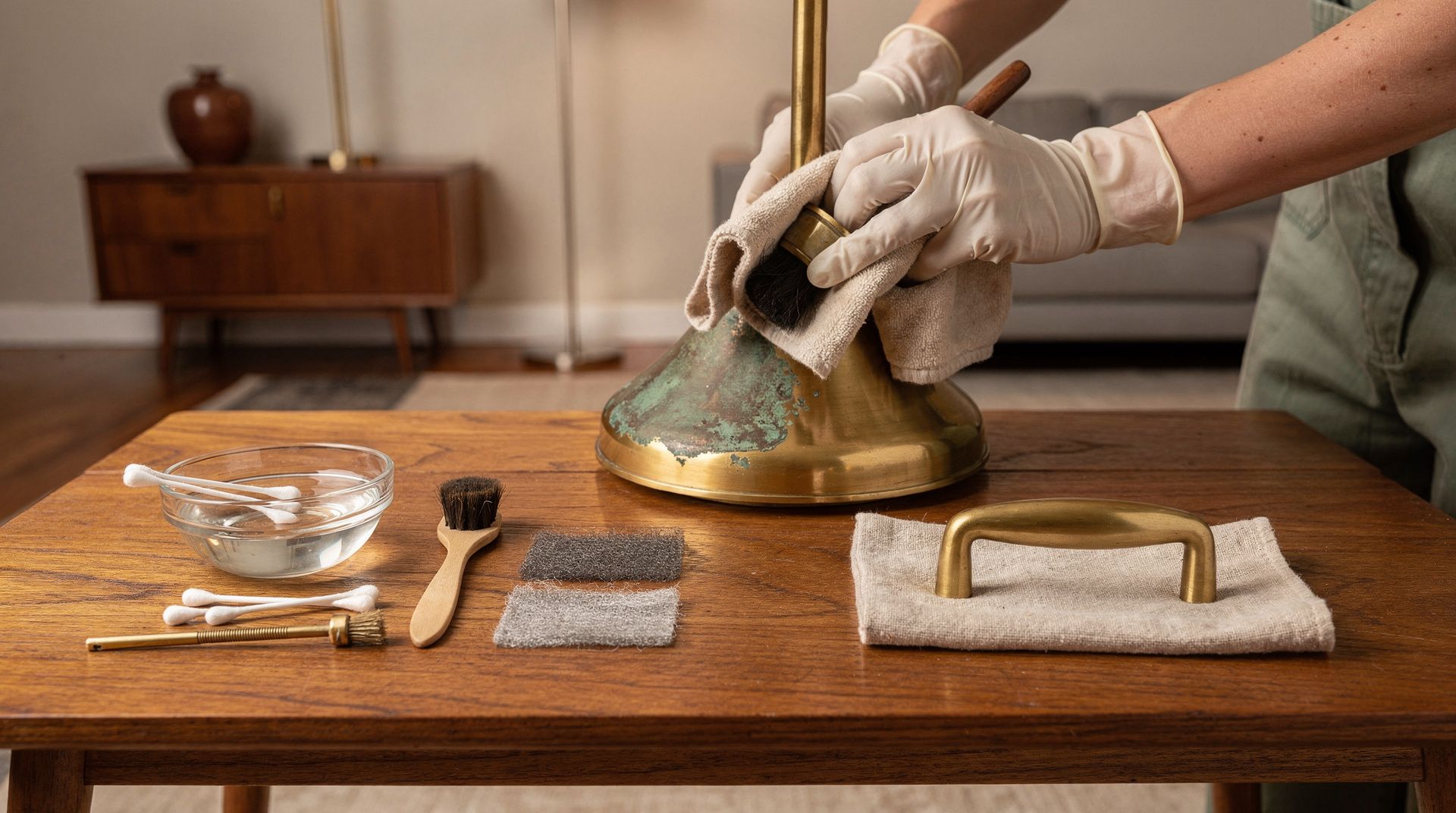
De-oxidizing brass and conserving patina
Brass is a copper-zinc alloy that was formative for Scandinavian, Italian, and American furniture-making in the mid-twentieth century. Unlike the industrial metal casting of the post-war era, the surface of a base by Paavo Tynell, a handle by Angelo Ostuni, or a rail by Paul McCobb is not an interchangeable detail but part of the work’s identity. Anyone who cleans brass is always intervening in a grown boundary layer. The question is therefore never whether patina should be removed, but which zone of the surface is considered worth preserving.
Professionally, three phenomena are distinguished: the uniform, mostly dark-brown to olive-colored sulfide and oxide layer that develops over decades and carries the character of the object; localized copper corrosion in the form of copper acetates and chlorides — commonly known as verdigris — which actively continues to work and destroys material; and residues of old protective lacquers, often nitrocellulose-based, that have yellowed or crazed. Only the active corrosion products must be removed without fail. The stable patina is historical testimony and contributes to value.
1. Characteristic materials and their cleaning behavior
In the mid-century context, three alloy families are most commonly encountered. Classic yellow brass (CuZn37, sometimes specified as Ms63 or Ms58) was used in Scandinavia for lamp bodies, decorative discs, and fittings. Red brass with a higher copper content is frequently found in Italian work from the 1950s, for example on bases by Arredoluce or Stilnovo. Nickel-plated or burnished brass parts appear on tubular steel constructions and on details from German manufacturers.
Chemical cleaning works with weak organic acids such as citric acid or with complexing agents. It dissolves oxides evenly but can, if left on too long, leach zinc from the surface — a process known as dezincification — causing the surface to become matte red and porous. Mechanical cleaning with microfiber cloths, bamboo sticks, or glass fiber brushes is more precise, but carries the risk of rounding off milling and turning marks, stamps, and fine guillochés. For valuable objects the rule is: work locally, under magnification, and never remove the intact sulfide patina over large areas. Verdigris is lifted point by point with a cotton swab soaked in ethanol or diluted formic acid, rinsed with demineralized water, and dried immediately.
2. Regional schools and designers in their approach to brass
The Finnish school around Paavo Tynell and Lisa Johansson-Pape at Taito and Idman favored perforated, sometimes hammered brass surfaces whose appeal lies precisely in their lively texture. A mirror-bright re-polish destroys the intended effect here. In Danish work by Jo Hammerborg for Fog & Mørup or in Vilhelm Lauritzen’s wall appliques, brass was often delivered clearly lacquered; traces of this original lacquer are a mark of authenticity and are preserved wherever possible.
Italian practice — as seen in work by Gio Ponti, Max Ingrand for Fontana Arte, or Gaetano Sciolari — combined polished brass with burnished or patinated ottone brunito. These intentionally dark-toned zones must not be chemically leveled. In the United States, Paul McCobb, T.H. Robsjohn-Gibbings, and Edward Wormley worked with understated, mostly matte-brushed hardware; here the original brush stroke is the reference for any restoration. Those who know these signatures make decisions that are more respectful of the material.
3. Authenticity, condition, and protective coatings for collectors
Cleaning is followed by passivation. Benzotriazole (BTA) in ethanolic solution has proven its worth — an established agent in metal conservation that forms a molecularly thin, visually inconspicuous protective film with copper ions and inhibits further corrosion. Over this, microcrystalline wax — such as Renaissance Wax — is traditionally applied in a thin coat and carefully buffed. This combination is reversible, barely alters the appearance, and can be removed again in specialist workshops. Spray lacquers, clear varnishes from DIY stores, or polishing pastes containing ammonia are unsuitable for collectible objects: they either form hard, yellowing films or attack the alloy.
For assessing the condition of an object, the following therefore count: even age patina rather than patchy re-polishing, preserved tool marks, intact engravings and maker’s marks, no visible dezincification zones, no active green efflorescence. A brass part that has been carefully maintained in a way consistent with its material is valued significantly more stably on the secondary market than one that has been brought to a high gloss.
The pieces offered on mid-centurydesigns.com are professionally assessed before being listed. Metal parts are examined for active corrosion, dezincification, and later over-lacquering; the original patina is preserved and, where necessary, stabilized using reversible methods. Condition, provenance, and interventions are documented in the respective object description, so that you as a collector or designer have a reliable basis for your decision.
This article was generated automatically by an AI system. Disclosure pursuant to Article 50 of the EU AI Act.